Swimming With Sharks!

“What are we doing?”  “I can’t tell you.  It’s a surprise.  I just need your shoe size.”  That’s all I knew.  While Phillip planning some total surprise for me—just on any given day, and especially when we travel—is totally normal, this was one of the first times I was overwhelmingly intrigued by it.  Riddled with the thought of it.  Excited by the unknown prospect of it.  One of the many (many) things that make Phillip and I work so well is that he loves to plan: trips, excursions, first-time experiences and random, active adventures for us.  And me?  I love to do it, all of it, every bit of it.  Seriously, pretty much any outdoor/active/artsy thing he has in mind for us.  Phillip has surprised me with spur-of-the-moment bike tours, walking haunted house excursions, random rock-climbing, pub crawls, even a super intense personal trainer session for me and I loved them all.

That last one, in particular, was a ton of fun.  The Sweat Social out of New Orleans.  Phillip told me we were going for an “adventure run” off of Bourbon Street.  “Okay, cool,” I thought.  I love to run.  Well … jog … semi-fastly.  Let’s put it that way.  But as we jogged along the bank of the Mississippi River near Hannah’s Casino in downtown New Orleans, I ran by a spunky little gal thumping out some awesome booty music, setting up a few yoga mats for a private river-view fitness session and I thought: “Man, that would be cool.  A private pump-it-up session on the streets of New Orleans.”  I tapped Phillip who was running ahead of me and pointed out Street-Fit Frida to him with a thumbs up.  He laughed, smiled, but kept running and I left Frida in my rearview, thinking nothing more of it.  But then Phillip circled around, jogged slowly up to the little circle of yoga mats and said “Surprise!”  I soon found the little private Sweat Social workout session on the Mississippi River was for me.  Me??  You see?  Totally cool shit like that!  Phillip plans it all the time.  He loves to do it and he loves that I will always love to do whatever he plans—no questions asked, with no idea what my day is going to look like.  I just need to know what to wear and if I’m going to get wet.  That last question I forgot to ask this time because, although I didn’t know it, I was about to get very, very wet.

My first thought when Phillip asked for my shoe size, though?  A play date in moon shoes!

Heck yeah!

Or maybe those funky impact-reducing kangaroo boots?  I even thought maybe we were going to some place where you can walk on the walls or ceiling with special Velcro or magnetic boots and gloves.

I would totally do that.  …. Well, with a safety net.  I’m not crazy!  Well, not entirely.

These are serious thoughts that ran through my mind because these are the types of things Phillip might seriously plan for me.  Super cool, right?  What had he actually planned this time?

A dive.  No, take that back.  The best dive of our lives.  To date.

And Phillip has been diving for more than twenty years: for pleasure, in the Marines, as a volunteer search and rescue diver.  He’s gone on hundreds of dives.  I’ve gone on, maybe a dozen.  The best with him, though.  Hands down.  And now the best, ever, for both of us, together.  And it wasn’t out in the Gulf or the Ocean or even a magnificent, secluded cave.  It was in a tank.  In Tampa, Florida.  What made it so special?

We swam with these guys!


Yes, sharks.  Right next to us.  We weren’t in a cage.  We weren’t in some protected tank just looking at them.  We were there.  Exposed, in open water, with only a half-inch of neoprene between us and their thousands upon thousands of sharp teeth.  At first it didn’t frighten me because they swam pretty far away but as we got closer and closer, there were a few times I found myself inadvertently in their path as they swam straight toward my face, deciding how best to avoid me, and I did have a few “Don’t freak out Annie, just breathe” moments when the shark locked his eyes on me for a frightening second before he just puttered on by.  It was such an enlightening, frightening, invigorating experience.  Way better than moon shoes I’m sure!  You want one of those moments too?  Well, we’re all suited up …

Whose ready to dive with us?  Some very cool footage for you here from our dive with the sharks, many thanks to the fantastic Dive Masters at the Florida Aquarium who trained us, took us down and graciously filmed the entire dive for us so Phillip and I could share moments like this with you.

Our most important take-away from this dive?  The education and enlightenment as to the true nature of sharks, their docile temperament, the need for them in our oceans and the unfortunate, very human-like tragedy of the greedy, plunder with which we trap, maim and needlessly kill them.  Our highly enthusiastic and passionate aquarium guide and dive masters spent a good bit of time talking with us before-hand about the nature of the sharks, their absolute disinterest in us, particularly as food, and their desire to simply be left alone, to rest, eat and explore.  They also taught us sharks in the wild generally only eat about five times a month and, when they do, unlike the many degrading movies that portray them as human killers, it is not humans.  The occasional reported bite is more often a case of mistaken identity or harassment.

Humans harassing animals?  Noooo!

Don’t you wish that were true?  A shark’s number one enemy is actually humans.  Particularly in China and other Asian countries, where they catch sharks by the hundreds upon hundreds, pull them out of the water for mere seconds to cut their fins off and toss them back—bloody and maimed—where they die in minutes.  Simply because they like shark fin soup.  Knowing that, before Phillip and I went into the tank, changed my perspective entirely.  I didn’t feel as scared as I thought I would.  Rather, I felt sorrow and appreciation for an ancient animal that was put on this earth to help keep it healthy.  What I did not know, but our guide explained to us, is that sharks help keep the oceans and reefs healthy by eating diseased and dying fish.  They help filter the waters of diseases and decay harmful to other fish and marine life.  Yet, there are so fewer sharks in our waters than there used to be because of us.  Greedy humans.  It was humbling.

The dive, itself, however, was mesmerizing.  It was a tank of wonder!  We saw huge sting rays, bright green eels, hundreds of fish, a sea turtle, a nurse shark and, of course, the big beauties we swam with: three tiger sharks, a female approximately 7’5” feet long and two males between 5-6” feet long.  They were slick and silvery, their skin, naturally the color of shimmery low-rider paint, and their thousands of teeth (constantly bared at you because they are always “breathing” water in) scattered in an impressive array in their large mouths.  Because their eyes are located on either side of their skull, they also see two separate fields of vision.  Imagine what that “looks like” and computes to in their brain?  One large panoramic image joining at the bridge of their nose?  I have no idea, but I had a great time imagining what they were seeing.  Especially when they saw me.  A wide, blue-eyed blonde, my hair wafting strangely around my head, these odd appendages sticking out and flailing, and bubbles constantly floating above me.  How strange I must have looked?  Certainly more weird than edible, right?  That’s definitely the impression the sharks gave us as they swam overhead, many times just inches from our heads.  Oh, how my heart pounded!  It was such an amazing experience.  Easily our best dive ever.  And, all because this man decided, yet again, to plan something fun for us.

It only required some spontaneity on my part.  And my shoe flipper size.  Had Phillip said that, I might have had a clue.  But I’d rather not.  Surprises are my favorite.

Captain’s Tribute

A little over 10,000.  That’s how many blue water miles I’ve racked up since I started sailing.  In preparing my Sea Service forms for my Captain’s License application, I’ve had to mentally trek back through my many offshore passages and day-sails to calculate the necessary “days underway” that I need for my USCG 6-pack, and it’s been a very fun journey.  In order to meet the USCG licensing requirements for a 6-pack, I was required to have 360 days on the water, with 90 of those days falling in the last three years and 90 of those days being in ocean or “near coastal” waters.  Luckily for me, the majority of my sailing has occurred in only the last three years so the first portion of that requirement was easy for me to meet.  (It actually shocks me some days to look back and see how much sailing I’ve done so recently.  When you look at the big picture, I really am fairly new to all of this.)

But boy did I take to it!  The day we splashed and re-named our Niagara, just three days after my 31st birthday, May 31, 2013.  With only 400 nm under my belt at the time.  What a ride it’s been!

If any of you are thinking about going for your Captain’s License too, you may be thinking: “What is considered a ‘day underway’ and what does ‘near coastal waters’ mean?”  Good questions.  According to my research and the folks at Mariner’s, a “day underway” is “at least four hours underway,” and “near coastal” waters means seaward of the boundary line.  The boundary line for the western coast of Florida, which is where I’ve done a good bit of my blue water sailing, is 15 nm. Unfortunately, I had not kept up with my sea time from the start.  I would have definitely done that if I had it to do over again because a) it’s humbling and rewarding to look back and reflect on prior passages and b) it’s good to keep up with your sea time in case you ever need to apply it for something like acquiring your captain’s license.  I would recommend any of you out there who may be thinking of getting some accreditation in the marine industry someday keep up with your sea time and have the captains you sail under sign off for you each time you complete a passage.  Here is the Sea Service form the USCG requires for obtaining any license.

You’ll see for each vessel, they ask your “average distance offshore.”  I’ll tell you it was a very cool moment when I was filling out the form for Yannick and I had to think … my average distance offshore during those 30 days across the ocean, had to be at least 1,000 nm+.  That’s wild but so exciting!   I have also since bought a log book so I can do a short, one page write-up on each of the passages I have made, the dates, nautical miles, destination, and one or two memorable moments from the passage.  It’s fun to go back through when I’m feeling nostalgic—or just a little too landlocked—and let my memories take me back to blue waters.

Sunrise on our way to Cuba, December 2016.

It’s been an enlightening, educational and humbling process going back through all of my sea time and reflecting back on those passage.  In doing so, I thought it would be fun to share with you all, the many lessons I have learned from the many captains I have sailed under, the primary being my person, my partner, my forever adventure buddy: Phillip.


Captain Phillip

Where to begin …  To the man who—when I come barreling out of a slip at 5 kts and almost take out three boats with both my bow and stern—will say: “It was my fault, honey, I should have … ”  Phillip has had such patience with me from the beginning.  And because we were both so new to the liveaboard cruising lifestyle, it has been so much fun to learn, try, screw up and grow together, both of our hearts 100% invested in each other and our beautiful, frustrating boat.  The greatest lesson I have learned from Phillip is that no matter how hard, or trying or scary any aspect of cruising may be—from running aground, to docking debacles, to discovering you have rotten stringers—it will always be easier, less frightening and more fun to tackle when we do it together.  To my forever buddy and the many more adventures, mishaps and lessons we have in store.  Cheers!

March, 2016: Our first time (and drink – thanks B!) out on the hook after three months, re-building our rotten stringers, re-rigging and conquering about 1,000 other projects at the yard.  Ahhhhh …..


Captain Kevin

Kevin has been on this journey with us from the start, from our first boat-shopping days to the purchase of our 93.46% perfect boat and he taught us so much along the way, particularly on defining our cruising goals and how we really want to spend our time on the boat.  The best thing I learned from Kevin?  “Just shove it out.”  A great de-docking technique that will guarantee no wayward backing or unwanted collisions.  Fun video for you here from one of our day sails with Kevin aboard his stunning Pearson 36 cutter, Pan Dragon, where Kevin demonstrates this super simple, never-fail trick.  Just shove it out!


Captain Brandon

“Go slow, hit slow.”  The best thing Brandon ever taught me?  Only go the speed at which you’re willing to crash into something.  That’s a good lesson.  We also learned a thousand things from Brandon during our time at the shipyard, one of the most important was: Always label anything you take apart, so you’ll know exactly how it all goes back together.  That way you won’t have to, you know, re-step your mast just to flip a stupid little aluminum plate ninety degrees.  That was fun.  But, one final, very important lesson from B: How to dock under sail.  “Because what you are you going to do when your engine goes out?” Brandon asked as he shamed us into finally, for the time, docking under sail (fun video of that adventure for you here).  And, notice he said “when” not “if.”  Because it’s going to happen.  It’s a boat, right?  Thanks for everything you’ve done for us B.  Cheers!


Captain Mitch

Mr. While You’re Down There!  Lord, did we have a time with him bringing our boat home for the first time from Punta Gorda, FL to … well, as many of you know, we didn’t make it all the way to Pensacola the first time.  We only made it to Carabelle, minus a few essential boat parts.  (And if you don’t yet know that story, holy crap, go get yourself a copy of Salt of a Sailor stat!)  One of the most memorable things I learned from Mitch?  Sight sailing.  Or, sailing by the stars as I called it.  Mitch taught me how to sail at night not by straining your eyes at the compass or the GPS but by getting on your course, then putting some part of the boat (a stanchion post, the spreader tip, the clew of the sail, anything) on a star and using that to hold your course.  It was a fantastic revelation and one that made me love sailing at night that much more.  Thank you Mitch.  Oh and “While you’re down there, could you get me some curly fries.”  Mitch.  There’s just none such like him.  Fun video for you here of his Nonsuch 35, aptly named Tanglefoot.


Captain Ryan


The ambassador of offshore sailing adventures at SailLibra!  What does Captain Ryan say about sailing across the 500+ plus, sometimes gnarly miles of the Gulf?  “Easy stuff.”  As long as you don’t panic, you think first and act second.  After several fun, windy romps across the Gulf on his offshore adventure boat, Libra, I definitely learned from Ryan the art of staying calm.  Even when sailing through the narrow, reef-lined inlet to Cuba in 10 foot seas and 25+ knot winds.  “Easy stuff.”  But, he’ll be the first to warn you: “Oh, if I’m panicking, yeah, you should totally panic.”  A good sense of humor.  That really helps out there too.  Fun video for you here from mine and Phillip’s sail from Key West to Pensacola on Libra.


Captain Jack

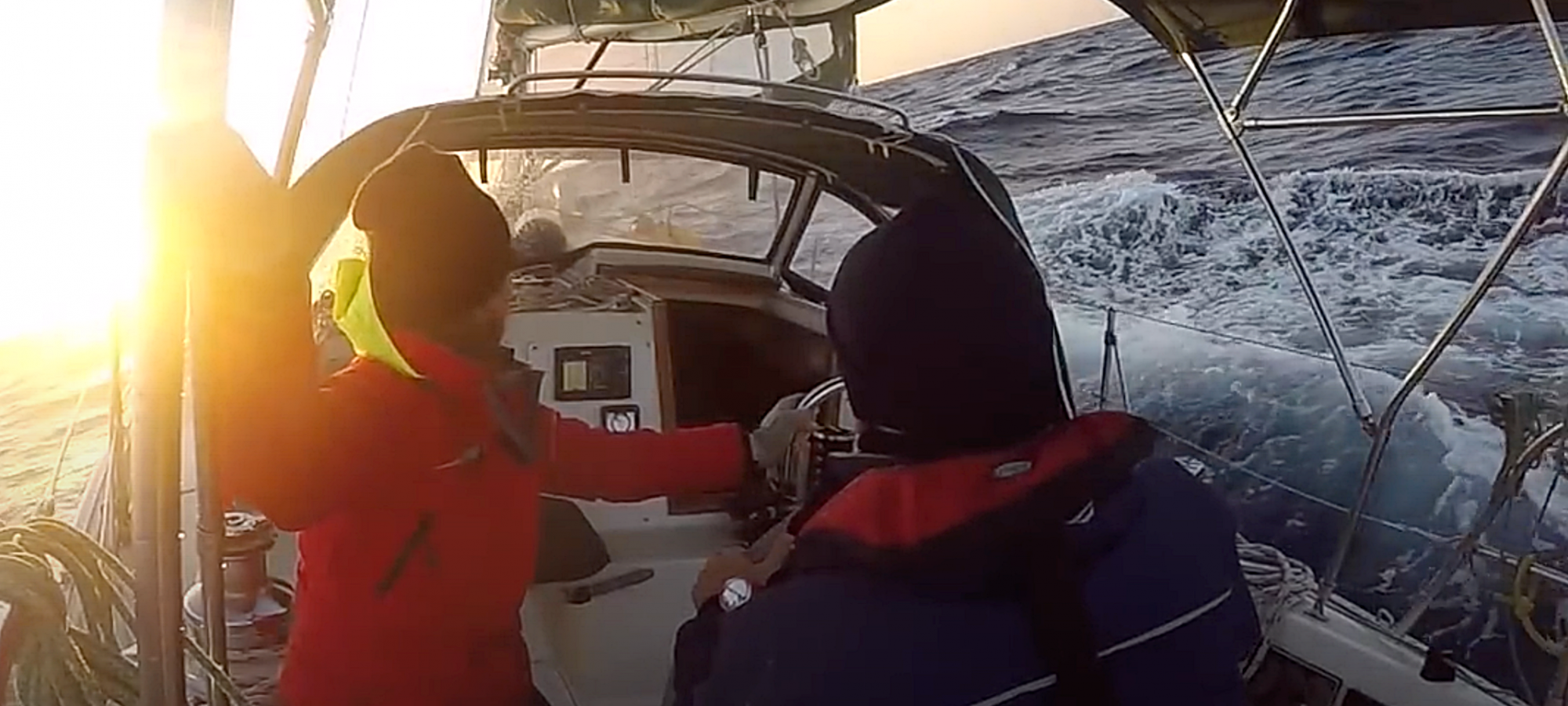
Jack Stringfellow.  I swear that’s the man’s real name and wasn’t he destined to be a captain with that one?  I’ve only sailed under Captain Jack one time but, to date (and to be honest I hope it stays that way) it was the most extreme conditions I’ve ever sailed in.  From my recent Captain’s exam, I know it ranks a 10 on the Beaufort scale.  We sailed two days on a Leopard 48, into brutal headwinds, topping out at 43 true, 48 apparent, but the boat and crew handled it beautifully.  What did I learn from Captain Jack?  He’ll be the first to tell you, Jack can get a little … wired.  He’s a very Type A personality, very task-oriented and very (very!) energetic.  It’s one of the things that makes him a great captain, but he also taught me the importance of the need for a “safe word.”  Because everyone gets a little wound up at times.  His safe word?  TRANQUILLO!  Fun video here from our very windy delivery of the Leopard, a 400 nm, 60 hour sprint across the Gulf, Pensacola to Naples.  Whew!


Captain Ben

I can’t wait to get back to the Bahamas!  But I’m so glad I went when the opportunity struck.  Remember this trip?  My spur-of-the-moment jaunt off to the Bahamas to sail with Ben Brown on his 47’ Beneteau, Cheval, in the Abacos Regatta in 2015?  What a fantastic adventure that was.  And what did Captain Ben teach me along the way?  The beauty of Bossa Nova.  You see, Ben is a long-time musician.  A sax player, and a fantastic one at that.  He played for the Cheval crew several times during my trip and it was the first time I was ever serenaded on a boat.  I found music and the water go together.  Almost like they’re one in the same.  Now, even when there’s no music playing, when I look out on the water gracing our hull, I hear music.  Thanks to Ben, it’s often Bossa Nova and more often than not it’s the song Ben played for us that morning on Cheval — “When she walks, she’s like a samba, that swings so cool and sways so gentle … ” Can anyone name that tune?


Captain Yannick

“Don’t tell me I did a good job, if I didn’t do a good job.  If I f&*cked up.  I need to know.”  Love that man.  Captain Yannick.  Our fiery French captain across the Atlantic freaking ocean.  He was so driven, so focused, so phenomenally energetic (working on boat project after boat project, day after day across the ocean) and such a diverse, eclectic personality.

I’ll bet you didn’t know: Yannick was a film student, a fighter jet pilot, a desert race marathon runner, even a published author and a raging Daft Punk fan.  His was an incredible and surprising friendship to form out of our 30 days across the ocean and he still texts me often, just to say “WHOO!  HOO!”  The most important thing I learned from Yannick was confidence.  If you have something to contribute, speak up and say it.  Don’t use your “recommendation voice.”  And, like much of the French do, which I appreciate: Don’t placate.  If a crew member fails at something, placating them by telling them they did a “good job” is not going to help them improve.  A very bold, hearty sailor he is and Phillip and I will be forever grateful for the opportunity Yannick shared with us in letting us sail with him 4,600 nautical miles across the Atlantic Ocean.

To all the captains I have sailed under and learned from: Thanks for the lessons, the laughs and the many-invoked Annie “Whoo Hoos!”  But, mostly, to the man who made this entire journey of mine possible.  From completely ignorant second mate (more like deckhand) on our very first sail across the Gulf together, to now an ocean-crossing, aspiring captain, the sailor who has inspired me, challenged me and encouraged me every step of the way.  I can’t wait to sail the rest of the world with you my love.

April 3, 2013 during the survey/sea-trial of our Niagara.  Where it all began.

Let’s Talk About this Captain’s Exam

We should, because I can’t believe how close I came to failing.  What I learned was the test itself is not really that hard … if you know how to study for it.  And if you know how to find the Niantic River.  Stay with me.  We’ll get there.

First, let’s talk about this Captain’s Exam.  Had I known exactly what it was going to be like going in, I would have approached my studies in a completely different manner.  And, it was partially on a stroke of wild luck in the last two days before the exam that I took the steps that actually enabled me to pass.  Otherwise, I’m 100% positive I would have failed.  I really would.

Here’s what I learned: The exam is all multiple choice, 120 questions.  30 are devoted to Rules of the Road, of which you can only miss 3 as you must get a 90% on that portion to pass.  (I’m proud to say I got a 100%, and I’ll tell you how.)  60 questions focus on “Deck and General” (think firefighting, environmental protection, life-saving equipment, marlinspike and seamanship, boat handling and boat characteristics, etc.) and you must get a 70% on that section to pass.  Meaning, you can miss 18 of the 60, but the wide range of topics this section covers requires immense studying to familiarize yourself with every potential possible question you might see on the exam.  I learned many folks struggle with this section for that reason—it simply covers such a vast array of obscure, rarely used or cited regulations.  Another 30 questions are devoted to Navigational Aids (think red and green buoys, nuns versus cans, channel markers, navigational lights, etc.), while the remaining 10 questions are reserved for plotting.

In response to the question of whether to physically go to Captain’s School or go at it on my own through an online course like I did, I got many mixed messages from folks who had taken the exam in the past.  (Boaters … the only people on earth you can guarantee will have conflicting opinions on any given topic.)  Some licensed captains told me the school was five days of the teacher simply reading to you, directly from a script with a final exam at the end.  That was one of the main reasons I chose the online course.  I know myself well enough to know I do not absorb information well when it is simply read to me.  For hours.  In a monotone voice.  My brain turns it into that wonka-wonka-wonka of Charlie Brown’s teacher and my mind would totally wander—if it didn’t shut down entirely and take a nap—and I wouldn’t absorb a thing.  Then others told me—after I’d already decided to go the online route—that the school tests you every day, over and over.  That their specific intent is to teach you the answers to the questions.  If that’s the case, had I had it to do over, I would have gone to school.  But, I kind of did, on my own, just before the buzzer, and it literally was the decision that saved me.

So, the “Captain-in-a-Box” package I purchased from Mariner’s Learning System consists of five study books (both hard copy and digital), which cover each topic on the exam with a practice exam at the end of each (hard copy and digital, so two practice tests for each topic), as well as a chart and chart-plotting tools.

The hard copy materials are for your own independent studies, but you must take and pass the online course (trying as many times as you would like) before you are provided the necessary certificate that enables you to sit for the Captain’s exam.

The materials were very thorough, dense at times, but jam-packed with information, which was nice because you could read and try to absorb the knowledge at your own pace, then test yourself at the end to make sure the information actually stuck.  This was one of the reasons I chose the course.  What I was not aware of, however, were the massive amounts of regulations, rules and tedious USCG requirements that were buried in the materials, but not included on the practice exams as well as the intentional trickiness of the questions.  Even if you know the applicable rule for the situation, by heart, many of the questions are tricky and designed to trip you up.  Often, the answers seemed to range from maybe right to arguably righter, but there was only one Coast-Guard approved rightest answer that mattered.

Let me give you a sample.  This was one question that irked me from the beginning.  Particularly because it was a Rules of the Road question, so a very important one, but if I could, I would lodge a complaint about it.  It’s just … arguable in my opinion.  Rule 17 of International Steering and Sailing Rules states that the stand-on vessel (meaning the vessel with the right of way):

“[M]ay take action to avoid collision by her maneuver alone, as soon as it becomes apparent to her that the vessel required to keep out of the way is not taking appropriate action in compliance with these Rules.”

Sounds simple enough, but let’s look at these two different questions applying that rule:

The answer to #8 is C, while the answer to #13 is C.  Are you in any way confused?  Doesn’t the B option in #8 look awfully like the C option in #13.  The catch?  Whether the action is one the stand-on vessel may take versus must take.  In #8, they ask what is “required” meaning the rule needs to state it is an action the vessel must take.  Although I would argue the “should” in question #13 and “must” fall awfully close together.  But, this is just one example of how tricky the questions can be and how easy it is to pick the wrong one.

The good news?

They’re going to look just like that on the exam.  Exactly like that.  Word.  For.  Word.  Every single practice question I took in the months and weeks before the exam, when it appeared on the exam, read verbatim (both the questions and the available answers) from the questions and answers I had studied.  So, any question I had seen and studied before, always appeared exactly the same in subsequent practice tests, so choosing the right answer was easy.

My main fear going in, however, was that the questions would not look the same on the exam, or there would be others, dozens maybe, that I had never seen before.  For instance, if I had never been asked how many and what type of life preservers are required for 7 adults and 3 children on an uninspected vessel in the practice exams, I was not going to know the answer to that question on the exam.  Is it the materials?  I’m sure.  Buried somewhere along with the 8,043 other tiny little tidbits of information in the 500 pages I read through that seem almost impossible to commit to memory.

While the Mariner’s materials are comprehensive and do provide everything you need to know to pass the exam, for me personally I felt I needed to be quizzed—over and over—on everything that might possibly be on the exam.  Knowing this, on a whim, two days before the exam, I Googled around looking for other practice OUPV exams online and I hit the mother-load.  Thank you BoatSafe.com!  As I started taking practice exams available on other websites, I realized how many more possible questions there were—some straightforward, but many very confusing—and I was failing the exams left and right.  Failing!  I’ll be honest, I kind of freaked out a little.  Thankfully Phillip was out of town those few days because I spent about 10 hours straight each day taking practice exam after practice exam after practice exam.  I literally answered, I’m sure, in those two days over 5,000 multiple choice questions.  I’m not kidding.

I wasn’t sure what else to do.  I felt I could either read through the materials over and over and hope the tiny little tidbits, hidden in the riff raff, would stick, or I could bank on a hope that the questions would look exactly the same on the exam.  I chose the latter and spent hours of time on these sites, until I could ace every single exam, 100%.  I highly recommend these if you are thinking about taking the Captain’s Exam.  They were invaluable to me:  

http://boatsafe.com/uscgboat/  (my favorite, covering all potential topics on the exam)  NOTE: Blog followers have told me this link no longer works – Boatsafe must have decided to take it down.

http://www.raynorshyn.com/NavRules/Default.asp (a very good one, but only covering the Rules of the Road)

http://meiere.com/CreateExam/start_Exam.php (again helpful, but only covering navigation) NOTE: Blog followers have told me this link no longer works – Meiere must have decided to take it down.

With this basis going in—the undeniable fact that I only knew specific answers to specific questions, far more than I knew the actual, entire wealth of material they covered—I was really nervous about the exam.  Despite Phillip’s persistence that I was going to pass, I was not so sure.  I distinctly remember telling him in a text message: “If the questions are the same, I’m home-free.  If they’re different, I’m f*&cked.”  Pardon my French.

So, there I sat on the day of the exam, with four other guys—each of us with parallel rules and pencils in hand—waiting to take the test at a Comfort Inn conference room in Pensacola.  Before the exam, we all started chatting and I found this nervous-looking chap next to me had apparently done exactly what I did.  Memorized all the answers to every single question he could find and hoped they would look exactly the same on the exam.  Then the two guys next to us—each of whom had failed the exam once and each of whom looked far more saltier and weathered than Chap and I did—laughed and told us, that wasn’t the case at all.  “Some of the questions are the same, but others are different,” they said.  You’re screwed, basically, was the message Chap and I got, which pretty much ended the pre-exam conversation.  Then we just sat there and chewed our pencils until it was time to sign-in and start.

Chap and I had already decided we would take the Rules of the Road exam first as that was the one you had to get at least a 90% on to pass the exam.  Meaning, you could only miss 3 out of the 30 questions.  Just three!  I sat first, opened my exam booklet and started working my way through.  After 4-5 questions, I looked up and caught Chap’s eye.  We both smiled.  Huge grins and nodded.

The questions were exactly the same.

Exactly.  Word.  For.  Word.  Chap and I were golden!  We breezed through the Rules of Road.  (He and I both getting a 100%, thank you!) and started tackling the others.  Now, the Deck and General was a little more difficult as I mentioned.  It just covers so many topics, from vessel stability, to emergency procedures, to CFRs, to six-pack specific regulations, to the marine radiophone, marine engines, you name it.  While there are 60 question on the exam, so this allows you to miss 18 on that section and still pass, the world of possible questions they might ask you probably peaks in the 1,000 range, perhaps.  I’m not being precise on that, but it is a lot.  And, I also say with 100% certainty that I would have failed the Captain’s exam had I not gone rogue in the days before and started taking dozens and dozens of sample captain’s exams online because many (many!) of the questions I encountered that I recognized and knew the answer did not come from the Mariner’s materials, but, rather the online exams and—again—they were worded exactly the same.  Say it with me again: “Thank you BoatSafe.com!!”

As I worked my way through, I marked each question I came across that I did not recognize.  And, trust me, they were very easy to spot.  When I say Chap and I memorized the questions and answers, I mean it.  If it was a question you had studied before, you knew it by the time you read the first three words of the question.  You then stopped reading the question and started looking for the specific phrase you knew was in the right answer.  I hate to say that’s the best way to pass the captain’s exam.  But, for me, it just was.  In the Deck and General section, I marked 16 questions I did not recognize and breathed a sigh of relief.  I was 100% confident about my answers on the other 44, so I knew I had already passed.  I simply had a 25% chance on each of the remaining 16 to increase my score above 70%.  Although it wouldn’t matter.  What’s the joke?  What do you call a lawyer that failed the Bar twice before he passed?  A lawyer.  Same here.  A captain who gets a 70% on the Deck and General section of the exam, as opposed to a 100%, is still called a captain.

I breezed through.  With the first three sections (Rules of the Road, Deck and General and Navigational Aids) behind me, knowing I had passed each, I felt I was on the downhill stretch.  Just a coast to the finish line.  While I wasn’t an absolute whiz at the chartplotting.  I generally got 100’s on those exams when I would take my time, re-plot, re-measure and re-calculate, but even when I goofed up somehow, I got an 80 or higher.  I had yet to score below 70.  And, here I was allowed to miss 3 out of 10.  Those are some pretty good odds.  Everything was gravy then, right?

That was until the stupid Niantic River.

I sat there in my chair, shaking my head back and forth, not fully believing what was happening.  I had studied so hard and it was going to come down to this?  The stupid Niantic River!?  I huffed.  The rules said you could not ask the proctor any questions while taking each module of the exam, only after.  But, nothing made sense!  He must have given me the wrong chart or the wrong light list or something.  The question was: “What chart would you refer to for more information on the Niantic River?”  It wasn’t a question, or even the type of question, I had been asked during my many, many chart-plotting practice sessions.  The question was always: “What’s your ETA to the lighthouse?” or “What true course would you need to steer to arrive at Faulkner Island?” or “What was your set and drift at 18:45 on a heading of 43°?”  Any of those I could have answered.

I flipped frantically through the light list, searching for a listing for the Niantic River (although the question had not asked specifically about the light marking the Niantic River) and while I did find a listing for the river but it didn’t in any way match the numbers on the multiple choice answers before me.  I was stumped.  Irritated.  A little pissed off, frankly.  I marked the Niantic conundrum as one question I was probably going to miss and moved on.  The next question asked me what megahertz frequency I should tune to in order to get mariner’s broadcasts for Hartford, Connecticut, and I huffed audibly. Every other plotting test I had taken was just that, an exercise in plotting.  It required marking a lat and lon position, drawing a line, finding a heading, converting true to compass, vice versa, or distance to time.  All of that stuff.  No one had ever asked me what the freaking megahertz was for Hartford freaking Connecticut!  What the hell?  Frustrated, I marked that question as well as one that I did not know the answer to, frustrated to find two of my three gimmees already gone, and I was only on question #4 out of 10.  Things were not looking good for captain-to-be Annie.  The only comfort I took was in watching my buddy Chap flip through his light list just as I had done, shifting feverishly back and forth between the numbers listed in the book which in no way matched those on the exam.  At least I wasn’t the only one who was stumped.

Thankfully #5 was the exact type of plotting I’m used to.  Find the ETA for my arrival at Horton Point if I leave at 11:35 at a speed of 8 kts.  Perfect.  I’m golden.  I start working through a few more like that, hopeful I could get the remaining 8 questions right in order to pass, then I saw it.  While working a heading toward the compass rose, my parallel ruler landed right on it.  The Niantic River!  I had no idea it was even on the chart.  You’re probably thinking: “That might have been a good place to start, seeing how it is the chart-plotting portion of the exam.”  And I would say: “You’re funny.  You think I know what I’m doing.”   Silly you.

I had to hold back laughter when I saw right there by it, too: Niantic River, refer to Chart number such-and-such.  I looked back at the multiple choice questions on dreaded question #2 and there it was.  C. number such-and-such.  How freaking easy!  And what a dunce I was for not being able to answer it.  For not even referring to the chart to try to answer it.  My eyes then started darting around the chart.  What other really helpful things might I find here …  Then I found it.  The megahertz for various marine stations around that area.  And, there was one listed for Hartford Connecticut.  Right there.  On the chart.  I felt like such an idiot.  But a happy one at that!  I was about to pass this sucker!  I made my way through the rest of the plotting feeling like I probably got them all right, but you always guess a little on those when the distances or headings are just a few degrees off.  It’s hard to be that precise with a parallel ruler.

Regardless, I stood excitedly before the proctor and asked him to grade my plotting portion right there on the spot, and he did.  100%.  I nailed that shit!

I can’t tell you how glad I was to know I had passed and to have all of that behind me.  I’m sure a lot of those tidbits about cumulus clouds, MARPOL regs, and the reflective material on lifejackets started to dribble out of my head the minute I left the room.  But that’s fine.  I knew that stuff when it mattered, and I had done it!  Passed the Captain’s Exam!

While I do still have a little bit of work ahead of me in rounding up my necessary Sea Service forms, getting my physical and drug test, the really hard part is behind me.  Now it’s just a formality.

If any of you out there are thinking about going for your Captain’s License, I highly recommend it.  If only just for the education and training.  STCW school was awesome and I have a lot more confidence now that I will respond more calmly and effectively if we do face an emergency out there.

But, for the exam, I also highly recommend you take every single practice exam out there you can find.  Learn the materials, try to make them stick, but after that, try to remember all the answers.  Oh, and don’t forget to actually look at the chart.  Amazingly, there’s a lot of really helpful stuff there.  Who knew?  Stupid Niantic River ….

The pic I texted to Phillip right after I found I had passed.  Happy Cap’n Annie right there!

If any of you are curious about the process or have any questions for me about the study materials or the exam itself, feel free to reach out.  As always here at HaveWind, we’re happy to share!