

“Sh*t honey!” Phillip shouted into what had once been library quiet air, spooking a splash of coffee out of my cup.
“Jesus Christ, what?” I scolded him, while wiping coffee off my lap, not knowing what he had just found.
“I … might have found her,” Phillip said, his voice lifting at the end with just a little too much hope.
By her Phillip meant our new boat, our new home, our new adventure. In the wake of Covid and Hurricane Sally, with our lives just a bit upended, we hit a tipping point. Phillip and I decided, rather than overhauling Plaintiff’s Rest to add all the systems we would need for our next chapter—full-time liveaboard cruisers—it made more financial and practical sense to get a newer (either newly built or gently used), slightly bigger boat instead that already had all the complex systems. And, in our hunt we had settled on the Outbound 46 as the premiere ocean cruiser.
The night before we had fortuitously run into our broker, Kevin, and, looking back, I think seeing him that night was just the nudge we needed to push us just outside of the 35-40-foot limit we had put on our hunt. Kevin had been really struggling to find a fairly new boat (in that size range with all of the systems we needed and wanted) that was a right fit for us. It was such a seller’s market at the time with Covid having inspired many others to do that thing they had been only dreaming of for years: buy a boat. Inventory was incredibly low. Frankly, Kevin was frustrated. Phillip was frustrated. And all signs just seemed to be pointing to the other side of our initial 35-40 foot bubble. Kevin gave us just the nudge we needed that night to tiptoe over to the “dream boat” list he had previously sent us (that Kevin, he’s a smart broker), which included, all in the 45-46 foot range, a Passport, a Hylas, and an Outbound 46, albeit an older one, 2007, which is just another reason we had not initially given it much thought.
The next morning, Phillip cracked open his laptop first thing and searched on Yachtworld for Outbounds. Only three came up. A 2007 somewhere in the Pacific … not ideal. A 2012 in Annapolis, MD … promising. And, a 2015, also in Annapolis. But, out of these three, only one was not under contract. The 2015, s/v Ubiquitous. *click* went Phillip. Minutes later I had a lap full of coffee and Phillip had his eye on a target. We got Kevin on the phone immediately to see if we could coordinate a hot trip to Annapolis to see Ubiquitous first-hand before she was snatched away! Once we started looking into the Outbound 46, it became very clear there were two places these boats do not stay: on the dock, and on the market. They are highly coveted vessels, and for good reason, with exceptional build quality, design, performance, and comfort, all in a moderate-sized ocean-crushing boat.
That day we also stumbled onto an article John Harries had posted on Morgan’s Cloud (Attainable Adventure Cruising)—a valuable sailor’s resource Phillip had been following for years—offering up a solid review for the Outbound 46, where he wrote, griping about most of the wide, flat-bottom, double-helm modern boats Phillip and I always loathe at the boat shows:
“except for the unpretentious boat lurking between the high-rise condo-marans and the big-assed marina queens. The boat perhaps most noticeable for the lack of a lineup of eager people waiting to be wowed by yet another interior designed to maim the maximum number of crew from nasty falls if she was ever taken offshore. As you will have guessed, that boat was the Outbound 46, and after just one glance I was smitten, a process helped along by knowing that she is from the board of Carl Schumacher, one of the all-time great sailboat designers, who would have become far more well-known if he had not died so young.”
I have to admit, I could feel Phillip tumbling over in that moment. He has always found Harries’s advice to be well-researched, sound, and (as Harries himself said) unpretentious so I knew his words had really sunk into Phillip’s psyche. When I read the article, it gave me chills. I felt like Harries was telling me about my future. It was a deep breath, fill your lungs day. Hypnotic, I would say.
I was snapped out of my haze when Kevin pinged back quickly with good news. The broker listing s/v Ubiquitous was Forbes Horton, a name we had heard often on Andy Schell’s podcast at 59-North. (Shout-out to Andy and Mia!) Phillip had heard Forbes give an interview on Andy’s podcast and we knew his was a trusted name in the world of brokers, which was a good sign. We felt Forbes would give it to us straight. More good news, the owner lived just a short walk away from the dock where Ubiquitous was happily floating and he was retired and free to meet and show her to us at any time. That day started with a shout and a spill, and it ended with Phillip and I having booked two tickets for a quick trip to Annapolis, Maryland over New Years Eve. We truly were starting 2021 off on a totally different path!
Go ahead. I know you want to. Drink in this listing. I give you s/v Ubiquitous.




Boat Name
UBIQUITOUS
Specs
Builder: Outbound Yachts HYBC Designer: Carl Schumacher Keel: Fin
Dimensions
LOA: 46 ft 0 in
Beam: 13 ft 6 in
LWL: 40 ft 3 in
Maximum Draft: 5 ft 6 in Displacement: 28000 lbs Ballast: 10000 lbs
Bridge Clearance: 63 ft 6 in Headroom: 6 ft 5 in
Engines
Total Power: 80 HP
Engine 1:
Engine Brand: Yanmar Year Built: 2015
Engine Model: 4JH80 Engine Type: Inboard Engine/Fuel Type: Diesel Engine Hours: 1580 Propeller: 3 blade propeller Drive Type: Direct Drive Engine Power: 80 HP
Tanks
Fresh Water Tanks: (200 Gallons) Fuel Tanks: (190 Gallons)
Accommodations
Number of single berths: 2 Number of double berths: 2 Number of cabins: 2 Number of heads: 2
Electrical Equipment
Electrical Circuit: 12V
Outside Equipment/Extras
Electric windlass
Factory Options and Upgrades
Out of the box the Outbound 46 is a powerful offshore passagemaker with a proven track record of safely taking owners around the globe. The owners of Ubiquitous have improved upon her design by outfitting her with smart upgrades and by choosing the “right” factory options.
Topsides rub rail (stainless over fiberglass)
Epoxy barrier coat (5 layers Interlux 2000)
Screens on all hatches, ports, and companionway
Tank tender system for fuel and water tanks
Second (upper) bilge pump (Rule 3700) with float switch and cockpit light
Dual Racor filters (Racor 75500MAX)
Vectran upgrade for Hood sails
Hydraulic backstay adjuster (Sailtec 12LI and Harken 3019 block)
Electric winch for main halyard and mainsheet (Lewmar 48) Cockpit design allows ALL rigging to be run to electric winch if necessary
Solent furler package
Mast pulpits
Radar pole with hoist
Starboard folding cockpit table
Adjustable headsail lead cars with 2:1 control lines to cockpit
Forespar carbon whisker pole mounted on mast
Adjustable salon table with hand crank and fill-in cushions creates a queen-sized berth. Separate freezer compartment with dedicated compressor and thermostat
Front opening refrigerator
SSB
Deck Features
There are few cockpits that feel safer than that of the Outbound 46. It is hard to imagine a sea state that would be uncomfortable, especially when tucked snugly under the hard dodger in a blow. The three short companionway steps and head placement make shucking off wet foul weather gear at the change of watch as pleasant as it can be. With salty wet gear in the head, the cabin and custom upholstery stay clean and dry.
Minimal exterior teak for easy maintenance
T shaped cockpit with long seats for sleeping and lounging outside Diamond nonskid on cockpit seats to reduce clothing chafe
32 inch high helmsman “Bishop Seat” for comfortable offshore driving
Molded 3 inch foredeck bulwark topped by 2.5 inch toerail for offshore safety
Electric Primary winches located in easy reach of helmsman for singlehanding
32 inch wide transom opening for easy access to transom swim/boarding platform and to provide instant cockpit drainage
30” high 1.25” diameter lifeline stanchions with 316 stainless steel 1×19 double lifelines
2 Pelican hook boarding gates: port, starboard, and aft
Large cockpit lazarette for easy access stowage and to provide ventilation and light for servicing auxiliary equipment installed under the cockpit
Liferaft stowage box (30”x16”x12”) under helm seat for easy deployment
4 Wichard folding safety harnesses padeyes installed in cockpit
USCG approved stowage locker for 2 20# aluminum propane tanks
Recessed engine control in seat back adjacent to pedestal controls, acrylic cover. Stainless steel grab rails within continuous reach along cabin top.
Four stainless steel dorade vent guards and cowls mounted on molded deck boxes. Molded sea hood with integral instrument box in easy view of entire cockpit
Large dodger breakwater for easy dodger design and installation, molded pass through for lines led to cockpit
Seven Lewmar tinted acrylic Ocean hatches
Stainless steel swim/man overboard boarding ladder.
Six 12 inch stainless steel mooring cleats mounted on stainless rub plates
Large bow sail/deck gear locker with watertight bulkhead and easy access to anchor rode. Work bench, 6 drawers, cabinet in lazarette
Fiberglass drop boards for stern opening
Wind generator pole
Factory pivoting davits deploy dingy beyond swim platform and are raised with cabin top electric winch.
Outboard Motor Hoist
Heavy-duty Sunbrella bimini (arches are thick wall stainless)
Bimini-dodger Sunbrella connector
Custom cockpit cushions
Hull and Deck
100% hand-laid solid fiberglass hull lamination (schedule designed by Carl Schumacher, NA)
Vinylester resin in outer layers for superior blister resistance
Epoxy barrier coat (5 layers Interlux 2000)
Hull and Deck Ceramic coated 2019
Knitted bi-axial fiberglass cloth throughout lamination for added impact resistance Additional hull reinforcement in bottom, turn of bilge, and bow sections
Ashland Max Guard brand ISO-NPG gelcoat for long lasting shine and durability Boot and Cove stripes painted with fade resistant linear polyurethane paint
Heavy duty longitudinal/floor/mast step/engine bed system
All bulkheads, floors (athwartship stringers), and longitudinals bonded securely to hull while in the mold
All furniture bonded direct to hull and deck where appropriate for added strength
No-liner interior construction provides direct access to entire hull
Divinycell cored vacuum bagged deck lamination
Molded pyramid nonskid in Max Guard contrasting color.. “Moon Dust”
Deck fastened and sealed with 3M 5200 polyurethane adhesive/sealant and through-bolted on 4 inch centers to 3” inward molded flange integral to hull lamination
Antal aluminum toe rail through-bolted to hull deck joint (teak toerail option)
Bulkheads securely bonded on their entire perimeter, hull and deck
Hull and keel molded as a single lamination to eliminate keel bolts and to provide 18 inch deep bilge sump
6500 pound lead ballast inside molded keel shell laminated with the hull itself
3500 pound lead bulb for maximum righting moment
Watertight bulkhead 7 feet from bow
Upper, lower, and intermediate shroud stainless steel chain plates through-bolted direct to main bulkhead, inboard for upwind sheeting angles
Balanced spade rudder with 4 inch diameter stainless steel rudder post
Bow Thruster
Rub Rail
Tankage and Plumbing
The Outbound 46 has the tankage every cruiser dreams of and it’s in exactly the right place. By putting the tanks below the floor, the weight is kept low in the boat which attributes to the boats phenomenal seakeeping habits and keeps her stiff when tanks are full. An added benefit of the location of the tanks is storage under the settees. Outbound has also designed the waste systems for the heads to be maintenance free. By utilizing a gravity feed system for discharge, long hose runs and the dreaded macerator pump is eliminated.
200 gallon fresh water capacity in two tanks located under the cabin sole, over the keel 40 gal/hr watermaker with maintenance free Danfoss high pressure pump
190 gallons of fuel capacity in four FRP tanks located under the cabin sole over the keel 11 gallon Isotherm stainless steel hot water heater
12 volt fresh water pump with accumulator tank
Saltwater deck/anchor wash down pump, plumbed for fresh and sea water
Rule 5 year 2000 electric bilge pump with float switch
Helm mounted Whale Gusher 10 manual bilge pump
Cabin mounted Whale Gusher 10 manual bilge pump
Second (upper) bilge pump (Rule 3700) with float switch and cockpit indicator
light. Cockpit indicator light on lower bilge pump as well.
Bronze flush mounted through hulls with sea cocks, labeled for easy identification Transom mounted hot and cold fresh water shower
FRP holding tank (approximately 30 Gallons), gravity feed overboard discharge (aft head) FRP holding tank (approximately 20 Gallons), gravity feed overboard discharge (fwd head) Deck discharge for both heads
Tank Watch holding tank indicator (2)
Tank tender system for fuel and water tanks
Toilets plumbed for fresh and sea water
Salt water manifold for Galley foot pump, aft head intake, generator, spare with strainer
Electrical
Special consideration was paid to the DC electrical system as the owners wanted a robust, reliable and environmentally responsible way to keep the ship’s systems running. A large battery bank composed of Lithium Ion Batteries were chosen for their incredible cycling ability, manageable size and reliability. Dual alternators and smart regulators make 130-150 amps/hour charging a reality.
New (2020) upgraded E34 AGM start battery. Corrosion resistant tinned copper wire
Marinco 110 volt / 30 amp shore power cord and deck fitting.
House battery bank consists of 12 Calb 180 A-hr LiFePO4 in 3P4S configuration for 540 A- hr useable.
Flexible soliban solar panels (on bimini) 2x 100w with Victron MTTP controller
(2) 120 amp Alternators, Yanmar Factory Option
Dual alternators have Balmar MC-612 dual alternator programmable regulator with temperature sensing.
Victron inverter/charger 3kW Victron Color GX display
Victron BMV-700 Battery Monitor
Balmar Smart Gauge SG200 Battery Monitor
Wind generator – 400 w
Custom backlit electrical panel with AC/DC amperage and voltage display, battery monitor
Fischer Panda DC 4 Generator 4 kw
Electrical panel hinged for easy access
12V utility plugs at chart table, helm, forward locker, companionway, salon Twin USB Outlets at Chart Table, Helm, both Staterooms
Copper ground strap glassed to hull at waterline for SSB ground plane Wiring led clear of bilge where possible
Electronics
B&G Zeus 2 12″ MFD at Helm
B&G Zeus 2 7″‘ MFD over companionwayB
B&G V50VHF with wireless remote
B&G GoFree WIFI (enables phone or tablet remote MFD)
B&G Broadband 3G Radar
B&G H5000 Autopilot
B&G H5000 Hydra CPU & Wind Instruments
B&G RC42 Rate Compass
B&G NAIS Class 2 AIS with GPS
DST 200 Depth/Speed/Temperature
NMEA 2000 Instrument Network
Maretron J1939 Yanmar to N2K Bridge
Maretron USB100 N2K to USB Gateway
Icom M802 Marine SSU with Tuner & Split Backstay plus separate WHIP DSCC RX Anntenna Sirius Satellite Receiver and Antenna
Wilson WeBoost Cell Phone Amplifier
Propulsion
Yanmar 4JH80 80 HP freshwater cooled common rail diesel
Yanmar C-Type engine control panel and alarms located adjacent to helm Waterlift muffler with 3” diameter exhaust hose
Dual Racor filters (Racor 75500MAX) with Vacuum Gauge
Bronze seawater strainer
Lewmar single lever shift and throttle control mounted on pedestal
Morse engine control cables
Stainless steel propeller shaft
Autoprop feathering propeller
Hinged companionway and two lift off side panels provide full access to engine Engine compartment sound insulation
Engine compartment utility light
Fuel tanks vent to midship stanchions – well above waterline when heeled Water tanks vent to galley sink (Starboard water tank vents to head sink) Fuel supply, fuel return, water manifolds.
Steering
Lewmar Cobra Enguard pedestal direct drive steering with friction brake 44” diameter Destroyer stainless wheel with leather cover
5” Ritchie Globemaster SP-5C Pedestal mounted steering compass Stainless steel emergency tiller
Lewmar folding cockpit table
Autopilot, thruster controls and B&G Zues2 12 inch multi-function display
Sails and Rigging
Hood Fully Battend Vectran Main
Hood Vectran Genoa
Hood Vectran Working Jib
Storm jib and Storm trysail
Hydraulic backstay adjuster (Sailtec 12LI and Harken 3019 block) Boom preventer system
Electric winch for main halyard and mainsheet (Lewmar 48) Cockpit design allows ALL rigging to be run to electric winch if necessary
Solent furler package (Harken MKIV Size 2)
Adjustable headsail lead cars with 2:1 control lines to cockpit
Forespar carbon whisker pole Mast pulpits (sissy bars)
Radar pole with hoist
Keel stepped Sparcraft double spreader mast with 316 stainless steel 1X19 continuous standing rigging
Internal mast wiring conduits
2 mast mounted Lewmar 40 self tailing winches
Split backstay for easy access to transom
Antal full batten mainsail track
T900 Spectra low stretch Main and Genoa halyards
Pole lift used for the whisker pole topping lift and storm jib halyard.
2 low stretch spinnaker halyards
Main and pole lift/ storm jib halyards led to cockpit – Lewmar rope clutch
Mainsheet led to cabin top – Lewmar rope clutch
Reef lines – two deep reefs, separate tack and clew reef lines (4 in all) all lead aft to cockpit. All reefing done without leaving the cockpit
whisker pole mast track and topping lift
Removable wire inner forestay
Genoa roller furler
Garhauer line blocks
Genoa furling line led to stopper near helm
Lewmar self tailing winches:
Electric Primaries
2 Mainsheet/halyard/reef on house #48 STC, two speed self tailing chrome 2 on mast #40 STC, two speed self tailing chrome
Lewmar Ocean 3 mainsheet traveler with 4:1 control lines and clutches
2 Lewmar Ocean 3 Genoa lead blocks
2 Lewmar end stop sheet leads
2 Lewmar Ocean deck organizers – 4 sheaves
Sparcraft boom vang with control line led to cockpit – Lewmar rope clutch Windex 15 spar fly on masthead
2 Lewmar 10 inch lock in Power Grip winch handles
Winch handle pockets
Galley
U-Shaped galley for safe offshore use
Corian counters with 2” fiddles featuring integral hand holds
Three burner Force 10 propane stove with thermostatically controlled oven
2 propane tanks
Polished stainless stove crash bar with welded eyes for cook’s safety belt
Scanvik polished stainless steel double 8” deep sink
Scanvik faucet assembly
Filtered drinking water tap at galley sink General Ecology Nature Pure QC2 Jabsco salt water foot pump
Jabsco fresh water foot pump
5 cubic foot icebox with minimum 4” foam insulation includes sliding tray Separate freezer compartment with dedicated compressor and thermostat Double opening icebox top with – front opening refrigerator
5 drawers, sliding trash bin, tambour cabinet, and louvered lockers
Large dedicated food pantry under counter
Remote propane shutoff switch
Hella Fan
Interior Features
Adjustable salon table with hand crank and fill-in cushions
– Creates a queen-sized berth!
Semi-raised salon design to provide long term liveaboard comfort 6’4” headroom
American Cherry interior
Satin interior varnish, 5 coats
Varnished Teak and Holly cabin sole
Generous handholds throughout interior
Positive locking floorboards
Positive locking locker buttons
Louvered doors and cabinet doors for ventilation
Mobella door handles
10 Lewmar Ocean portlights
9 Lewmar Ocean hatches (6 size 00, 2 size 60’s, 1 size 65) 4 dorades with internal closures and deck plates
Padded vinyl removable overhead panels with traditional teak/cherry trim throughout overhead
Screens on all hatches, ports, and companionway
Marine Air Air Conditioning in Salon
Webasto Diesel Heat System Main Salon
Semi-raised salon provides excellent natural lighting
Dining table
7 foot rectangular dinette designed so outboard bench can be used as a sea berth
7 foot straight couch style settee (doubles as starboard midships sea berth)
Fold down cocktail table in center of settee with bottle stowage outboard
Ergonomically designed foam cushions with lumbar and thigh support
Storage compartments accessed through hinged and positive locking doors behind settee and dinette backs
Generous storage under dinette and settee
Padded vinyl removable overhead panels with traditional teak/cherry trim throughout overhead
Lewmar tinted acrylic Ocean hatch over table
4 reading lamps at each corner of settee and dinette
Two Hella Fans
Lighting
Aquasignal Series 32 LED Bow, Stern lights Aquasignal Steaming and Deck light combo
OGM Anchor/ tricolor light with photocell
Imtra white/red dome style interior lighting Courtesy/safety lighting throughout the cabin sole Individual reading lamps in each cabin
Task lighting in engine compartment, lazarette, and forward sail/chain locker Automatic locker lights in hanging and pantry lockers
Aft Cabin
45” wide quarter berth, 5” foam mattress 2 drawers under bunk
Hanging locker and 4 shelf locker
Sliding storage lockers over bunk
Open stowage shelf for personal items at head of bunk Three opening ports
One Lewmar Ocean hatch
Two reading lamps
One Imtra Red/White Dome light
Bundling board to split the quarter berth for two crew or to provide tighter space for heavy weather.
One Hella Fan
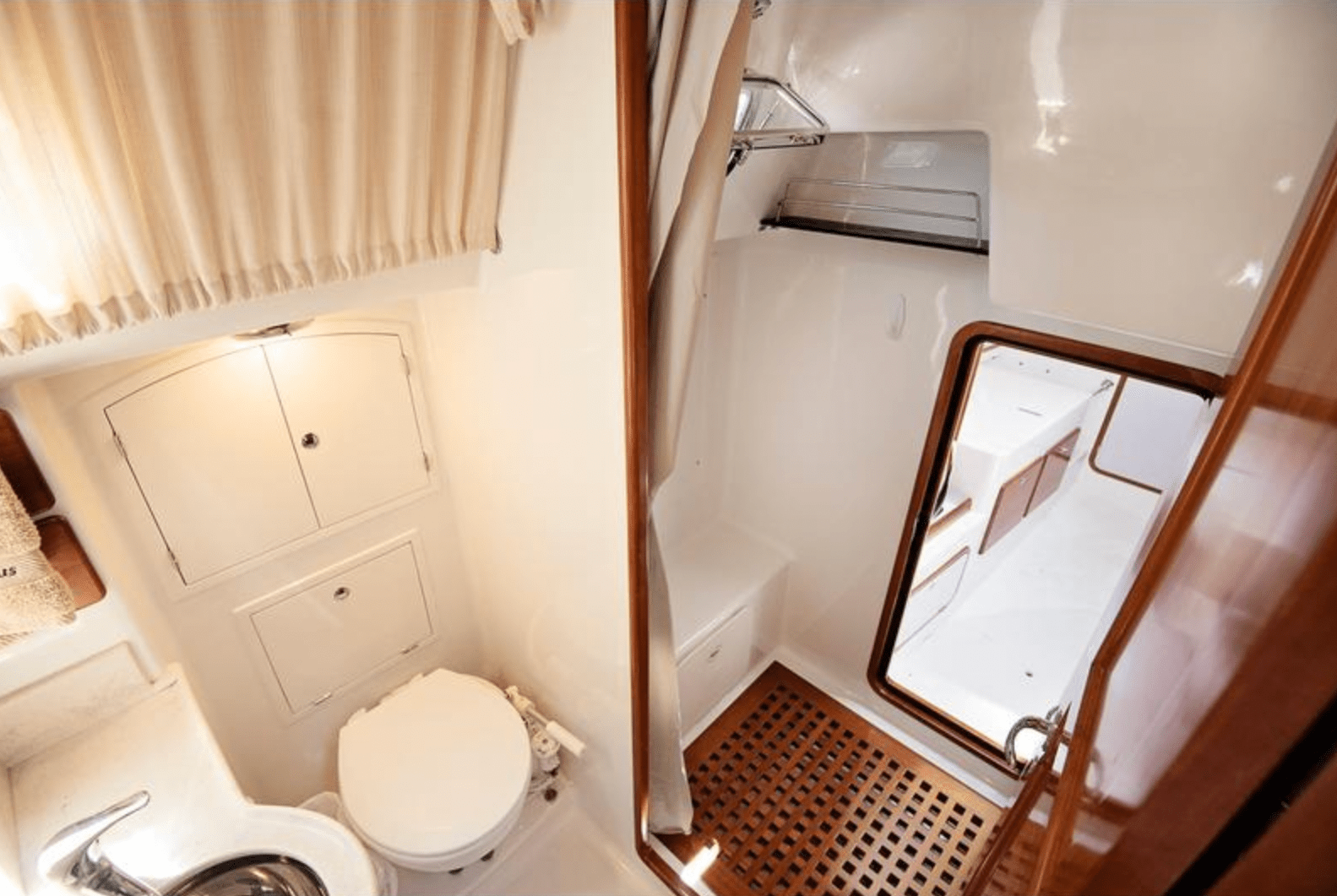
Aft Head
Seamless fiberglass construction from cabin sole to counter for easy cleaning Polished Corian counter tops with Corian fiddle
Large molded stall shower with molded seat and shower
Large stainless steel sink
Scandvik faucet Raritan PH 2 head
Forward Head
Fiberglass molded shower
Scandvik bulkhead mounted Hand-held shower Raritan PH 2 Head
Dorade with inside closure
Forward Cabin
Centerline Double berth
Large hanging locker
Drawer storage under bunk Custom Outbound mattress Sliding storage lockers above bunk LED reading lamps over bunk
One Lewmar 60 Ocean hatch Dorade with inside closure
5 Opening ports
Two Hella Fans
Scandvik Stainless steel sink Corian counters
Scandvik faucet
Ground Tackle
Divided self draining chain locker easily accessible from forward stowage locker Stainless double anchor roller
Molded scupper aft of bow roller to catch water brought aboard with anchor chain Lewmar V4 Windlass with capstan
Lewmar handheld windless remote control
200 feet 5/16 Hi tensile
Rocna 33 (73 lb) anchor
Fortress FX-37 stern anchor and 200’ 3-strand rode, 40 feet chain 6 12” stainless steel mooring cleats
I know, right?! Whooooaaaa … take a breath.
Next up, we hop on a plane (for the first time since the pandemic) and fly to Annapolis to look at this amazing boat! s/v Ubiquitous. While Phillip and I hoped she would feel right, fit right, and perhaps be “the one,” we wouldn’t know until we stepped aboard. We had seen many boats that looked good on paper, seemed promising, but then when we stepped aboard at a boat show, they felt like a Jim Walters home, all thought put into the condo feel of the cockpit and interior, rather than the solid build of the hull and the offshore “feel” you want when you grab a handrail or shut a hatch. Although our own research and, particular, Harries’s opinion had our hopes high, Phillip and I knew we had to step aboard an Outbound 46 and feel her for ourselves before we would know, for sure, the Outbound, and Ubiquitous specifically, was worth the chase. So, off we went! Annapolis or bust! Stay tuned!


