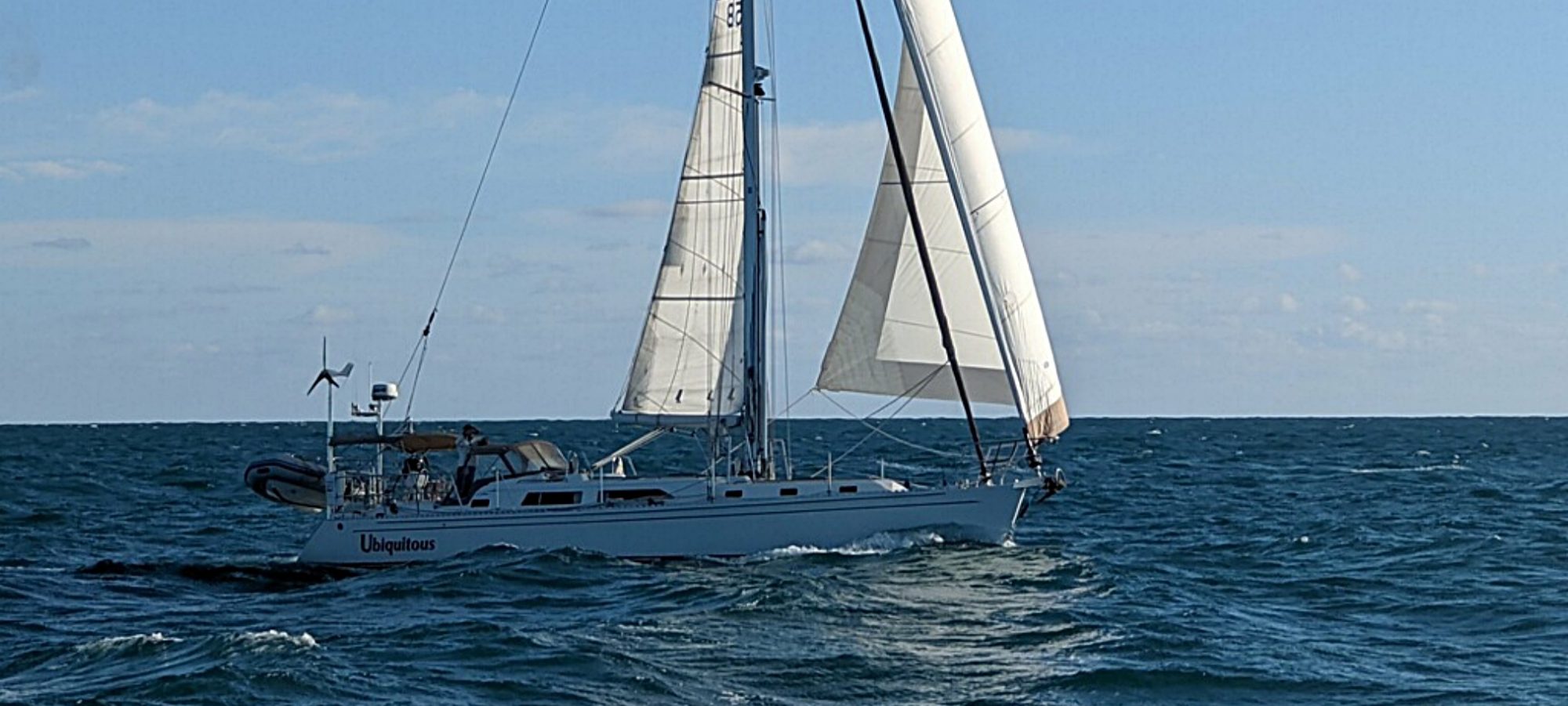
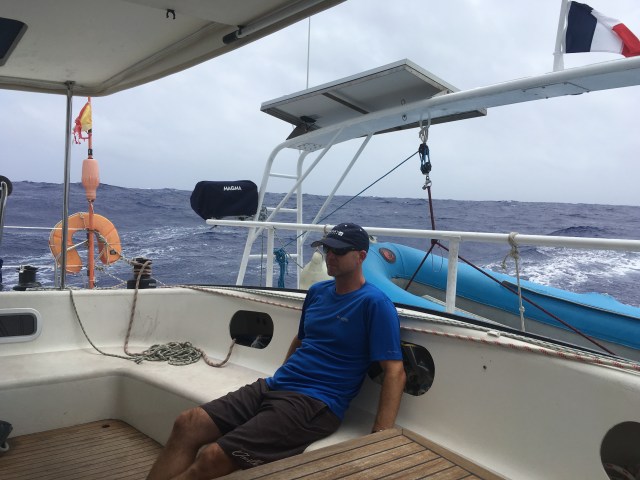
“What follows was one of the more fun-loving and honest interviews I’ve done in a while.” Those are Andy’s words and they mean the world to me. I am honored to be able to share this with you all, my podcast interview with Andy Schell from 59-North.com. I had been talking with Andy off and on for a little over a year about the two of us potentially teaming up on a joint project to create something both of our audiences would enjoy and Andy had the great idea to get the exclusive post trans-Atlantic interview from me. If Andy Schell asks, you say “yes” I can assure you, and so I did. And here it is: an intimate conversation with Andy Schell about my first ocean crossing. Please leave a review on iTunes to help Andy’s insightful conversations reach more sailors and share on Facebook as well. I hope you enjoy the interview.
Annie Dike is a reformed lawyer-turned-sailor – that is, she left the profession in her early 30s to pursue a more passionate life. Her and her partner Philip sail a Niagara 35 on the west coast of Florida, and they recently crossed the Atlantic to France on a high-tech Catamaran. Annie & I discussed how she left the lawyer world behind, what the Atlantic crossing was like for a first-time ocean sailor, her various movie projects, her friendship with Pam Wall & her passion for helping others pursue the cruising lifestyle.
Annie Dike is a truly interesting & inspiring character, and what follows was one of the more fun-loving and honest interviews I’ve done in a while. Annie has an infectious personality, and has been using her lawyer-like work ethic to offer cruising opportunities to other aspiring sailors. Mia & I recently teamed up with Annie to offer one of our offshore passages aboard Isbjorn to one of her fans – check out Annie’s Patreon page on patreon.com/havewindwilltravel for details.
Also, remember Andy and I have teamed up to offer one of YOU a chance to join Andy & Mia on one of their incredible offshore adventures. Become a Patron, read Andy’s offshore voyaging FAQs on his website and email me for a chance to win!
Hey there HaveWind followers! As you may have seen on Patreon on Facebook, Phillip and I recently hosted a Skype Q&A session with Patrons who had watched the movie from our Atlantic-crossing and had some questions about the boat, maintenance, provisioning, things that frightened us, things we learned, etc. While it is not a perfect recording (this was my first time hosting a group Skype) there are some great segments in here, primarily from Phillip, where we share our thoughts, lessons learned and experience from our first ocean-crossing aboard a catamaran. I thought you all might get a kick out of it. Yes, a kick. Enjoy!
These were some of the varying pieces of advice we were getting when we reached out to folks about our shuddering shrouds on the Freydis. To this day (primarily because of this experience) I am not a fan of rig tuning. I don’t like the science behind it (or should I say the lack of science). It’s like Matthew McConaughey’s “fugazi” from Wolf on Wall Street.
“It’s not on the elemental chart. It’s not real.” That’s about what the “proper amount of tension” on rigging feels like to me. Thankfully, Yannick, with the seemingly endless supply of information he had compiled about his boat, found a very small notation in the back of a manual made by the previous owner of the boat when the rig was replaced in 2012 about the amount of barrel that should be visible in the turnbuckle. It was the only resource we had that included a non-subjective component. You know, actual numbers not just “I’m okay, the rig’s okay” feelings. For that reason, it had my vote. And Yannick’s as well. According to the previous owner’s notation, the starboard shroud needed to be tightened until 2.5 more centimeters of thread were exposed in the turnbuckle. The port shroud needed an additional 3.57 cm of thread. With heavy PVC tubes that had to be lifted while two others handled the tightening and measuring below (while the boat was still bashing around underway), it was not the easiest of chores but it was do-able.
With Yannick serving as our Chief Measurer, and Johnny and I awarded the honor of Turnbuckle Turner Nos. 1 and 2 we set to tightening the rig in the early morning hours of June 8th, eleven days into our trans-Atlantic. I learned a good lesson from Johnny that day too. I would say he cracked me up, but I think I actually cracked him up. As we bundled up the tools, a towel and the cotter pins we would need for the job and headed up on deck, Johnny mentioned tying a safety line in case we dropped things. Good idea I thought and I carefully tied a tiny Dyneema line from the turnbuckle to the new cotter pins we would be putting in once we finished tightening the shrouds. When Johnny settled in next to me and saw what I had done, he doubled over chuckling and said:
“I meant tie a line to the tools. We have plenty more cotter pins. We don’t have more tools.”
Ahhh. That Johnny. You can tell he’s been around boats a while. These were the kinds of simple tips and tricks I was picking up out there. All part of why I went.
Once we had tightened the shrouds to Yannick’s measurements, the murderous shuddering definitely subsided. It was so comforting just to hear that sound in particular—such a horrid metallic clanging—stop. That shrill cry is not something you want to associate with a boat beating its way across the ocean. Water on hulls. That’s fine. Taut sails and crashing waves. All fine. Shrouds vibrating themselves to death. NOT fine.
It seemed about the perfect time to tighten the shrouds, too, as the winds continued to howl through our rig that day, holding steady between 22 and 26 knots. We knew exactly where there winds were coming from too: Tropical Storm Collins.
As I mentioned, we got incredibly lucky with the weather on that trip. No matter how much intel, satellite equipment and cautious planning you have or make for an ocean-crossing, a good bit of your fate still falls in the category of “pure luck” because once you shove off with the intent to cross an ocean, you’re exposing yourself to a big open body of water and a boat that doesn’t travel near as fast as storms. We had been watching TS Collins forming in the Gulf and had actually heard from friends first with the worry that it might be coming toward mine and Phillip’s Niagara 35 back in Pensacola. *gulp*
Yannick’s going to kill me when he reads this, but I’ll just be honest. I pleaded with the storm to continue heading west to Texas, or perhaps hook and go east, go across Florida, go anywherebut to our poor little, just re-built boat in Pensacola. Apparently the storm heard me because that’s exactly what he did. The Wednesday on that storm tracker chart above is June 8th, when the storm was just starting to make his turn toward the Big Bend of Florida. We were following it closely out in the Atlantic. Thankfully, on Andanza, we had fantastic weather intel in the form of a hired weather router, a friend of Yannick’s (who proved equally capable) doing the same, as well as Weather Fax, GRIB files and unlimited Delorme texting available to reach out to anyone on-shore with the ability to follow the storm. This may sound awful, but it actually became a little tedious trying to respond to everyone who reached out to us then warning us about TS Collins. Our weather router kept us on a more southerly route while TS Collins dissipated over head in the Atlantic. But, Collins sure brought the freaking wind!
It didn’t seem thirty minutes after we’d finished the rig tightening the morning of June 8th that the blow started to creep to 27, 28 and upward.
Although we had just finished our rather rigorous rig tightening, Yannick instructed the crew to drop the sails down to Reef 2. I told you it’s never boring out there! If you think it’s always sitting around, reading, writing, napping. It is sometimes, but the other days feel like a flurry of projects, one after the other, and you can’t believe it’s time for your night shift already. This was definitely one of those days.
And, sadly, while we did now have our reefing procedure down (thanks to Yannick and his typed-up, taped-up list at each crew member’s station), we still had so many things to learn about that boat. I believe every day crossing an ocean will teach you something new about sailing. However, I also believe every day on passage will teach you something peculiar or particular about that boat (or boats like it). I am actually grateful that we all made it safely across the ocean so that I can now sit here and merely write and share some of these experiences as lessons learned (as opposed to tragedies) because some of the things we survived out there were just pure luck. On that day we battled the Barber Hauler and almost lost in a big way. Our critical lesson learned: Detach the Barber Hauler before reefing.
For many of you who sail with a Barber Hauler often, this may sound like a very basic proposition. Common knowledge. For those of you scratching your head merely at the sight of the word “Barber Hauler” … well, this is why you make trips like that. To learn critical lessons like this. Recall the Barber Hauler was a secondary line we ran from the clew of the genny down to the deck to pull the sail outward away from the center of the boat to open up airflow between the genny and the main sail.
Brandon taught us this during our very first sail on the catamaran as he has raced many boats in his days and learned this trick to increase the efficiency of the boat, particularly catamarans where it is often difficult to make good use of the genny due to the boxy shape of the boat. We had been using the Barber Hauler often on Andanza as it did, visibly, increase the speed of the boat on a close haul. But, we made a serious mistake when we left it on while bringing the sails down to Reef 2.
Recall in our reef drills, the first step was always to head into the wind so we could furl the genny a bit (so she wouldn’t snap and pop and beat Yannick up at the mast while he handled dropping the main). Once furled halfway, Phillip would then fall back off and fill her with a little wind while we set to dropping the main.
Here you can see everyone’s respective positions as well: Yannick at the mast, Johnny at the genny winch on port, Phillip at the helm, and me at the winch(es) on starboard. Here I’m furling the genny while Johnny is easing out the port genny sheet. This is what we were trying to do when the Barber Hauler incident occurred.
The precautionary genny furl was usually a no-sweat first step and one that we could easily accomplish with both Johnny on port and Phillip at the helm on starboard who were both easing out the tension of the genny sheets while I furled her. Our wild card this time was the stinking Barber Hauler, which we had fastened to the genny clew on port. Think of it like a wild, uninhibited bull whip. We had unclutched the Barber Hauler to allow slack to pull through so the genny could furl but we should have detached it from the clew because as soon as the wind came out of the genny the genny now had a live cracking wire in her hands and she started whipping Yannick at the mast with it and Johnny on port.
Soon after I started to furl, I heard shouts. I looked to see Yannick holding his head down at the mast with a hand clasped over his right eye. I looked to Phillip at the helm who was looking to Yannick for instruction, then I looked to Johnny on port and saw it. The snarling beast that was off its chain. The Barber Hauler was snapping on the deck, beating the windows, flailing out overboard and coming back again. Johnny was crunched down near his winch with a guarded hand held over his head. I cleated the furling line and bolted through the cockpit to try to catch the Barber Hauler as I heard Yannick shout to Phillip: “Fall off!” Thankfully, even with the Barber snapping at him, Johnny knew to cleat the genny on port as Phillip was about to put the wind in her before he ducked back down. And don’t think I was heroic. It was probably dumb of me to try to jump in as the hero and wrestle that line in the whipping wind. I could have probably been easily injured as well but (by luck yet again) I was able to get a hold of the flailing Barber Hauler, bring it down on the deck and pull and cleat the slack out of him before he could slap anybody else.
When we re-grouped in the cockpit, having only furled the genny a few wraps, we all could see now that Yannick had been popped in the face by the Barber Hauler. A thick red whelp traveled from the middle of his scalp down to the top of his jawbone on the right side and he said he thought he had blacked out for a couple of seconds when it happened. But, Johnny had truly got the worst of it. He lifted his shirt to reveal a clear, puffed up red slash across his mid-section which I’m sure was painful. But his voice was a little shaky as he rubbed his thumb and told us the line had got caught around his neck at one point and his thumb another.
We were all a little shaken up by the Barber Hauler incident, and were reminded—in a rather stark fashion—that things can go very wrong, very quickly and unexpectedly out there. Like I said, thankfully all we did was suffer some whelps and learn a lesson. We got very lucky that day with the Barber Hauler. But, we still had winds of 27+ and three-quarters of our main sail up. So, once we shook it off and realized the mistake we had made, we disconnected the Barber Hauler and secured it safely to the deck while we then went through, efficiently and safely, the rest of our reefing procedure to bring the main sail down to Reef 2. By that time, we were beat, whipped and each of us ready for rest.
With the second reef in the sails, the boat was still bashing along but it was much more manageable and the boat held steady, romping and ripping through waves, everything soggy and moist, but with each of the boat’s primary systems (the sails, the rigging, the auto-pilot, etc.) all performing beautifully as we clicked off miles and days passed in a wet montage. It was funny the things that would once seem abnormal on shore, now seemed totally normal out there. Case in point:
Doing laundry with saltwater, a bucket and a clothes line? Out there, it’s normal!
Yannick playing dinner-prep D.J.? NORMAL.
Phillip breaking out arbitrarily in “What shall we do with the drunken sailor?” NORMAL.
Daily disassembly of random boat parts? NORMAL.
Finding yourself happy to be awake at sunrise? NORMAL.
Discovery of unidentifiable black objects in the food bin? NORMAL.
Discover of unidentifiable “gobbly bits” in the bilge? NORMAL.
Annie pairing shorts with rubber boots (and 100% pulling it off I might add)? NORMAL.
Yannick taking his morning Nespresso in the engine locker?
TOTALLY NORMAL.
Yannick actually just told me a couple of weeks ago when he first watched my movie from the trans-at crossing with a friend that his friend said: “It looked like you spent the entire trip in the engine locker.” To which Yannick replied: “It felt like I did.”
The movement of the catamaran, however? NOT normal. At least initially for us monohull sailors. It was such a strange new feeling. While the cat does not heel, I will give you that. It does do this strange four corners type movement that keeps you guessing which way the boat’s going to throw you at any second. It reminded me of that game we all used to play as kids where you move it right, left, backward, forward, trying to get that little silver ball to fall down through the right hole. Well, we were the ball, and the boat was having a hell of a good time bouncing us off the walls, down the stairs and into our beds. You could almost hear her laughing as she did it. But, it wasn’t miserable. I actually like the feeling of movement underneath me. It reminds me we’re going, traveling over a frothy body of blue to a new place. It’s fun!
The waves, too, were absolutely incredible. Just when we started making our way east of Bermuda, we saw some of the biggest of the trip.
It reminded me of fire. Something so natural and mesmerizing that you watched perhaps because of the seemingly inexplicable novelty of it—i.e., what it is exactly that creates a flame and causes it to dance? What forces move water into mountains and push them toward your boat? The sheer fact that it is threatening is entrancing. You want to watch it because it’s beautiful and because you need to keep an eye on it. The waves in the middle of the Atlantic would loom on the horizon, grow like lumbering hillsides until they appeared taller than the boat on the horizon. Then, as one neared, Andanza’s stern would rise up. You would feel her nose start to pitch downward as the wave lifted her high above the ocean. Sometimes the boat would catch the wave just right and start skidding and careening down the surface, surfing the wave at speeds of 14, 15 and upwards before she lurched into the trough of the wave in front of her. Other times, she would not catch the gravity of the wave on the front and instead it would roll heavy and foamy beneath her. Better still, sometimes her hull would toss around and land just right, contacting a wave dead on and causing a wall of water to slap up and swamp the cockpit.
Still I found it fun! Cool snippet from the Trans-At movie for you here, showing the height of the waves and the moment when I was honored to have witnessed the highest boat speed of the trip. Can you guess what it was??
Often a wave would grab the stern of the boat, kick her out almost 45, 50 degrees off course and you would sit at the helm, hands poised over the wheel knowing it would be your job to get her back on course if Auto did not do it for you but not 100% confident of your ability to do it. It was shocking to see the degree of deviations the auto-pilot could correct. A swift shove off course and he would diligently nose her back onto her heading. Every time. Every wave. It almost created a dangerous sense of nonchalance. We were definitely spoiled with the auto-pilot.
Our main concern at that time was making sure he had power. We were struggling with the generator at the time. According to the MasterVolt, it was only charging the batteries up to like 60%, then it would trickle off and not put any more juice in. Many discussions were had about voltage, amps, watts, generator cables, etc. While I listened, I mostly stayed out of those debates because—pitted next to Johnny, Yannick and Phillip—I certainly was no generator/battery expert. And, to be honest, even with all of their expertise combined, they seemed to be contradicting one another often. But, not discussing it (10 out of every 24 hours of the day like the boys did) did not mean that I wasn’t concerned about it.
It was around 11:35 p.m. the night of June 9th and I couldn’t sleep. My shift didn’t start until midnight and while I usually sank into my berth like a log until the very moment when my relief crew member shook me awake or the alarm on my phone went off, this night I could not quiet my mind. I kept imagining the batteries were draining down to 10% and suddenly there wasn’t enough juice to power the auto-pilot. I imagined this would of course happen when someone wasn’t close enough to the helm (or with enough mental clarity, myself included) to turn the wheel in the right direction the moment Auto gave out in order to keep the wind in the sails and the boat on a safe course. It’s very easy to get disoriented—when you have to run up to the helm and you’re not in tune, at that moment, with the environment and wind direction—and easier than you think to turn the boat in a direction that backwinds the sails or causes a terrible accidental jibe or worse. I kept imagining this would happen during my 12-2 shift and it was ruining any sleep I thought might be possible in the hours that lead up to that dreaded shift. I finally just got out about bed around 11:45 p.m. to look, once again, at the percentage on the MasterVolt and confirm it was at least above 10%. It showed 65% and trickling in.
Yannick was bent over the instruments at the nav station when I staggered behind him, his head hanging like the sad ornament on a Charlie Brown Christmas tree. “I’ve been counting the minutes,” he said as he started to rise to go to sleep. I thought, for a moment, to protest saying it was only 11:45, not midnight yet, but I knew it wouldn’t do any good anyway. I wasn’t going to be able to fall back asleep and Yannick needed rest more than anyone. So, I just let him go. But then I sat and cursed him as my dreaded two-hour night shift was now a dreaded two hour and fifteen-minute shift and was starting now. Uhhhhh. Yannick told me before he went to bed, though, that he didn’t trust the percentage on the MasterVolt. He did not think it was calibrated correctly because the volts were showing 24.62V (plenty). Yannick said the the number to watch was the volts. If they fell under 24.0, then it was time to wake him. The Captain then stumbled off to bed and the boat was in my charge. Uhhhhh.
After thirty minutes of sitting at the nav station below as Yannick had been doing, watching the instruments (particularly the rudder indicator on the auto-pilot instrument showing how far, starboard to port, the auto was truly having to steer the boat) and praying Auto would hold, I couldn’t stand it anymore. I didn’t care if the wind was blowing, if it was wet and drizzly outside, if it was a little cold. My mind would not let up unless I was sitting at the helm feeling connected with everything and knowing exactly what I would need to do if Auto gave out. Bottom line is, I feel safer at the helm. So, I slugged it out topside and it actually was much better. It’s like sitting in a passenger seat of a fast, seemingly out-of-control car, or sitting in the driver’s seat, with your hands on the wheel. I can’t explain it, but it soothed me.
And, my shift actually went quicker because of it. The winds were finally easing off a bit. We had shaken out the second reef earlier in the day when the winds dropped below 25, followed by the first reef when they dipped below 20. While it was still blowing a steady 17-18 during my shift (an amount that would worry me on our Niagara) on the Freydis, with the sails fully up, it was a nice, steady ride. With reliable winds, the big seas were our main concern and I liked sitting at the helm imagining myself actually steering through those collosal waves (that way if Auto did lose juice I could do it when the time came.) Little did I know I would get more than my desired share of that experience on this trip. But, before I knew it, it was nearing 2:00 a.m., the winds were lightening up, Johnny was rousing down below and I was about to hand over the reigns of that bashing boat (one of my favorite feelings) and crash back into my soft, cottony palace of sleep below (another of my favorite feelings). Life was good.
Until the unmistakeable scent started to seep in. The smell of burnt plastic in your berth? NOT NORMAL.
It crept into my dreams at first. I was in a kitchen somewhere scraping an oven. Then footsteps thundered overhead. I started to rouse, but I felt so confused. Where am I? What’s that smell? When did we crank? I blinked my eyes awake to the sight of Yannick, his head careened downward into mine and Phillip’s berth from the hatch overhead, darting his eyes all over the room. I popped my head out of the hatch, coughed up melted plastic fumes and asked what was going on. Then Johnny emerged from the engine room on port with the sad state of the muffler in his hands.
Aren’t offshore voyages fun? If you just said, “Heck yeah!” we need to talk. I’m helping to light a fire under my followers who are serious about cruising by getting them booked on some fantastic offshore voyages this winter, starting with a Thanksgiving voyage with us to Isla Mujeres that we are filling now with Patrons. If you are serious about wanting to travel offshore this winter, send me an email NOW and let me get you on board this fine vessel! Boat tour coming soon.
I watched him in anticipation as Johnny eyed it and swished it around a time or two. Water dripped from Yannick’s nose onto his forearm as he, too, strained to see.
Having confirmed the prop was not fouled, Yannick was more curious than anyone as to why the starboard engine had cut out again on the early morning of June 1st.
“It doesn’t have enough fuel in it,” Johnny said. Yannick’s head craned back quizzically.
“How do you know?” he asked, locking eyes with Johnny. This was the same kind of direct stare that often made me second guess whatever I had just told Yannick and start to mumble. Yannick has a rabid desire for scientific, rational answers. He needs things to make sense for him logically before he can accept them and move on. While it is fun to watch this trait play out as he devours another technical manual or draws a diagram for you of how the flaps on an airplane wing work, it can be a little intimidating when his ravenous thirst for logic is directed at you. At least that was how I felt when he would shift those probing eyes in my direction.
I want YOU to give me answers. Annie says *gulp*
It didn’t seem they had the same impact on Johnny, though, with his unquestionable knowledge gained from experience.
“I can feel it,” Johnny said simply, circling the fuel in the filter round and around, along with his thoughts on it, likely thinking back on everything he and Yannick had done to the engines in the weeks before we shoved off. It didn’t take long for the two of them to come to the conclusion that the fuel had been polished (because it had been sitting for the tank during the months of repairs) but that not all of the fuel filters had been replaced afterward. Another lesson learned. And, it was pretty impressive to see Yannick whip out a plastic bin with at least ten spare fuel filters (I told you he was pragmatic) and put a new one on. Once again, we seemed to face a pretty daunting problem—an engine that would not run—and we were able to reach a fairly easy solution, implement it and move on. I could already tell all of these little “it doesn’t have enough fuel in it” experiences were going to serve Phillip and I well when we set off to sail our own boat across an ocean.
Within a matter of forty minutes, we went from Captain overboard to check for a fouled prop and a disassembled fuel system to a fully-functioning engine and bagels on the burner all before the start of my 6:00 a.m. shift!
Once the buzz of the incident fizzled off, Yannick (who had just finished the 4-6) went back to his berth to sleep. Johnny headed back to get some more rest as well and Phillip began to fiddle in the galley making coffee. I sat, a little tired at the helm, knowing I was about to be there for another three hours and secretly wishing the fuel incident had occurred just an hour or two later as a nice distraction mid-shift.
Does that sound horrible? Of course it does! Hoping for some sort of equipment failure just so I could be entertained with repairs during my shift. Yannick’s going to howl when he reads this. That’s not quite what I meant. I never hoped for a failure, but I will admit I did—occasionally, on some lackluster shifts—hope for some sort of occurrence (dolphins at the bow, a ship sighting, some interesting conversation over the radio, very benign things like these) to break up the monotony of my watch. That’s only because the minute you were relieved from your post a whole world of wondrous activities waited! You could then read to your heart’s content, cook up an extravagant meal or sit down and write a vivid, gloriously-detailed story, just for the heck of it. Outside of cleaning the boat and assisting the Captain with his many-a-boat projects (which was rare, Yannick truly took on most of the boat work in solitude, declining assistance often) that’s really what our days out there were filled with and it was heaven!
It was funny to watch each crew member start to gravitate toward one of the four rotation days they liked better than others. The 6-9am, 7-10 dinner shift, followed by the 4-6am “sunrise shift” the next day was definitely my favorite. Sadly, that day was always followed by the stupid 4-hour shift day, which was actually my idea initially.
“We’ll do one long shift each day, right in the middle of the day when everyone is awake so it will help make the shift go quicker,” is what pre-Atlantic Annie thought. Well … even when everyone is awake, that doesn’t mean they’re really inclined to do anything that makes your four hours at the helm go any quicker, and why should they? It’s their off-time. Outside of boat maintenance or other necessary chores, they should be doing whatever the heck they want, whatever helps them relax and best prepare for their next shift. Oftentimes, you were left to fend for your creative self during that four-hour shift. I sometimes counted each of the 240 minutes.
I actually got pretty crafty in finding at least one way to shave this four-hour sentence down when I would ask the Captain, very benignly, very nonchalantly, right at the start of my 12-4: “Yannick, we need to switch time zones today. Do you want me to handle it?”
“Yeah, thanks,” Yannick would say, his thoughts consumed with yet another diesel engine diagram.
I would walk away with a wicked smile, take my post at the helm at noon and immediately change the clocks to 1:00 p.m. Muuuhahahaaa. Sadly, this very peculiar pattern of time changes always occurring very conveniently during Annie’s 12-4 shift was soon discovered by the wily Captain Yannick. The next time I asked if he wanted me to handle the time change, blinking and batting my doe-like eyes, he went straight to the watch schedule taped on the saloon wall to find, yes, indeed, it was Annie with the 12-4 that day and he replied:
“No,” with a playful grimace. “I’ll handle it later.”
Dag nabbit! I did have a good run, though. Four of the seven time changes we had to make from Florida to France did occur during my four-hour shift. My God I’m terrible! Who wants me to crew with them now?
But, I was paying my dues that morning. Watching the horizon. Watching Phillip read contentedly in the saloon, counting the minutes. Then suddenly a match struck and the minutes started to burn. It was somewhere around 7:30 the morning of June 1st when we heard the first startling whizzz of the fishing reel on the port transom. Phillip was up and was piddling around in the galley when I heard it at the helm. My heart started pumping, my eyes darting around the instruments, the engine panel, the chartplotter thinking surely this sound was some kind of alarm that was telling me, as the helmsman, that something was very wrong with the boat. Your mind (or mine did, at least) went instantly there when a loud noise sounded out. But, this sound was a good one! As my frantic thoughts finally stopped swirling and started to come into focus it finally dawned on me. Fish. Fish on. The fishing rod! Then Phillip, far more capable of actual spoken words than me at the moment, shouted it out as he scrambled out of the saloon.
“FISH ON!”
I checked everything at the helm to make sure I could leave my post to help with this awesome new development. We had a fish on the line! The line we’d had out for three freaking days now. “All good here. FISH ON!” the instruments told me, so I went. With some tag-team reeling and some creative baptisms-of-rum at sea, we pulled in our first fish of the trip! A hearty tuna!
She made a mad bloody mess on the port transom kicking and flailing around until we had her tamed, but boy was she a beauty. That slick, silver body, contrasted with the rich crimson blood spilling out. Such a right and proper feeling of carnage! Often I feel bad for a fish when we catch one and I watch it flip and kick itself to death, but this time, it felt right. Like we were out there, living on the sea, and this was the bounty she had provided us to keep us fed and motivated and moving along. I can’t explain it, but I felt like the fish was a gift and I was grateful.
After an hour spent filleting her and scrubbing the blood off of the transom, my shift was then magically over! The Distraction Fairy shined down upon me those days. On days that she didn’t I imagined her a crafty little thing flying above the dodger, hiding from my line of sight, deciding whether I deserved something fun that day or not, like a naughty Tinkerbell.
Obviously I had a lot of time to think about it.
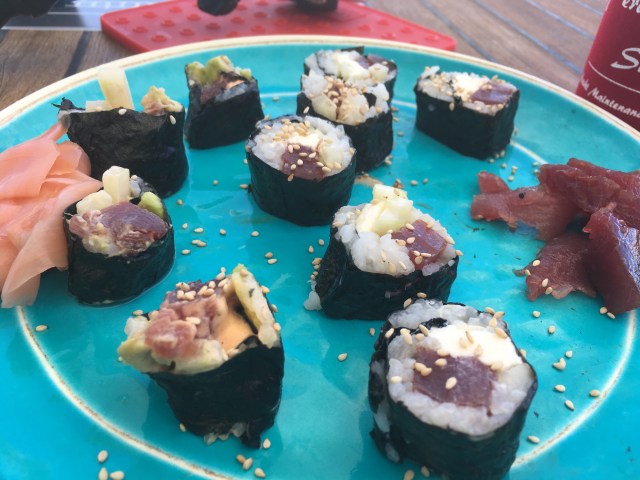
Phillip and I decided to chill the fish filets for a few hours so we could make a huge sushi spread for lunch. This was one of the those fun moments you had only talked about in the many weeks before we shoved off, when we were discussing fishing equipment, sushi ingredients, and how much fish we might eat during the passage. Now those visions and predictions were here. Sitting in the form of four hunky maroon filets in our fridge. Phillip and I had experimented one evening before the trip making our own sushi at home from fresh tuna bought at Joe Patti’s. I had never made sushi before but it was really very easy, as long as you have all of the ingredients on hand (most of which keep for weeks except for the cucumber or avocado) and there’s something about home-made sushi that just tastes better. (Well, assuming you get the rice mixture right–not too much vinegar, not too much sugar.)
Phillip likes rice on the outside.
I prefer them seaweed out with cream cheese!
The cool thing about making the rolls yourself is you can make them however you want! And we were about to put that sushi-rolling experience to use making an awesome spicy tuna spread from a fresh fish pulled right out of the Gulf. As with many things I had already experienced in my life—baths, afternoon naps, sushi platters—the version of those things experienced while we were underway crossing an ocean became instantly “the best,” because the sushi platter we all feasted on in the middle of the bright blue Gulf on June 1st was the best of my life.
I also had another “best of my life” that day. (Some days out there were full of them.) Soon after our filling sushi lunch, when the entire crew (except for Yannick who had the 12-4 that day, take that!) was reading and dozing, we were all snapped wide awake when Phillip spotted a pod of dolphins off the port bow, rippling in the water, dipping and jumping and coming our way! Phillip, Yannick and I all made our way to the bow of the boat and watched as eighteen (by my count at least) bottle-nosed dolphins zipped and played in the glimmering jewel-toned waters of the Gulf.
I had never seen that many dolphins at one time, all converging, swooping and swishing together. It’s amazing how agile and aware they are of each other and how quickly they are able to meet up, communicate through clicks and whistles and them swim instantly in sync. I don’t care how many times I see them, dolphins will always take my breath away and make me sit, jaw dropped, the goofiest grin on my face and stare like a kid at the Wonka factory. I ran down below to see if Johnny wanted to come up and see the show but it turned out he had the best seat in the house from the escape hatch in his berth, and I caught it all on film! Friends, I give you a fun little clip I shared with Patrons back in June:
Another fun project I decided to tackle that day was to try out the OCENS sat service Phillip and I had purchased for the trip. (Detailed blog post outlining the various services and packages we considered, what we purchased and why HERE.) And, after some fiddling and holding of the sat phone up to the heavens (seriously), I successfully sent my first email that day from the glassy Gulf of Mexico!
I wrote it ahead of time (it was my first “Atlantic Log” post for Patrons with a picture), so the only time I spent “on the clock” was about four minutes acquiring a signal, inserting the text, uploading the image (recall OCENS has a feature that automatically compresses the photo for you to decrease the upload time) and sending the email. With a data rate of $1.39/minute under our package that meant roughly $6.00 each time I wanted to send a write-up with a photo, which in my mind was perfectly quick, affordable and worth it to enable me to send followers an up-to-date report and photo while abroad.
My only disappointment was my misunderstanding that the emails could only be sent from my phone so the typing took longer, but when I am forced to write less, my writing is always better. One of my absolute favorite quotes about writing is from Mark Twain: “I didn’t have time to write something short, so I wrote something long instead.” This is so true. It’s easy to babble. So, the “phone limitation” (as do many things that are initially perceived as a limitation) turned out to be a blessing in disguise.
The GRIB service could be useful, too, in that we could download a fairly detailed (wind, wave and current) GRIB file for the region of the Atlantic we were sailing in at the time in about six minutes (so roughly $8.00 each time you downloaded). Yannick, however, had such great weather service in the form of a hired weather tracker, who analyzed the weather patterns and sent us new coordinates roughly every 24 hours, a friend who did the same (just for fun and who proved to have a keen eye for heavy weather diversion), as well as WeatherFax on the boat, we didn’t really need the additional GRIB service available under our sat phone plan. But, it’s always good to have a back-up system, so Phillip and I did not regret the purchase. What we vowed to get next time we head offshore, however, is a Delorme! That thing was awesome.
Yannick had purchased a Delorme package that allowed for unlimited texting on the iPad via the Delorme app and that service proved to be invaluable, both in terms of seeking out answers or help when dealing with a non-urgent boat, navigation or medical problem and to simply stay connected to friends and family while underway. Phillip and I will definitely be getting a Delorme for our cruising this winter to Cuba and beyond, for this reason. We also shared Yannick’s tracker link with Patrons so they could follow us each step of the crossing and message us along the way, and we will do that again with our trip to Cuba as that was a really fun experience to share with close followers, friends and family. (Get your Delorme ticket now!)
“It’s going to take you two months to cross at this rate!” some of our friends and followers were saying during those sluggish days in the Gulf, when we were motoring bare poles on a sheet of satin, barely making five knots. And, at that rate, they would be right. The winds were non-existent in the Gulf.
Even the birds were beating us to Key West.
Do you see the bird here?
While glassy waters are beautiful, they don’t offer much in the way of sailing. This crew was ready to get around the tip of Florida, into the frothy waters of the Atlantic and find some stinking wind! Be careful what you wish for. Those first few slow days, we all simply counted our blessings that the engines, swapping from one to the other approximately every 10-12 hours, were still chugging us along and kept trucking toward Key West so we could re-fuel and re-provision.
Seeing as we were headed to port for one major supply, the Captain wisely decided to check to see if we needed others. Which provision comes to mind first? If you said water, you would be correct! Yannick enlisted me that afternoon as his trusty water maker mate and I controlled the water maker panel from Johnny’s berth in the port bow while he diverted the product into a separate container so we could taste and test it before sending it into the main tanks.
I watched Yannick sip, smack and frown, sip, smack and frown before he brought the bottle to me and handed it over without saying a word, which did not bode well. I dutifully tipped it up and repeated Yannick’s sip, smack and frown, just the once.
Sadly, a system that had been making non-salinated 60 parts per million water was now making a salty 290 ppm concoction that wasn’t going to keep anyone happy or hydrated. We chocked it up to the making of the first batch in the pure, pristine waters (ha!) of Bayou Chico. Whoops. Whatever had caused it, though, it was clear we would not be making any potable water on this trip, so in addition to fuel, we also needed to stock up on water (and lots of it) in Key West.
“Land ho!” I shouted when she came into view off the starboard bow, although I’m not even sure what that phrase truly means. Why the ‘ho’? (Dictionary.com says it’s used “as a call to attract attention” … I guess that’s fitting for many reasons.) But, knowing what something really means has never stopped me from saying it. I can’t tell you the origin of “Whoo Hoo!” but now having watched over a hundred hours of Atlantic-crossing footage, I can confidently tell you I say it too much. (Movie will be coming out Sep. 22, 2016 on Patreon! I’m allowed to say it this time … Whoo Hoo! : ) It was exciting, though, to see shore emerge on the horizon after our five serene but slow days crossing the Gulf.
The Captain gave the crew two hours to jump ship and run our errands in Key West. This was no leisure visit. We were on a mission. Key West in 3 … 2 … 1 … GO!
If you all are enjoying this story, I have (soooo many) more! Become a Patron for an additional weekly post giving you an up-to-date report on mine and Phillip’s current adventures and boat projects and our preparations for sailing “To Cuba and Beyond” (said in a Buzz Lightyear voice) this winter. A HUGE thanks to my many supporters and followers who make all of this fun sharing possible.
What do you need to cross an ocean? A level-head, an adventurous spirit and a sense of humor! Exciting news guys! I have completed the complete, 90+ minute movie from mine and Phillip’s first trans-Atlantic this past June when we crewed aboard a 46′ catamaran from Florida to France. It was an incredible adventure: 30 days of feats and failures at sea. I had a daunting amount of footage and photos to sift through when we returned, but I spent a lot of time trying to make a high-quality, realistic, engaging account of what an ocean crossing truly feels like for those of you who may be considering it, or who may be afraid to do it.
This video discusses some of my own personal fears in signing up for the passage, some advice I received from Andy Schell with 59-North, and includes the “Official Trailer” for the movie that will be coming out this September! All Patrons will get a free early viewing so BECOME A PATRON to get your ticket to view (as well as access to all of my other cool Patrons-only content)! The movie will also be available for rent on Vimeo in October so everyone can watch. Stay tuned here for updates on the release of the movie and my podcast interview with Andy Schell! Very exciting. I’m all fidgety about it! : )