Ch. 7: Best Shower of My Life

“I wouldn’t go if I couldn’t take a hot shower every day.”

It was my brother who told me this recently.  Sorry, John (if you’re reading this, probably not!), but you did say it and I’m sure you would still stand by it now.  We were talking about the Atlantic-crossing, what it was like for me and whether he would ever want to do something like that and that was his response: “Not if I couldn’t shower every day.”

“You could shower every day,” I huffed back at him, “as long as you used mostly saltwater with just a quick freshwater rinse.”

John looked at me kind of funny.  I think he seriously forgot it’s saltwater out there and that your fresh water supply on a boat is limited.  Understandable as he is my brother.  I forget the order of the cardinal directions sometimes and have to say that “Never Eat Shredded Wheat” ditty to myself to remember.  We’re both well educated but still blondes at heart.

collage

Love you Bro.

“It would have to be a hot shower, though,” John said.  “The water out there is probably super cold.  I would want a comfortable shower.”

“Those were some of the best showers of my life,” I responded, instantly, immediately because it was so true.

Bath2

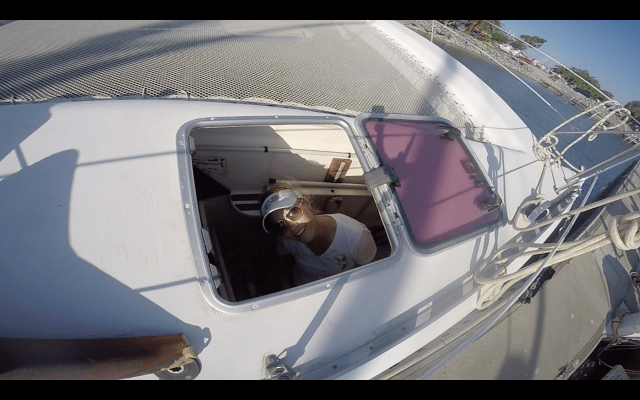
The second day of the trip, Phillip and I took our first of several showers on the transom of Andanza and it was an incredible experience.  There is no better feeling when you’re sweaty, dirty, oily and all gummed up from a passage to be able to jump overboard and submerge yourself in cool, crisp cleansing water.  As predicted, the wind in the Gulf was virtually non-existent, which sucked for sailing but was great for a Captain-approved intentional man overboard dip!  Phillip and I tied a tow line and jumped in, both of us squealing and shouting “Whoo hoo!” when it was our turn in the water because it just felt so incredible.  I don’t care what the instruments said.  2.9 knots?  Please!  In the water it felt like we were making 10!

Buns

Get your drawers Annie!

Water whisked across my body like a running river, washing all of the dirt and grime away and almost sucking my britches clean off! I had to keep reaching back and snatching them to keep them on.  It was also difficult to pull my legs back underneath me just to get back onto the boat, but it was so much fun!  Phillip and I took turns jumping in, coming back out to soap up, jumping in again to rinse off then helping each other with a warm Solar Shower rinse afterward and I honestly cannot think back on my 34 years and recall a shower I enjoyed more.  I can walk up to a tub, turn on the water and have the same “hot shower” experience everyday and it will be just what John craved: comfortable.  What I cannot have, though, is a crisp, chilly, invigorating saltwater cleanse like I had on the back of Andanza with an endless blue horizon around me in every direction.  That kind of unrepeatable newness is what I crave.

Screen Shot 2016-08-29 at 9.33.47 AMScreen Shot 2016-08-29 at 9.32.00 AM Screen Shot 2016-08-29 at 9.32.49 AM

The sunrise that morning, our first on the trans-Atlantic passage, was also a moment I will not forget.  We were all kind of shocked that the first sail we raised on the trip was the spinnaker and that we had flown it all through the previous night without a problem.  She was still up and fluttering in the bright morning sun when I rose just after 5:00 a.m. May 30th, to find Phillip in his absolute happy place.  He had made a pot of coffee and was standing in the cockpit just watching the sun rise.  His serenity was infectious, so I just stood next to him and watched too.

Screen Shot 2016-08-29 at 9.52.22 AM Screen Shot 2016-08-29 at 9.52.49 AM

“Some minutes go slow but the days go fast.”  Andy Schell with 59-North told me this recently when he interviewed me about my first ocean crossing for his “On the Wind” podcast.  (Such an honor!  You know I will let you all know when that comes out!)  Andy said someone had told him that’s what it feels like to cross an ocean and I could not agree more.  That moment with Phillip, our first morning on passage, watching the sun rise, felt so vivid and slow.  I remember the feeling of the cool morning air, my hair dancing and tickling my face, the sight of the spinnaker with sunlight glowing through it.

Sunrise

What I don’t quite remember, though, is the rather large chunk of time from that moment until our shower on the transom some seven, or perhaps eight, hours later and what I did during that time.  Some moments tick by like an eternity but other stretches of time pass by in a blurry succession and all of sudden you can’t believe it’s already Thursday, or June or just 1,000 nautical miles left to go!  Time slows and speeds like an accordion and the song is over before you want it to end.  Andy was right about that.

While the lackluster wind did not make for great sailing, it did make for an absolute beautiful backdrop for the hours of reading, writing and daydreaming the crew did as we motored our way across the glassy Gulf.

IMG_1391

We knew we were going to have to stop in Key West to fuel up at the very least and it appeared—at the rate we were going—we would get there in about three days, although no one was in a rush.

I tried to make myself do some “work writing” (I call it)—the various articles and pieces I write for my legal marketing clients—during those first few days, but to be honest, I found it difficult to make myself do anything that felt like work.  With a beautiful blue backdrop, the smell of salt water all around, water as blue as a sapphire with sun streaks that pierced down for miles, it was hard to force your mind to do anything but relax and reflect.  This is probably one of the aspects of blue water passages people love.  It’s like your mind rejects stress.  It flat out refuses to fret over anything that doesn’t involve your immediate surroundings.

IMG_1525

With each of us having pushed ourselves to our stress-load limits in the days before we shoved off, the crew rested a great deal during those first days on passage.  And I say “the crew” because the Captain, Yannick, remained in boat project mode, every hour, every day of that trip.  Unlike the rest of us, he never slowed down.

IMG_1501 IMG_1502 IMG_1496  IMG_1698 IMG_1701 IMG_1625

And if you think that’s a lot of photos of the Captain working, I laugh at you.  I have at least 103 just of Yannick doing boat projects.  I’ll do a whole montage one day!  It’ll be great.

The only thing the crew focused on, however, was the status of the boat and when our next shift was.  And, for Phillip, what he was going to make us for lunch and dinner!

IMG_1635 IMG_1636

It was tuna pasta with beets for lunch that day.  Thank you Chef Phillip!

My shift that night was ten to midnight.

IMG_1404

I was sitting in the cockpit with Yannick while he was finishing what we all started to call the “dinner shift” (7-10pm).  That was an awesome shift because it usually included the fun entertainment of everyone making and eating dinner and often a movie.  That shift was cake. It seemed it was the 2-4am shift that most folks didn’t care much for.

I was getting ready to take over around 10:00 p.m. when I saw a zip of white flash by in the water.  Perplexed, I craned my head over the side to try to decipher what I saw.  At first it was just darkness, black water.  Then I saw another zip of bubbles, quick and nimble, fast up to the bow and it finally clicked in my mind what I might be seeing.  DolphinsIn phosphorescence.  I nudged Yannick and told him to look.

“They’re all up at the bow!” he said.  “Get your tether.  Let’s go.”

I couldn’t scramble into that thing fast enough.  I was fidgeting and fighting my way into my life vest.  And, I would say I didn’t think to wake Phillip because I knew he was tired and needed to rest up for his midnight to 2am shift, but that’s not true because I wasn’t thinking about Phillip at all!  Not one bit.  There were dolphins at the bow!  And, they were glowing!  And I was going!  Yannick was tapping his foot at the helm waiting for me so we could both go together.  (We were still sticking by our rule that no one was allowed to leave the cockpit to go foreward at night alone.)

The sky was dark.  The moon had been rising around 2:00 a.m. every morning since we set off from Pensacola, leaving often a dark night sky with a barely visible horizon, until the moon would rise a fiery orange on the port beam. Yannick had his head lamp on and lit my way to the bow.  I heard them before I could see them.  The gentle puff of dolphin’s breath, three puffs, at least four, in a matter of seconds, which told me there were many dolphins, and they were everywhere. I could hear them on our starboard side, near the starboard bow, and near the center of the boat where Yannick was already looking over.

I perched on the edge near the port side, my feet dangling over the bow feeling the crisp salt spray from the water and I saw them.  Dolphins.  A dozen at least.  Zipping through the water at seemingly lightning speed from one hull to the next, leaving behind, each time, a trail of glitter.  At least that’s what it looked like.  Their bodies gleamed with phosphorescence, moving so fast they left a sparkling trail behind.  I have never seen such a thing and I believe the only experience that could compare would be this same sight and phenomenon again: Dolphins in phosphorescence.  It was breathtaking.  Inexplicable in its beauty.  These creatures move with such speed in the absolute dark, completely aware of their surroundings, our boat, each other, the entire body of water it seemed. They had no fear. Only joy.  And in the moment, so did I.

It was a very memorable moment to share with Yannick, as well.  We both looked at each other like two kids at an aquarium, saying nothing, just smiling.  I’m sure he remembers that night.  The glowing pod stayed and zipped along with us for about ten minutes.  When they finally trailed off to the east, their last brilliant streaks fading into dark, Yannick and I slowly made our way back to the cockpit where it was my turn to hold the helm.  I kind of thought Yannick would stay up a little with me to re-live the dolphin moment, but “Goodnight” he said as he made his way down below.

I’m glad my shift that night began with such a lively, invigorating scene because it was a long, slow two hours after that.  The “time accordion” was slowly stretching apart.  I forced myself to stay alert.  Do a walk-about around the cockpit every ten or so minutes.  Look at the instruments.  Check the engine temp.  Without any wind, we had been motoring all day, letting the starboard engine pump us across the Gulf.

No wind! Johnny's view

It was a calm night, but cloudy, which meant no sparkling chop, no horizon.  There is something eerie about motoring straight toward a black sheath.  You’re not entirely confident that you’re not about to slam into something.  It’s hard to look away from the bow.  You have the instinct to keep verifying but each time you do it just stirs your worries anew because you can’t see anything.  Shifts like this, like Andy said, ticked by slowly.  I was always so grateful when a worrisome shift ended to hand over the helm with the glorious, gratifying knowledge that the boat hadn’t struck something and cracked into a hundred pieces during my shift.  That didn’t happen when I was at the helm.  And, I know how awful and selfish that is to say, but it is just the truth.  I also shocked myself at how easily and quickly I could fall into a deep sleep after my night shifts because the tediousness of the worrying had exhausted me so.

The crew was able to fall off into deep slumbering comas often with the mere closing of our eyes.  Johnny slept ten hours a day those first few days.  While all three of the crew members had been working incredibly hard the final weeks before we left to complete work that had to be done or finished ahead of schedule so we could leave the country for six weeks, Phillip and I had been doing that at a desk while Johnny, as a diesel engine mechanic, was doing that often on his feet or hands and knees finishing several rather large engine repairs before he left.  And, he’s 72!  He’s an impressive guy that Johnny.  And, he always held his shift so it didn’t bother anyone at all that he slumbered so much in between during those first few days.  It actually turned out to be a blessing because the next morning we sent him right down in the hole at the crack of dawn.

I heard the rumble of the port engine cranking beneath me in my berth early the morning of May 31st.  Something felt a little off about it as we had been trying to split time between the engines and Yannick had told me the night before he was planning to run the starboard engine until well into the following day.  I thought something might be wrong, but I was also tired and didn’t quite want to wake up yet so I just rolled over.  Then I heard rushed footsteps.  Then Johnny’s voice.  Then I woke.  It was just after 5:00 a.m.  I popped my head out of my hatch on the port-side as Phillip rustled out of bed and I heard Yannick’s report.

In the middle of his 4-6am shift, the starboard engine had shut down again on its own.  No sputter, stutter or puttering out.  It stopped immediately.  Yannick had already checked the oil and other fluid levels, the temp, etc. There were no visible problems in that regard.  He was preparing to go overboard to see if something had fouled the prop as Johnny, still blinking himself awake, starting making his way down into the starboard engine locker.

No wind

“Well, it’s a good thing you got a lot of rest yesterday, Johnny,” Phillip said.  Johnny just smiled and shook his head as he eased down into the hole.


Want more HaveWindWillTravel content?  Become a Patron to get our weekly: 1) Pic of the Week, 2) Cuba Prep Update, 3) Trans-At Exclusive and 4) a Sneak Peek of each Friday’s video, as well as free early viewing of my Atlantic-Crossing movie which will be coming out in just a few short weeks!

Pat extra

Ch. 5: Shoving Off!

How much experience do you need to cross the Atlantic Ocean?

That is honestly one of the questions that flitted through my mind as we pushed away from the dock in the morning heat, May 28, 2016.  That and “Happy birthday to you.”  That was playing in my mind as well.  (Are you singing it now?  You’re welcome.)  I turned 34 that day and I couldn’t think of one (much less 34!) reasons why I should NOT be going on this trip.  We were about to sail to France.  Sail.  I could not get my mind wrapped around it.  Every time I mentioned the trip to friends or family I would say “When we land in France … ” and I would have to stop myself, back up, and say “When we dock in France” and instantly I would envision Kate Winslet walking up to the gallant, towering Titanic.

1465381892-kate-winslet-rose-titanic

Because those are the kinds of boats that “dock” in France, right?

Well, not this time.  We were going on a 46-foot boat with a virgin crew to an ocean-crossing.  While everyone has to have a first time, it’s probably a little uncommon for four sailors to embark on their first crossing together but we were.  While Johnny had about thirty years sailing experience under his belt, many passages in the Gulf, around the Bahamas as well as one solo voyage to Jamaica, he had never crossed an ocean.  Phillip and I had crossed the Gulf several times before (well, to be honest, I’ve been told hugging the shore doesn’t even count as crossing) but a six-week trip to the Florida Keys and back on our Niagara was the longest voyage we could boast.  While Yannick had sailed Andanza with a hired captain from Martinique up to Pensacola when he purchased the boat in 2015, that was his only blue water passage on the boat and it was still not across an ocean.  Would stepping on this boat for this voyage frighten some of you?

IMG_1358

To be honest, that collective limitation did not worry me.  No matter how much experience you have, if you get stuck in a storm or the boat is compromised beyond repair, a hundred ocean crossings under your belt may not save you.  Truthfully, what worried me the most, was my own personal lack of knowledge of the boat, i.e., how best to handle her, how her systems operated and how they should be maintained, repaired and rigged, and most importantly, how to sail her because I didn’t feel like I really knew how to do that all that well.  Yet.  That was the thought that made my heart race.  An emergency occurring.  The crew needing me to do something, the right thing, to help save the boat or lives, and I would not know the right thing, or perhaps anything, to do to help get the boat and the crew through the situation.  I feared paralysis brought on by ignorance.  I still feel to this day the answer to that question—How much experience do you need to cross an ocean?—is none.  Obviously because we all did it without any, so while it may be helpful, it is not a necessity.  What you really need, in my humble opinion, after good mental and physical health is (in this order): luck, a level head, patience and an eagerness to learn: the boat, the seas, the stars and from your mistakes.  Oh, and a sense of humor.  You need a sense of humor.

After that, you shove off.  That’s what we did.  And somehow we made it.

We woke to a fiery sunrise on Andanza the morning of May 28th.

13316991_899803776797412_9159782657306573636_o

It was crazy to think we would be leaving the dock that day actually headed for France.

13320635_899803783464078_5549541210902692172_o

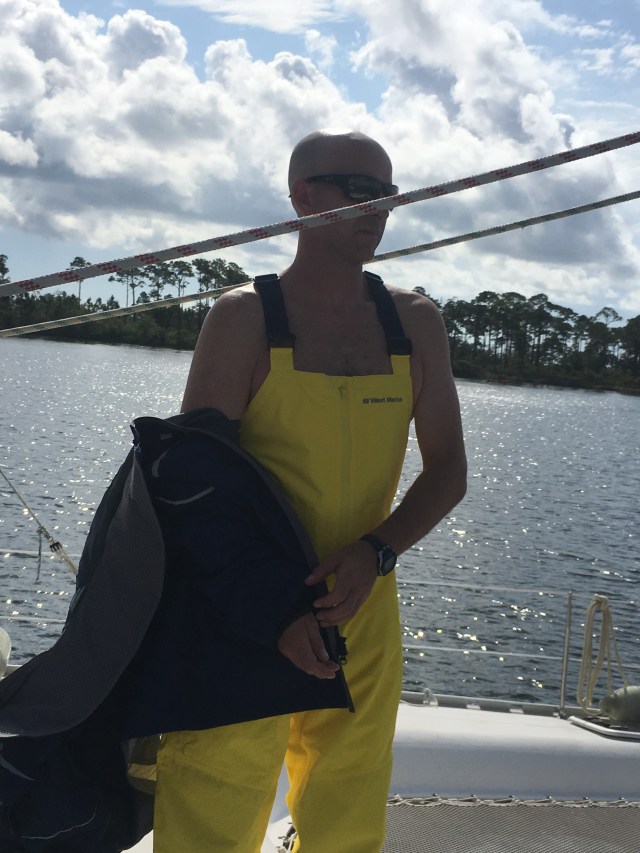
Crew morale was incredibly high, thankfully, as I forced them all to gear up (in the middle of May heat) in our foul weather gear for a “Thank You West Marine!” crew photo.

wm

See?  Totally worth it.

It was hot, though.  After five minutes of sweating, the crew was about ready to kill me.

IMG_1338

We all were sporting next to nothing under those heat lockers.

IMG_1343

Farmer John style:

IMG_1345

IMG_1326

To be honest, I can’t quite remember what brought on this strange pose.  I think I called him Ronald McDonald in his red-and-yellow ensemble and there was some mention of a hamburger craving.  That’s all I remember.  That Yannick.  He’s a funny one.  And, I’ll know exactly what he’s thinking as he reads this:

That bit was re-enacted (too) many times during the passage.

It was a quick doffing and donning of our foul weather gear, though.  We stripped and stowed those away as they would likely not be needed anytime soon in the hot, muggy Gulf and prepared to shove off, although we would not be heading out into the Gulf that day.  Why no Gulf, you ask?  Brandon and his wife, Christine, that’s why and an alcohol-induced cajoling the night before at our little farewell party at the dock.

Screen Shot 2016-08-11 at 5.11.13 PM

pic

Screen Shot 2016-08-11 at 5.12.22 PM

I mentioned there was alcohol … 

While Brandon and Christine had the best of intentions talking us into spending one night on anchor at everyone’s favorite anchorage—Ft. McRee—for the stated purpose of “a good night’s rest” before the passage and one last “check of the systems,” mine and Phillip’s lawyer sides saw right through them.   We all knew what they really wanted was to have one last hoorah on the hook before we sailed across the Atlantic.

We did too!  So, it was settled.  One night at McRee, then we would be off.  While we knew we would not be headed out into the Pensacola Pass that day, it was strange to think it might be our last sighting of Andanza next to a U.S. dock.

dock

Brandon was planning on bringing his boat out for the night as well, a Gulf Star 45, s/v 5 O’Clock.  With all of the work he had put into Yannick’s boat at the yard, all of the time he had spent helping us all prepare for the passage, an evening on the water with he and his family truly seemed like the perfect send-off.  Plus, I (selfishly) could also not imagine a better way to spend my birthday!  Yes, remember it was still my birthday!  There were so many cool things about that day.  One being a sail-by farewell from two of our other local fellow cruisers: our broker, Kevin, aboard his Pearson 36 Cutter and Andrew, aboard his Sabre 34.

Screen Shot 2016-08-11 at 5.16.55 PM

The crew had a very fun sail from the Navy Base to Ft. McRee with a few of Yannick’s French friends aboard (who were very cute I might add).  It was the first time all four of us were on the boat, sailing away from Pensacola and we were all prickling with energy.  I think Phillip put it best when he said:

Okay, so maybe we were going to have to drop it just for the night while on anchor, but that was all.  Just one night.  And, it was very fun being the celebrities at the anchorage.  Phillip and I spend so many weekends there that we had two, three, four dinghies, if not more, pull up, filled to the brim with our cruising buddies, wanting to say “Bon Voyage!”  It was humbling to see how excited and invested our friends were in the trip.  They were all planning to follow us on the Delorme and it really was cool to know they would be here, doing what we would normally be doing every weekend during that month, while Phillip and I were moving each day across the ocean toward France. And, getting to say goodbye on the water was really where Phillip and I feel truly at home, so there was something special about that.

Screen Shot 2016-08-11 at 5.15.12 PM

I was also really touched by the things Yannick’s wife, Clothilde, had left aboard the boat specifically for my birthday celebration: a super scrumptious hazelnut coffee cake that she made, as well as birthday candles and party favors.  It was funny to watch Yannick scrambling around looking for them when it came time to blow out the candles.  He did find one rather large candle, which he sunk down into the frosting and that I noted was quite _______.  (If you have a word you think is fitting here, leave in a comment below and check out this week’s Patron’s video extra: “Birthday Trivia”)

new

To be honest, though, I hated to say it, but I told Christine toward the evening, that Phillip and I were so itching to go, to get out there on blue water, that the hours honestly kind of started to slow down for us.  All of the crew kept looking out past the beach toward the Gulf, craving that offshore, nothing-but-blue-horizon feeling of being on an offshore passage.  We were ready to take the plunge!

Screen Shot 2016-08-11 at 3.41.42 PM

It was tough to sleep that night we were all so excited.  Rum helped, though.  The stories told that evening on Brandon’s boat I can hardly recall.  I doubt he does either. But it was a fantastic night with friends, warm hugs and good cheer.

IMG_1368 IMG_1375 IMG_1371 IMG_1370

When I started to stir in bed the next morning and realized this (yes, finally THIS) was the day we would be truly headed out the pass and offshore, I didn’t care what time it was.  I ripped my eyes open and nudged Phillip.  “This is it,” I said.  He was awake in seconds, nodding and smiling.  “I know,” he said, tickling with the same excitement.  We were leaving today!

And, early too.  The entire crew was awake before 6:00 a.m., brewing coffee and talking about the weather.  The seas looked calm in the Gulf so Yannick plugged in a placeholder coordinate outside of Key West and that was that.  We had our first leg of the trip plugged in.  It was actually really cool to think this time Phillip and I headed offshore we would just be going, non-stop.  While we love to coastal cruise and check out all of the neat inlets, ports and harbors along the coastline, we love to be underway too, so the thought that we were about to leave Pensacola Bay and not set our sights on Port St. Joe, or Clearwater, or Tarpon Springs or anything north of the Keys was truly exciting.  Phillip and I had no clue whether we were going to like this—long offshore travel—we had an instinct, and it turned out to be right, but at the time, we had no idea.  But that was the whole point of going.

The crew of s/v Andanza weighed anchor that morning and made our way through the North Cut on our way to Pensacola Pass around 6:45 a.m.  We had one last surprise visit from another local cruising group (thank you Bridgette, Tom and Karen!) via dinghy on our way out the channel.

Screen Shot 2016-08-11 at 3.39.44 PM

They circled around us shouting “Bon Voyage!” and snapping photos.  It was such a cool moment, such a proud moment, to know we had worked so hard to get here and we were doing something many wished they could, wished they had, wish they still will, and I was right there, not one day into 34 and I was doing it, with my best friend beside me.

13301306_902868229824300_1639919668775614652_o

Hearts were beating and sighs were heaved as the rookie ocean crew motored our way out the Pensacola Pass.  We had a great time spotting the last bits of land.  Johnny watched Portofino disappear on the horizon.  Phillip threw out the fishing line.  And then … (notice anything suspect here?)

Screen Shot 2016-08-11 at 5.18.33 PM

The starboard engine shut down.

I think Video Annie summed it up best.  This was literally two hours into our trip:

“The adventure begins!”

Ch. 4: Paris Panties and Provisioning Tips

I guess we should talk about the really important stuff before we get to the panties.

Fuel:

While there were many, many critical provisions we needed to stock on the boat, fuel was one of the first items to come up during our initial crew briefings at Yannick’s house.  If your goal is to get the boat across the pond without stopping, there are only two ways that can happen: wind or fuel.

yann

Andanza carries 90 gallons of fuel, which sounds like a lot but considering the distance we needed to cover (4,600 nautical miles), it would not really get us that far.  Yannick had calculated an approximate consumption rate of 0.5 gallons an hour per engine, running at about 1,800 RPMs, which he had determined was the optimal, most efficient range for the engines.  He also found running both engines at the same time only added 0.5 knots in speed for double the fuel consumption, so he had decided we should only run one engine at a time as needed.  (Know there is some debate out there as to whether this puts unnecessary strain on the propulsion system.  What?  Boat owners with differing opinions?  No way!  Yannick researched it and made an executive decision that the decrease in fuel consumption was justified over the potential strain on the sail drives.)   Running only one engine at a time translated to roughly 180 hours of tank burning time which would carry us about 1,000 nautical miles purely motoring.  The plan was to bring aboard additional Jerry jugs of fuel, each jug giving us an approximate additional 10 hours of motoring, with the amount of jugs TBD considering the additional weight they would bring aboard.

IMG_1177

We eventually decided on 11 jugs, stored in the foreward starboard bow.  That locker is massive.  I can stand up in it!

Screen Shot 2016-07-28 at 11.04.21 AM Screen Shot 2016-07-28 at 11.04.39 AM

The funny thing is, as Yannick and Phillip both pointed out, you cannot possibly bring enough fuel to motor across the entire ocean.  The boat could not carry it all (and likely could not move with that much added weight).  So, once you decide to go anyway, the risk is really the same whether you have 50 gallons, or 90 or 150.  We simply brought an amount we thought would help “fill the gaps” when we would have to motor sail or just motor because the wind was not behaving.  The plan was to sail as often as we could.


Water:

Screen Shot 2016-07-28 at 11.39.17 AM

The catamaran has a 100 gallon water tank on the boat.  While that sounds like a lot, it also is not much when you consider the washing, cooking, cleaning, and bathing you have to do with that same water, in addition to just drinking it.  The boat also had a water maker but we weren’t really sure how well it would work, how much water it would produce and whether that water would even be drinkable.  Brandon and Yannick worked on the water maker while Andanza was in the yard and it was reportedly working well, although we all were a little leery about testing it.  (To be blunt about it, no one wanted to get the sh%ts!)

Screen Shot 2016-07-28 at 11.21.11 AM

Yannick reported to us during the weeks before shove-off that the water maker was working and producing about 3/4 gallon per minute.  Quite a bit.  He bought a water tester to see how many parts per million (meaning dissolved solids … could be salt, could be fish poop or oil, who knows) and we tested the second batch he made during our first sail on the boat in Pensacola Bay.  Yannick told us the first batch registered at 290 ppm and this second batch was now at 66, which is very low.  However, we still made him do the actual drinking first.

Screen Shot 2016-07-28 at 11.20.53 AM

Phillip couldn’t make it out with us the first time we went out on the catamaran (remember all of that pesky work stuff we were doing to get ready to leave the country) and I told him about the water testing when I got home.  His first question: “Where was the first batch made?”  Knowing zip about water makers at the time and thinking nothing of it, I told him: “Bayou Chico.”  Ruh-roh.  Phillip was definitely worried that the filthy water from the bayou had been run through the water maker and we learned later the maker should only be used when you’re in the cleanest water possible.  (The Atlantic Ocean would be a great place to start!)  But, it seemed to be working fine at the time (Yannick had not yet reported any sh%ts) and it was likely whatever water it made could at least be used for cleaning, bathing, etc.  (Another small worry was the fact that the water maker fed straight into the main water tank.  Meaning, if the water it made was contaminated, it could spoil our entire supply.  For this reason, Yannick always diverted the initial production into a separate gallon for testing before he let it run into the main tank.)

There was also the possibility that the main 100-gallon tank could be contaminated somehow, or that it could crack and leak out.  After fuel, water was our most important provision on the boat.  We wanted to stock as much water as possible (considering space and weight) to carry us across the ocean.  Yannick bought 15 cases (36 water bottles each) of water for the trip and Phillip and I packed the bilges of the boat with a total of 540 water bottles.

Screen Shot 2016-07-28 at 11.19.12 AM Screen Shot 2016-07-28 at 11.17.46 AM water


Ditch Bags:

IMG_0899

Each crew member was responsible for packing his or her own ditch bag with the usual supplies (life jackets, GPS, flares, emergency food and water, etc.)  We would also each be bringing our own hydrostatic life jackets with tethers to clip into the jack lines.

Screen Shot 2016-06-08 at 9.02.34 AM

Yannick’s boat was equipped with an EPIRB for the vessel (located near the nav station below) and he also had a beacon on his life jacket that would sound an MOB alarm if Yannick fell overboard.  Phillip and I brought our own personal EPIRB to keep with us when we were on night watch in case one of us fell over.  Yannick also had a green laser light on his jacket that could be seen from (I can’t really remember) like twenty miles or something.  For intentional overboard, Phillip and I brought an old wet suit that would be donated to the boat in case anyone had to go overboard (to un-foul the prop for example) and Yannick had a dry suit as well.

We also had many haling devices.

9763779284784035824

Yannick testing the Delorme’s capabilities in flight.  It tracked him the entire way!

Counting everyone’s individual cell phones, hand-held GPSs, iPads and such as well as the two chart plotters on the boat and other electronics (Delorme, sat phone, etc.), Yannick predicted we would have approximately 15 GPS devices on the boat.  Needless to say, PLENTY.  While a ditch of the boat was not something anyone really thought would happen, we had to plan for the possibility.  I can assure you there were many, many discussions about ditch gear.  And, with the life raft having arrived (just days before we were set to leave), if in fact the moment did come, we would now be ditching the boat in much better shape.

Screen Shot 2016-07-28 at 12.16.41 PM

There she is!

To be honest, our primary concern was significant injury to a crew member (think illness, broken bone or infection) or a man overboard.  There were also many discussions about everyone’s respective first aid experience, known procedures, and the proper response and duty of all crew members if a man fell overboard.  Yannick explained many times (likely because he had to, the electronics on his boat are dizzying) how to set off the MOB alarm on the chart plotter and what each crew member should do to safely retrieve the fallen crew member and get him (okay, or her!) back on board.  Our primary defense to injury and emergencies was what Yannick continually referred to as “discipline.”  This included:

  1. Moving around the boat slowly and with caution;
  2. Clipping in at night or in rough seas;
  3. Never leaving the cockpit alone during a night shift;
  4. Monitoring and timely responding to health problems (fevers, infections, malaise, etc.).

We also discussed the known possibility that catamarans, because they do not heel, can get unknowingly overpowered with too much wind on the beam.  This was discussed and it was decided we would always put a first reef in at 20 knots of wind, a second reef at 25, and a third reef at 30.  The crew agreed we would also always reef at sunset.  Sailing cautiously and conservatively was another huge part of our safety plan.


First Aid:

IMG_0869

Let’s just say we had way, waaaay too much medical crap on the boat.  Yannick had a fantastic supply of antibiotics, which was one of our top concerns.  Johnny, having been a paramedic in a previous life, also had great wound care and suture kits to supply.  Phillip and I cleaned out all of our band-aids, bandages, Neosporin, Ibuprofen, etc. from Plaintiff’s Rest and contributed that.  And, we brought many varieties of seasickness prevention.

IMG_0871

While neither Johnny, Phillip Yannick nor myself were prone to seasickness (thank goodness because once we shoved off for France, we were looking at 30+ days at sea), many folks had told Phillip and I that the motion of the catamaran is just “different” and that it’s possible for people who do not get seasick on a monohull to get seasick on a catamaran.  So, we were prepared.

I hope as you’re reading through this, you’re starting to get a sense of how much planning really goes into making a passage like this.  Yannick was good at delegating items like this (i.e., rounding up everyone’s first aid gear and making a combined, non-duplicative kit for the boat) to each of us so no efforts were wasted.  Phillip and I were responsible for preparing the boat’s first aid kit as well as food-planning for the passage.  Phillip specifically requested this task as it had already been decided among the crew that he would serve as Andanza‘s head chef for the passage.  (You recall Yannick’s “gut it and put soy sauce on it” approach.)  I worked on the watch schedule, the window sealing and inventorying the boat while Yannick and Johnny completed the work on the starboard sail drive once the parts arrived from Italy.  Hooray!

IMG_4337

We all had many, many jobs to do during those tumultuous two weeks before departure.


Clothing and Gear:

IMG_1188

Phillip and I found it a little difficult to pack for this trip for two reasons: 1) we needed clothes for extremely hot conditions (think bikinis in the Gulf of Mexico), potentially very cold conditions (spitting rain in the North Atlantic) as well as a few somewhat stylish pieces for France and 2) we needed to be able to fly home with only two checked bags.  Our goal was to bring many things with us on the trip that could be shed (meaning thrown away, used as rags, or donated to good will) once we got to France so our packing for the flight home would be minimal. This proved even more difficult as most of our carry-home luggage was already going to be filled with items we needed to bring back–i.e., our foul-weather gear, life jackets, tethers, electronics (sat phone), etc.

For me, the clothing items that proved to be the most comfortable and useful were wool socks, long johns and anything synthetic or quick-dry.  I will never set off on a long off-shore passage again with as much cotton as we brought for this crossing.  It never (ever!) dried completely.  Our plan to bring clothing that could be discarded once we got to shore was good, in theory, but it put us at a disadvantage in that most of the clothes we already had that we were willing to part with once we got to France were cotton and many of the items we purchased were cotton (because they’re cheaper).  I now know why high-performance gear is more expensive … because it performs.  Phillip and I did have a great time, however, watching the Wal-Martians for a bit and picking up a lot of cheap, throw-away goodies and toiletries for the trip.

IMG_0857

This is where I found my infamous Paris Panties!

IMG_0854

Seriously, they had little Eiffel Towers and other Paris icons on them.  Some even said “Bon Voyage.”  How friggin’ perfect?!

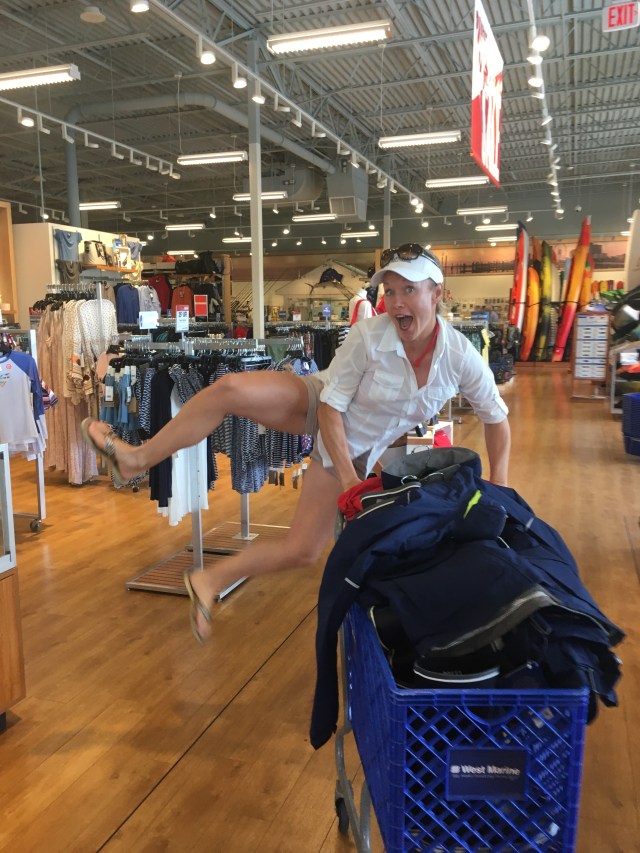
Another really cool item we had was a complete set of Third Reef foul weather gear (jackets, bibs and boots) for the entire crew donated by West Marine.  You can tell I was a little too excited when I made the pick-up at the store.  It was a very generous offering and the gear proved to be perfect for our cold, wet days and nights in the north Atlantic!

IMG_1282 IMG_1278 IMG_1303


FOOD!

Now for the really important stuff.  FOOD.  As you’ve seen from our initial briefing with Yannick, we quickly learned he is decidedly not a “foodie,” so Phillip was quick to step in to  fill the role of head chef for the passage and handle the planning for food.  While the boat did have a rather large fridge (with a small icebox) as well as a separate, almost as large, freezer, Phillip continually warned me: “You have to expect they might go out.”  Brandon had actually told us a fun story of a trip he made from Bermuda to New York where the freezer went out in the first few days and he and the crew had to eat meat for breakfast, lunch, dinner and dessert, before it spoiled.  “It was SPAM after that,” he said.  *gulp*

I wasn’t nearly as concerned about the canned goods conundrum as Phillip was. I’m a bit like Yannick in that, if it was me, I’d be fine opening a can every day, eating out of it and drinking the veggie juice after!  Proof:

12916139_870821739695616_1973652783706482966_o

Phillip, however, is a bit more gourmet.  And for good darn reason.  The man is an exceptional cook.  I am grateful and honored every evening he cooks us up a feast better than I have had at any fine-dining restaurant.  These are, seriously, just a few of his at-home creations:

Chicken Bryan:

IMG_5688

Beef wellington:

IMG_5995

Arugula, pear & blue cheese salad:

IMG_6502

Stuffed bell pepper:

IMG_6499

Braised short ribs:

IMG_6148

For this, reason, Phillip was definitely gunning to be in charge of the food.  He spent a lot of time planning the meals and preparing the grocery list for the passage.  His plan was to get about a week’s worth of good, fresh stuff we could eat in the beginning before it spoiled.  The second week, we would be defrosting things we froze (pork, ground beef, shrimp, etc.) as well as cooking up the last of the hearty vegetables – cabbage, carrots, broccoli, cauliflower, potatoes, etc.  Once the perishable goods were gone, it was on to the canned goods as well as non-refrigerated eggs, UHT milk, sardines and the infamous Spam (which actually is quite gourmet these days as part of a pineapple slider!).  This was Phillip’s list of planned meals.

meals

I have included a link for Phillip’s complete shopping list for the passage in this week’s Patreon post, “Phillip’s Provision List,” which includes food, safety gear and other equipment needed for the trip.

Then it was time to go grocery shopping …  Holy crap did we go shopping!

IMG_1230

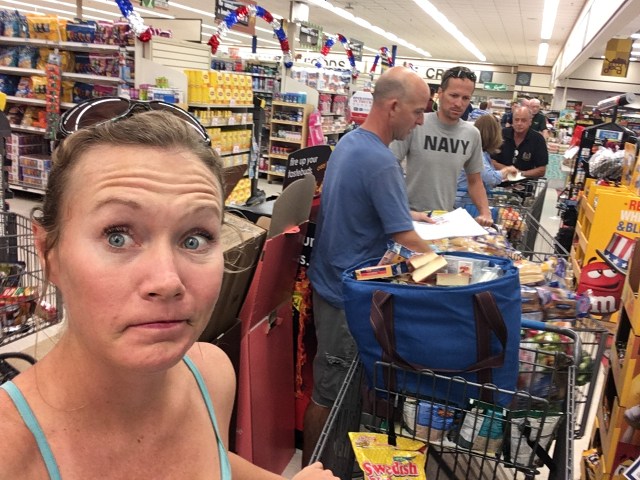
Yannick met us at the Commissary on the Navy Base in Pensacola so we could get boat-loads (no pun intended) of large quantities of food at a good price.  Phillip divvied the list up among us.  I had three pages of canned goods, pasta, crackers and snacks to get. Yannick was sent to produce, while Phillip dove into dairy and meat.  Shoppers eyed me strangely as I filled my cart with multiple 12-can packs of canned peas, corn, potatoes, pineapples, tomatoes, carrots, tuna and more.  I ran into Yannick somewhere near the Velveeta and it looked like he was pushing a bush around the Commissary.  His cart was brimming with leafy greens, carrots, cabbage and bags of apples and oranges.  He called it his “barge” and then he ran it straight into a 5-Hour Energy display and sent those little cocaine-filled energy bullets rolling everywhere.  We had accumulated four “barges” by then and were definitely turning heads all over the store.

IMG_1224 IMG_1226 IMG_1221

Things only got more comical after that.  As we pushed our four carts (‘scuse me, barges) toward the check-out lane, people started to stack up behind us, pointing, whispering, then finally asking us what the heck we needed all those groceries for.  It was fun to tell them: “Because we’re sailing across the Atlantic!”  We were all so proud!  Thankfully our checkout girl was phenomenal and she started zipping us right through.  “No bags,” said Yannick.

IMG_1232 IMG_1233

After the 5-Hour Energy incident, several floor managers had come out to help “escort” us through the check-out process, which was probably a good call.  As our goods were ooching along the conveyor belt toward the cash register a shoe-boxed size carton of grape tomatoes got the bump, crashed to the floor and sent little red balls rolling everywhere.  While Yannick and I scrambled to pick them up, a manager worked to finish unloading my cart and he dropped a half-gallon size bottle of Dawn on my foot where it ended it’s life after in a goopy puddle on the floor.

IMG_1240

I swear I can’t make this stuff up.  There he is with a handful of Dawn-soaked paper towels cleaning it up!  Better put out a “Wet Floor” sign, sir.  We’re lawyers you know.

It’s a good thing Yannick was moving back to France, because I don’t think they’d want to see him in there again.  That was wild.  I’m surprised we were able to cram all of the Commissary crap into Yannick’s Explorer but somehow we did.  Yannick called his technique “pyramiding.”

IMG_1245 IMG_1244

I thought the tailpipe was going to drag.  Buying all of the food and getting it in and out of the Explorer proved to be the easy part, however.  Once we got it all onto the boat, trying to figure out where in the world it should all go turned out to be the real puzzle.

IMG_1135

We stocked every cubby!

IMG_1248

Inside the fridge:

IMG_1246

We wanted to try, as best we could, to stock items according to frequency of use while being sensitive to location on the boat (i.e., moisture or potential for breakage or spilling), while also trying, as best we could, to inventory the items so we could somehow find them later.  This had to occur within about about an hour and a half’s time before the boat needed to be cleaned up so we could finish other projects, actually move aboard and have the boat presentable enough to host a little farewell party at the dock.  At the time the boat looked like this:

Screen Shot 2016-07-28 at 2.12.56 PM

This was just days before we shoved off.  With the time constraints, I will say we did not stock that boat as well as we should have and we paid for it during the passage with the loss of some produce and the occasional discovery of a molded unidentifiable object in a dark corner of the boat.  Friends, don’t let moldy unidentified objects happen to YOU.  In hopes of helping prevent that, I have included below some offshore provisioning tips (some earned from our very own lessons learned aboard ANDANZA) in case any of you are planning for an offshore passage soon.  (I hope so!)

Provisioning Tips:

1.  Discard all boxes and any unnecessary packaging.  Put as many things as you can in Ziplock bags (often double-bagged).  I found it useful to tear off the instructions and put them in the bag with the food for identification as well as instructions for cooking.

2.  Do not stow “breakables” in hidden or sloshing lockers.  If there is a chance the container could roll, puncture or spill, try to stow it somewhere visible or packed in such a way as to prevent collision and rupture.

3.  You do not have to refrigerate as many items as you think.  We bought several containers of UHT milk (Annie loves her Grape Nuts in the morning) and refrigerated only as needed.  We also had cartons of never-before-refrigerated eggs that will keep for weeks if turned over once every week.  Also, many vegetables (tomatoes, carrots, zucchini, cabbage, etc.) and condiments (mayo can stay out as long as the utensil used is always clean as well as butter) do not have to be refrigerated.  Many people simply throw them in the fridge out of habit.  And, little tip on the un-refrigerated eggs: If you’re worried they may have turned, put them through the “float test.”  Submerge the questionable egg in water.  If it sinks to the bottom, you’re good to go.  If it floats, toss it out.

4.  Stow onions and bananas separately.  They tend to accelerate the ripening of any fruits and vegetables near them.

5.  Watch out for the “frozen tundra” around the portion of the fridge that is a freezer.  We had many produce items (carrots, zucchini, etc.) get pushed too close to the small box freezer in the fridge and we lost them to freezing.  We found packaged cheeses and meats survived the freeze just fine.  Beer also worked as a great freezer buffer.

6.  High calorie/protein snacks serve you better than candies and sugar.  If you’re heading up on deck for your night watch or to handle something that may require energy for hours, peanuts, peanut butter and protein or energy bars were a good idea to grab on the way out.  We stocked a lot of Nature Vally granola bars, peanut butter crackers, nuts as well as peanut butter and Nutella for this reason.

7.  Mesh bags or hammocks are best for fruits and vegetables.  It keeps them dry and visible (great to both remind you to eat them and make sure they’re not “turning”).  We lost a bag of oranges because I stowed them in a dark locker and we all forgot about them.  You don’t want to know what they looked (and felt like) upon discovery …

8.  If you have time, write the name of the canned good in Sharpie on its top.  This makes it much easier to see when searching a large locker for a single type of canned good.

9.  Freeze as much meat as you can.  Yannick’s wife made us a huge batch of frozen pulled pork which was fantastic to pull out every 4-5 days and make for lunch or dinner.  All we had to do was thaw, heat and add BBQ sauce.  We also had a good bit of shrimp in the freezer as well as two pork loins as well as ground turkey and beef.  Oh, and bread.  Bread was one of the most quickly-consumed items, but it was still hard to keep up with the growing mold on a damp boat.  Freeze as much bread as you can for longevity.

10.  Stow away some treats for special occasions.  We had some frozen peanut butter M&Ms (my favorite!) that Yannick’s wife tucked away for my birthday, home-made pepper jelly that was poured over cream cheese for Johnny’s birthday, as well some nice cheeses and a bottle or two of wine that we saved for certain milestones or celebratory-worthy events (like making it to the Azores!).  “Pop!” went the champagne after we docked.  Little culinary boosts like this are great for crew morale.

I also welcome any additional tips you all may have for best packing and preserving food for long offshore passages.  Please share them in a comment below.

One of the best things I believe we were able to accomplish while stowing away all of those goods, was creation of a complete inventory list, documenting how many cans or boxes of what went where.  It is a lot of work in the beginning to tediously document all of those items, but well worth it while you are voyaging and looking for that one stupid can of sardines!  I typed it up that night (I believe it was around midnight May 26th), Phillip printed at the office the next day before we officially moved onto the boat (May 27th) and it served as our official, incredibly helpful “Inventory List” for the entire passage.  I have included a link for that as well in this week’s Patreon post.  Here is a sample from one of our largest (and only one of what ended up being 14 total) food lockers on the boat:

shelf

So, provisioning …. whew.  Done.

Are you tired yet?  We were!  But, we were running on French fumes and Atlantic-crossing adrenaline.  Who’s ready to sail to France?  Next week, we shove off!!

Screen Shot 2016-07-28 at 2.52.06 PM

Thank Patron, Carl (aka “Chief Corrao”) for the shove here.  My Patrons make all of this fun adventure sharing possible.  Get Inspired & Get on Board!

Ch. 2: “No Gloves”

“No gloves,” she said.  “Okay?”

We were at Yannick’s house, meeting his wife and children, and discussing, for the first time, the realities of Phillip and I serving as crew aboard his catamaran for the passage from Florida to France.  It was pretty much understood that Yannick had granted our request to make this passage with him, but I think (wisely so), before that decision was officially announced, he and his wife wanted to sit down with us and have a serious discussion about the voyage so they could get a better sense of who Phillip and I are and why we really wanted to make this passage across the ocean.

Can’t say that I blame them.  I’m sure they were asking themselves:

people

I believe Yannick got a sense early on that Phillip and I were capable, committed sailors and this was truly a bucket list item for us, something both of us had wanted to do for a long time and that we were planning to do in the future on our own boat, but that Yannick’s crossing had presented itself at an opportune time to give us the invaluable experience, first, serving merely as crew as opposed to Captain and First Mate aboard s/v Plaintiff’s Rest.  Another concern Yannick had was that I would probably want to share the entire voyage on YouTube via my HaveWindWillTravel.com platform.  While he has plans to launch a YouTube channel someday, exposing himself, his family and their future home aboard s/v Andanza to the scrutiny of my YouTube audience through the perspective of my camera lens was not something he was comfortable with.  It may come as no shock that not everyone enjoys having their lives and home put on widespread public display.

While I was a little surprised and disheartened by his request initially, as with many things that appear to be bad at first, with a little time and perspective, I found it was really for the best.  It was Yannick’s request and agreement to allow me to share it on a non-public, exclusive medium (Patreon) that inspired me to create a new, hybrid platform, where some content is free, some is for purchase.  It’s like putting on a free concert, but also selling backstage passes for those who want to pay to get backstage to meet the artist.  Overall, in exchange for the privilege to be invited as crew for my first ocean-crossing, it seemed a small price to pay.  I also had a fantastic time sharing the voyage through my “Cross the Atlantic with Me” Patreon campaign via the Delorme tracker link as well as weekly travel logs, photos and videos while we were underway and I gained many new followers and supporters, whom I now call friends.

With the YouTube issue settled the only other matter that seemed of utmost important to both Yannick and his wife Clothilde, was that we understand that Yannick was the Captain.  We were to offer input and our opinions as needed or solicited, but it was Yannick who would make the decisions and instruct us accordingly.  It was Clothilde, actually, in broken English, who really drove this matter home when she said:

“No gloves.”

Clothilde previously worked as a flight attendant with France Air and was telling Phillip and I the procedure and delegation of duties for her and the rest of the flight crew as an analogy to what we should expect while serving as crew under Yannick, and she repeated the phrase several times throughout: “No gloves.”  At first Phillip and I weren’t quite sure what she meant by it but as she continued to explain, it became clear she meant no kid gloves.  Clothilde was trying to prepare us for Yannick’s very matter-of-fact, direct approach.  He was not going to sugar coat anything for us and he was not going to treat us gingerly to avoid potential hurt feelings.  If he disagreed with our recommendation or input, he was simply going to tell us, without the gloves.

“Agreed,” Phillip and I said in unison, both surprised by Clothilde’s bluntness and both in admiration of the no sugar-coating agreement Yannick and Clothilde had obviously assumed in their relationship which had served them well for years, as they have embarked together on many adventures—sailing, traveling, moving from France to the states and back, as well as biking and backpacking through Iceland, and much more.

227554_6776017527_8348_n

With those understandings in place, it was understood.  Yannick was the Captain and Phillip, myself and Johnny Walker would be joining him as his diligent and dutiful crew.  One other very exciting piece of information we learned during this meeting was our departure date:

May 28, 2016

Why was that exciting?  Because thirty-four years ago, on that date, a fine specimen was brought into this bright, blazing world.

kids

Annie “Jo-Lo” (2) and “Bro-Lo” (5) circa 1984.  Anyone remember ShowBiz Pizza Place?

When I learned we would be leaving on my thirty-fourth birthday, I knew, then and there, I had made the right decision.  I couldn’t imagine a better way to celebrate the accomplishment of thirty-four years—particularly when I had spent the last three trying to build a life that allows me to do the two things I love most: write and travel—than by setting off on my first trans-Atlantic crossing, my first trip overseas to Europe and my first blue-water voyage.   As Johnny so accurately put it: This trip was going to cross “many items” off the bucket list.  But, it was mid-April already so we had much to do to prepare for the trip.

Very soon after mine and Phillip’s “no gloves” meeting with Yannick and Clothilde, Yannick set up another rendezvous at his house, when the whole crew was able to attend, for a detailed discussion about gear, provisioning, sail plans, weather and (most importantly) crew safety, complete with a slideshow he had prepared.

Screen Shot 2016-07-20 at 1.52.47 PM

I kid you not.  Yannick had put together a very helpful step-by-step PowerPoint that he used to walk us all through the important topics that needed to be covered to ensure we were all aware of the risks we were taking, how to decrease them and how to respond if we did, in fact, find ourselves in an emergency situation.  I was astounded at the amount of research, thought and energy Yannick had put into this trip.  Well, except for the meals.  I give you Yannick’s thoughts on passage food:

Aside from meals, however, he had considered and made contingency plans for some situations I had never even considered.  When we were discussing that night the one obvious downfall of the crew—i.e., our lack of experience in that not a one of us had crossed the Atlantic Ocean before—I will never forget what Yannick said when I made the comment that, despite his experience, I believed he was competent and intelligent enough to serve as our Captain for the passage.

“It’s not intelligence,” he said.  “It’s situational awareness.”

Touché.  I could tell at the outset I liked Yannick.  Was he cocky at times?  Sure.  He’s a fighter pilot.  They all are.  Well, most of them.  (Allan, if you’re out there and reading this, I exclude you.)  Was he blunt and dismissive of input at times?  Yep.  But, it was often because he had already researched, considered and (rightfully or wrongfully) rejected your idea.  Frankly, I like that quality in a captain.  If anything, he was decisive and incredibly efficient in the use of his time and resources to analyze, decide and move on.

“No gloves.”  Got it?

10400575_25040030779_8967_n

Got it.

I have uploaded a link to view the entire, extensive PowerPoint slideshow our esteemed Captain put together for our first crew briefing on Patreon.  You will see there were many (many!) situations of which he was more than aware.  : )

pat2

In the PowerPoint, Yannick mentions a “2012 Passage Video” aboard s/v Andanza.  This was something super cool I shared on Patreon back in May.  Get this: Andanza has crossed the Atlantic Ocean not once, not twice, but THREE times before we set off on her in June for her fourth crossing.  And there is an awesome video on YouTube from the previous owner’s crossing in 2012.  Check it out!

ss

Did you SEE the 17.4 knots she was making?  I believe the highest our Niagara has ever reached was 8.3.  (Phillip, correct me if I’m wrong on that.)  And, that was while surfing down a wave.  At the time, I could not fathom a sailboat traveling at 17 knots.  I can now …

With our extensive crew de-briefing complete and all crew in agreement with the “No gloves” standard operating procedure, all that was left to do was (snap our first crew photo!) then ready the boat and crew for the passage.

glubs

We were about six weeks out from our departure date at that time and we had about 600 very important things to accomplish before then.  First and foremost, our focus was on the boat.  We only needed to install and test a few key items before we would be ready to shove off on May 28th!

  1. The mast
  2. The new sails
  3. A few windows
  4. Some critical transmission parts (which were still en route from Italy ETA TBD at the time)

Minor stuff, really …

Screen Shot 2016-07-20 at 12.35.24 PM

(Screenshot from my first tour aboard Andanza, posted to Patreon May 4, 2016.)

I hope you all are enjoying the Atlantic-Crossing tale thus far!  You’ll see there is a lot of additional Patrons-exclusive content I have been posting to Patreon since we learned we would be making this voyage back in April.  If you needed any other excuse to get access to some extra goodies, I hope a chance to win our 6-Day Bareboat Charter Certification course through Lanier Sailing Academy is enough!  Just a few short weeks before we’ll be giving this awesome prize away.  Get on board at https://www.patreon.com/havewindwilltravel.

Gift 2 logo

Atlantic-Crossing Top Tens!

“You’re going to hate sailing forever.  It’s like wanting to try cake for the first time and instead of trying one slice, you eat the whole cake instead.”

This is what one YouTube follower told me when I shared the exciting news that I was going to sail across the Atlantic Ocean.  Now that I have completed the journey and can respond with the benefit of first-hand experience, my initial reaction remains the same: “I have never regretted eating an entire cake.”

Cake

It seems the decision to join a handful of fellow sailors and embark on an undeniably risky, yet promising new journey can invoke some extreme guttural reactions from friends, followers and especially family.  The wide range of responses we received to our announcement (ranging from the excited to fearful, the encouraging to foreboding) undoubtedly surprised me.  Thankfully, none of the naysayers swayed me and I can now say—with the benefit of hindsight—I am so glad I made that voyage.

IMG_2467

While the crew of s/v Andanza did endure some difficult passages as well as our fair share of equipment failures and frustrations, I enjoyed every bit of the arduous, eye-opening journey and am thankful for the valuable lessons and insight I took away from my first ocean crossing.  I am also excited to share all of it with you.  Before I got into the incredibly-fun task, however, of one of my favorite parts of any adventure—the telling of the … story—I thought it might behoove you all to first share a few fun, educational and entertaining “Top Ten” lists Phillip and I put together soon after we finished the voyage.  (Many of you who followed along via the Delorme link on Patreon heard about many of these along the way.  Others you will find we did not share publicly at the time so as not to worry followers about our occasional precarious state.)  In all, I hope you find them, as I did, enlightening, insightful and a fun way to kick off this Atlantic-Crossing Saga!

Top Ten Things that Broke:

IMG_1504

(Not necessarily in half or in two but they did break in some fashion and not necessarily in the order of breakage)

  1. The auto-pilot
  2. The generator
  3. The water-maker
  4. The spinnaker
  5. The main halyard
  6. The starboard engine injectors
  7. The port engine muffler
  8. The MasterVolt
  9. The starboard shroud
  10. The port shroud (much more on this later but know the true gravity of the failure, which we discovered upon our rig inspection after making landfall, was alarming).


Top Ten Phrases (and Expletives):

IMG_1538

  1. “Ahhhh … putain!” (French for f%@k.  Grumbled by Captain Yannick after each breakage)
  2. “Arthur!” (A reminder to trim the mast. Yes, you read that right.  The mast.)
  3. “Request received” (Intended to confirm receipt of a request while offering no guarantee of its grant in order to prevent useless repeating of said request)
  4. “That is not good thinking” (Offered by Captain Yannick when he didn’t like your request)
  5. “Recommendation voice” (The oddly high-pitched inaudible tone Annie’s voice takes on when she lodges a request)
  6. “Hundred percent” (Phillip’s way of saying he’s sure about something, 100%)
  7. “Mayonnaise biscuit” (Johnny Walker’s alleged confectionary specialty)
  8. “What’s our voltage?” (An inquiry into the state of the batteries)
  9. “Get some rest” (According to Yannick, something Annie said every time a crew member went below for sleep)
  10. “I think this is a do-over” (Johnny’s way of saying he liked Phillip’s cooking)


Top Ten Things We Ate:

Fish!

(Lawyer disclaimer: This is in no way an endorsement of these items as being the most healthy, cost-effective or best items to bring along for an ocean-crossing.  These were simply the items that were, in fact, stocked and consumed in voluminous amounts on Andanza):

  1. Peanut-butter cracker packs (I’ll leave it to Johnny to say how many he truly ate … )
  2. Nature Valley granola bars
  3. Ground coffee (made every morning, several batches in the French Press; Nespresso made in the machine for Yannick)
  4. Bread (loaves as well as hot dog and hamburger buns, bagels and naan, many frozen for longevity)
  5. Pork (many batches of frozen pulled pork as well as pork tenderloins and bacon)
  6. Hearty produce (carrots, cabbage, turnips, Brussels sprouts, potatoes, etc. – devoured and disposed of early on as a result of poor packing that lead to quick spoliation)
  7. Various coveted snacks (the wasabi peas were diminished early but later followed by Chex Mix and Cheetos; Yannick hoarded the beef jerky)
  8. Canned tuna and chicken (often used by Chef Phillip to make tuna and chicken salad sandwiches for lunch)
  9. Canned fruits/vegetables (peas and corn primarily for cooked dishes; mixed vegetables, carrots, asparagus, pineapple, peaches primarily for me – eaten out of the can, including the requisite drinking of the “veggie juice”)
  10. Boxed meals (red beans & rice, jambalaya, pastas, etc.)


Top Ten Things We Drank:

Screen Shot 2016-07-12 at 2.10.55 PM

(In the order most consumed) 

  1. Water! Bottles primarily.  (We packed approximately 15 packs (36 12 oz. bottles each) of water in the bilges of the boat, as well as 80 gallons in the tank and approximately eight back-up gallons stowed here and there.  We re-filled the tanks in Key West and the Azores and bought a few more gallons but, as Yannick put it, he is “confident we brought some Pensacola water with us to France.”  Even after suffering the loss of the water-maker very early on, we had plenty of water.)
  2. Monster drinks (Yannick. Nuff said.)
  3. Powdered tea (Arizona brand, made in a large pitcher with water from the tanks and kept in the fridge)
  4. Powdered Gatorade
  5. Beer
  6. Wine (We had a good bit of beer and wine aboard—some brought aboard for the passage and a good bit leftover from our farewell party at the dock. In true French style, Captain Yannick allowed each crew member a single beer or glass of wine each day while off-shift.  I think it helped to deter thoughts of mutiny.  Thank you Yannick!)
  7. Canned teas and sodas (primarily Arizona Green Tea, Coca-Cola and A&W root beer)
  8. Dasani water squirts (this was just for me, good for flavoring the water and easily “marking” my bottle as “the pink one” – any time a water bottle was removed from the fridge it was to be marked with Sharpied initials immediately upon opening under threat of being “keel hauled.”)
  9. Port wine (as the occasional after-dinner sweet treat!)
  10. Water from the tap (although it tasted fine, for whatever reason it was shunned)


Top Ten Things We Did:

IMG_1393

  1. Read! (One of my favorite parts of the passage were the long stretches of time that were utterly devoted to reading!  While Johnny devoured (sometimes one a day!) books about piracy, submarine warfare and other battles on the high sea, Phillip and I clicked through a long-awaited list of books we had been meaning to read for quite some time and had a fantastic time discussing each of them afterward, our particular reactions to certain characters, plots and scenes and our general takeaways from the book.  I will share our reading list soon.  Oh, and Yannick read manuals, dozens of them, as well as maintenance textbooks, instructions, labels, and more manuals, for hours at a time.  The Captain indulged in no pleasure reading on the trip.)
  2. Slept! (I will miss the naps!  Never in my life have I had the pleasure of indulging myself a deep, soothing daily nap, sometimes two!  Now, while this was necessary for the 2am, 3am or 4am wake-up to hold your two-hour night shift, for me it was well worth it.  Some of my fondest memories were lifting my sleepy lids to reveal a beautiful dancing blue horizon and then falling right back to sleep.  The sleep was necessary yet savored.)
  3. Worked on boat projects. (This was primarily the work of the Captain but it deserves the number three slot because this is what Yannick did approximately 70.3% of his off-shift time).
  4. Held watch. (Each crew member held a 3-hour shift during the day, sometimes two depending on the rotation, as well as a 2-hour night shift, sometimes two shifts a night also depending on the rotation.  This is the watch schedule we used (rotated every four days) when the auto-pilot was working.  We created a secondary, shorter-shift schedule after the auto-pilot quit as it took much more energy and focus to hand-steer as opposed to simply “Supervising Otto.”)Watch
  5. Talked.  (Many a debate was sparked on Andanza!  Mostly they were fun and intriguing, sometimes they were a little heated, sometimes they were a little tedious, but I was pleased to find it was easy to politely decline to engage in conversation if you wanted to sit quietly and read, write or just stare at the wall, and the other crew members took no offense.)
  6. Cooked.  (Phillip was our head chef on the trip and he often cooked a warm meal for both lunch and dinner every day, even while manning his shift (a.k.a. “supervising Otto”) at the helm.  I was his soux chef, but he bore the real burden of preparing the meals, something he very much enjoys doing, but I would suspect Phillip devoted 2-3 and maybe sometimes 4 hours a day to cooking.)
  7. Cleaned.  (Dishes primarily.  I might have spent an hour a day doing dishes and cleaning up the galley, although the crew readily chipped in often.  With Phillip doing the bulk of the cooking, I felt the best way I could contribute was by doing the bulk of the cleaning.  The crew also devoted the occasional 1-2 hours every week or so to cleaning the boat, although looking back I believe everyone would agree we could have cleaned the boat more thoroughly and more often).
  8. Watched movies. (Yes, we did this plenty, primarily toward the end of the trip.  But, if I had to guess I would say we all gathered and watched a dinner feature—when the boat and conditions allowed—probably every other evening while on passage.  The best part of this gathering was often the heavy debate struck over which of the hundreds of movies we had available on hard-drives that the crew should watch (i.e., whether we should watch another “dude movie” (Yannick’s term) or an “actual, good movie” (Annie’s term) and the endless ridicule that would fall on the unlucky crew member who made a very poor movie choice (just ask Phillip about Big Trouble in Little China.)
  9. Watched shows. (While Yannick spent approximately, what was it I said 70.3% of his off-time working on or researching issues on the boat, the remaining 29.7% was spent watching entire seasons of Breaking Bad and other drama series.  While he had downloaded season five of Game of Thrones on his computer, the wife banned him from watching it without her and enlisted the entire crew to ensure this pact was held sacred.  Clothilde — there was no Thrones viewing, I swear!)
  10. Wrote.  (I, of course, did the bulk of this, but Johnny did his fair share, hand-scrawled in a little spiral-bound notebook (often with the jovial prodding among the crew that he was writing America’s next great novel) and Yannick did his fair share as well tediously-documenting his daily list of maintenance and projects accomplished on the boat.)


Top Ten Lessons Learned:

IMG_1347

  1. Crew dynamic is key. (Nigel Calder actually told Phillip and I this during his lecture at the Strictly Sail Miami show in 2015 and he was right.  Nigel said, “I can teach anyone to sail or work on the boat.  What I cannot teach them is how to get along.”)
  2. Cotton is the devil. (Do not bring any cotton on board for any blue water passage.  There were some towels and shirts that remained moist, if not thoroughly saturated, for three weeks straight.  I’m not kidding.  Quick-dry, synthetic blends are a must.)
  3. Don’t forget who is in charge. (If you forgot, it’s the weather.  You have to be flexible.  Even if you have allotted ten extra days to make it to port, be prepared to need fifteen.  Things never go according to your plan, or your back-up plan or your last-resort contingency plan.)
  4. Carry spares. (Many, many spares.  Particularly impellers, zincs, fuel filters, and the typical lot.  But, if you have the space and can handle the weight, other larger spares may come in handy, like a spare water pump, auto-pilot, starting battery, etc.)
  5. Sail responsibly. (Don’t take unnecessary risks.  Go only as fast as you absolutely need to.)
  6. Take care of yourself. (Rest and eat well. No matter what kind of physical shape you are in, ocean-crossing is far harder on your body than you realize.)
  7. Monitor all systems. (Try to remain aware, at all times, of the status of each system: What is the engine temp?  How long has the generator been running?  How much water is left in the tanks?  When was the last time the sails were trimmed?)
  8. Look for chafe. (Walk the boat multiple times a day, every 3-4 hours would be best, with the specific purpose of looking for chafe.  Lines chafe through much quicker than you think.)
  9. Clipping in needs to be a habit. (Especially at night.  If it’s not habit, it will not be done the time that it needs to be done most, i.e., in an urgent situation.  Make yourself do it every time so that you build muscle memory and it becomes habitual.)
  10. Organize and stow. (Keeping things secured and stowed away inside the cabin is a must, for both safety and comfort of the crew.  Everything needs to have a place and it needs to go back to that place when you’re done using it.  Make this a habit too while you’re at it.)


AND ONE FOR THE ROAD:

  1. Time is truly the only commodity.

IMG_1525

If there is one huge lesson I took away from this passage it was how incredibly rich each moment was, how in the moment I felt (with very little to truly stress about other than the boat, the weather and what book I was going to read next) and how quickly the whole trip was over.  Phillip and I are already planning our own ocean crossing on our beautiful Niagara sometime in coming years.  This voyage definitely told us this is something we want to do: cross oceans.

If you’re thinking about getting a boat, thinking about cruising, thinking about traveling the world, please take one small piece of advice from this wild-eyed adventurer who has been lucky enough to do some of it early on: DO IT NOW!  Whatever you can do in your current situation to allow yourself more time and opportunity to get out there on the water and experience cruising, do it now.   Even if it is just small steps.  Take them.

I will be doing the same by working even harder to create more content and more sources of remote income that will allow me to do what I love (write) to earn income that allows me to do what I also love (travel).  Maybe I should call this blog HaveWillpowerWillTravel because I am more committed than ever!  Here is the grand plan:

  1. The Atlantic-Crossing Tale!  I will post a vivid weekly article on the blog replaying each colorful day of our Atlantic-crossing adventure, beginning next week with “Ch. 1: The Wandering Frenchman” which will cover our first encounter with the adventurous Captain Yannick, his initial plan to make the sail across the Atlantic single-handed and my personal decision to join him and the rest of the crew for the journey.  This series will likely one day be melded into the Atlantic-Crossing book!
  2. The Atlantic-Crossing Movie! I will also be working over the next couple of months to make a high-quality, polished short film covering our Atlantic-crossing from May 29th in Florida until we docked in France on July 5th.  This will be free initially to all Patrons as my personal thanks for your continued support and will publish thereafter on Vimeo.
  3. My Gift of Cruising Campaign!  I will pick back up with my Gift of Cruising campaign this Friday on the YouTube channel where I will reveal my second Gift of Cruising!  A phenomenal six day, five night on-the-water coastal cruising and bareboat chartering course offered by our very own Lanier Sailing in Pensacola.  I’m kind of (super) excited about it!  If you are too: Get on Board!
  4. My Weekly YouTube Videos! I will continue to publish a video once a week on Fridays covering mine and Phillip’s travel adventures and progress in preparing our Niagara and ourselves for cruising south this winter!  Yes, that’s still happening.  I’m kind of (super) excited about that too.  I will also continue to include the occasional boat tour to help you all out there in the boat-shopping phase get a better understanding of the compromises and capabilities of various boats.

If you all have found any of this content helpful and you’re excited about the Atlantic-Crossing content to come (or, more importantly if you’re looking to go cruising and would like the chance to win a six-day coastal cruising class to help get you cruising more safely sooner!) please get on Patreon, become a Patron and help Phillip and I continue sharing this incredible lifestyle on the water!

Patron

My thanks to all who have followed, supported and joined us vicariously on this incredible ocean-crossing.  We have many stories to share and much more traveling to do!

Andanza Means Adventure

It truly does.  “Andanza” is Spanish for “adventure.”  The minute Captain Yannick told me this, I knew it was the perfect boat for me to jump aboard to sail across the Atlantic.  And, the entire adventure — from our breath-taking blue water days, to our troubling times dealing with equipment failure, even to the 3:00 a.m watches — have been truly eye-opening.  I find myself trying to answer a lot of big life questions during my night shifts, particularly those where we had to hand-steer.

While I mourned the loss of auto-pilot and sympathized with Yannick’s dilemma in having to stop his journey to replace it, as well as fund the project, I will never regret the fact that I had to hand-steer the boat for a short amount of time.  I know I would not have experienced that feeling otherwise.  Up until the point he gave out, we had been (rightfully, as he is far better at it than we are) allowing the auto-pilot to hand-steer the boat every minute of every day.  Had he not failed, I am sure we would have let him steer us all the way to the channel and breakwater in France.  If this had occurred, I would not have had the privilege to truly feel the boat diving into waves, skidding and careening across the ocean.  This feeling was only possible with my hands cinched on the leather of the wheel, guiding the boat gently left and right along our rhumb line.  It was a bit of a majestic feeling, particularly at night and it gave me hours of time to think about what this trip has meant to me.  I imagined one of the most common questions I would get (perhaps from Andy Schell during my interview!) when I returned would be: “What did you truly take away from the trip?”  As I pushed the wheel right to left, watching our heading of 110 degrees hour upon hour, I tried to formulate — for my own benefit and in order to share with others — a truly valid answer.  This is what I surmised.

Ocean crossing is simple.  Sailing is really very, very simple.  Cruising is simple.  You have a certain skill set — knowledge of your vessel and the things you need to monitor, repair and maintain to keep it healthy and capable coupled with knowledge of the wind and coming weather patterns (via the water, clouds and colors of the sun or information provided by today’s impressive electronics, either way) — which you apply to the situation at hand.  That is all you have to do.  That is all you have to worry about: your boat and what it needs to endure.  After that, there are no pressing deadlines, no people to please or disappoint, no due dates, no briefs to file, no bills to pay.  Many of those things will likely greet you when you make it to shore, but they cannot reach you out there.  In a vast body of blue, it is only the wind, your sails, your hull and your hunger, for food, books or philosophy.  Your only real stress is what you’re going to read or eat next and that is really a rather fun choice to make.  The simplicity of it is truly freeing.

While I am thrilled to be on this journey, savoring every minute, I am also excited to get back and begin trying (to the best of my creative ability) to capture and re-create it for you.  I have been diligently keeping a running log as we’ve been going, which recounts in mere clips and phrases (just enough to remind me) of the events, stories and mishaps we have experienced along the way, and that alone is already 60 pages single-spaced.  I have hours of footage and hundreds of photos.  It is overwhelming now to even think of how to begin, but it is an invigorating challenge as creating content for this website is one of my absolute passions.  I’m eager to begin scaling this creative mountain!  But first, I’m eager to finish this voyage.  More to come my friends.  We have many stories to tell!