BV2: The Best of Times, The Worst of Times (Night Shifts)

You’re out there.  Nothing but denim blue water lapping the sky as far as you can see.  The sun has just set, so each chop has a bright pink cap reflecting the magenta sky.  Colors and senses are heightened.  The boat is floating along nicely with 10 kts on the stern and you’re hoping it will stay that way through the night so you and the crew can make comfortable way during the oncoming night shifts. You hope …

Ahoy HaveWind followers!  Bahamas Voyage Chapter Two coming at you!  I wanted to share with you a little bit of what it’s like to hold a night shift alone offshore on a sailboat and tell you about two particular night shifts on our Gulf-Crossing: my best night shift ever and my worst.  Some very fun happenings in here for you.  Enjoy!

I saw it,” I said to myself.  Perhaps out-loud.  I can’t even be sure at this point.  During my night shifts, I talk, sing, whisper and think for two hours straight and I can’t easily differentiate which of those play only in my mind or which make it to my lips.  But I saw it!  I love it when I’m staring right at it when it happens.  It’s one thing to catch a streak out of your peripheral vision and turn to see, yes, in fact a shooting star finishing its impressive blaze across the sky.  But is an entirely different experience to have it happen to the very star you are staring at.  At first it is fixated star in the sky.  A beautiful white point.  Then you see it.  The very white point you were looking at light up, blaze brightly, and suddenly streak, screaming almost as if you can hear it, across the sky.  “I saw it,” you’ll find yourself saying as if to confirm to whatever cosmic spirits are out there—the dolphins, your magnificent boat, Neptune, whomever—that, yes, you did indeed see it.  “And it was beautiful.”

Shooting stars are one of the most mesmerizing parts of holding a night shift on a sailboat offshore, many miles away from the glowing shore.  Just you.  And a million stars.

But they are not the most mesmerizing.  I did not know it until I first saw it with Yannick during our Atlantic-crossing back in 2016 on his gallant Soubise Freydis 46’ catamaran.  I was holding a night shift alone somewhere north of the Bermudas and I really thought my mind was playing tricks on me.  While shooting stars overhead were common, I truly thought I had just seen one in the water.  I peered again, straining my eyes into the dark blue chop and there it was—a streak of glitter.  I stepped one foot out onto the deck and looked over.  This was as far as I dared to venture alone while holding my shift.  Yannick’s very strict rule for our four-man ocean-crossing crew—and it was a good one—was that no one was allowed to go forward on deck alone while holding a night shift.  But, from this arched-over position I could see it.  Flashes and trails of glitter gleaming behind what appeared to be an ethereal outline of a dolphin.  Then I saw others, all of them seeming to be making their way to the bow.  We had seen pods of dolphins swim, romp and play in front of Andanza’s bow many times while on our ocean voyage, and I just knew they were doing it now—glowing in the dozens at the bow.

Yannick was sitting in the saloon below downloading a WeatherFax chart.   He was often awake throughout the night, while the rest of the crew was holding shifts at the helm, researching issues, studying manuals, looking at the weather, doing any number of a dozen things that required his focus everyday all day across the entire ocean.  I told him what I thought I had seen and, as stern and steadfast as he was a Captain, he was also an adventurer at heart.  “Let’s go see!” he said and allowed me to follow him, clipping in along the way, as we made our way to the bow.  And there they were.  It had to be fifteen to twenty of them.  The small, zippy little dolphins we’d seen throughout the Atlantic crossing, weaving in and out of one another, their bodies aglow, the disturbed water behind them forming a glistening trail.  That was the most mesmerizing thing I had seen dolphins do.  Until …

My second night shift during our Gulf-crossing toward the Bahamas.  I finally saw dolphins in phosphorescence in the Gulf.  These are the not the small, zippy critters of the Atlantic.  No.  As residents of the Florida coast, many of you may know how lucky we are to typically see dolphins just about everyday we venture out onto the water.  And, how big and gallant their movements.  The dolphins of the Gulf are much larger and more lumbering than those we saw in the Atlantic.  And now, as I saw them during my night shift on our Niagara, they appeared so large, outlined in phosphorescence, it was almost as if they were small whales, slipping sleepily in and out of one another.  The first one I saw that swim up toward the cockpit, his entire body outlined in a web of sparkles, he seemed so big and so close that I jumped when he dipped under the boat for fear he would touch my feet.  I felt that connected to them.  They were elegant and wondrous.  Although the same “going topside alone at night” rule applies a bit more loosely on our Niagara (technically Phillip and I have a genteel agreement to wake the other if we need to go forward, but we’ve also both broken it when conditions are calm and we’re not going forward to handle some dangerous equipment failure or make a challenging sail change), I ventured forth.  Clipped in mid-ship and watched them—majestic, glowing creatures bringing us across the Gulf.  That.  Was.  Mesmerizing.

So, shooting stars and glowing dolphins.  Can night shifts offshore aboard a sailboat be like this?  Of course!  I’ve often had many of my most memorable moments from an offshore voyage occur during a night shift, because there is simply nothing that can replicate the beauty of the dark, the overwhelming multitudes of stars and the gentle lapping of dark water on the hull.  Night sailing is an experience all its own.

But, I have also often had my most frightening and frustrating moments of an offshore voyage occur during a night shift.  It is amazing how different the conditions feel on the boat when you are robbed of the security of visibility.  At night, you often cannot see how big the sea state is (or, more appropriately, how small).  It all feels big because it can only be felt and heard, not seen.  All of the sounds the boat makes are also amplified because your hearing takes over for vision.  Sails flogging, rigging rattling, halyards snapping all sound infinitely more dangerous and harmful at night as opposed to day.  Every adverse consequence of rough conditions—the pitching of the boat, the groan of her bending, flexing structure, the crush of water against her hull, the thunderous pop of a sail that fills with wind—sound and feel worse at night.

My third night during our voyage across the Gulf to the Bahamas was easily one of the worst night shifts I have held on our boat.  Granted, it does not compare to some of the night shifts I held on Andanza, when we were battling a failing auto-pilot, hand-steering in heavy winds, navigating ships in the dark, but this was definitely my most challenging aboard our our monohull.

As many of you know, if you followed us via our Delorme posts across the Gulf or in the Gulf-crossing video we recently put out, Phillip and I faced a pretty gnarly front outside of Tampa while we were making our way down south to Key West.  It wasn’t anything too daunting, 20-25 kt winds and 6-8 foot seas, all on the stern thankfully, but it did make for a very tiring 24 hours underway.  And, the culmination of happenings combining to create a pretty hairy situation happens as it always seems to happen.  Phillip and I call this the “onion theory.”  A dangerous situation during a passage is usually not the result of one catastrophic event.  It is usually a culmination of several unfortunate occurrences or situations that add on top of one another, much like layers of an onion, to result in a conglomerate bad situation.  Let’s say you have a small equipment failure.  The auto-pilot goes out.  The transmission needs constant refilling.  The engine overheats on the hour.  Whatever it is, it calls for more attention and effort from the crew.  This then creates added exhaustion in the crew.  Then perhaps the weather turns, calling for a grueling sail change or rougher conditions on the boat which further tires the crew.  Then perhaps a bad decision is made, to try and power through a rough front or handle a sail change alone, likely made because the crew member or captain is tired, irritated and this adds to poor judgment.  You can probably see a pattern here: minor problem after problem, stacking on like layers, adds up to one nasty, dangerous situation.  Phillip and I were operating under pure onion theory our third night crossing the Gulf.

To begin with, that morning, Tuesday, December 12th, started with winds that built to 20 knots right after we woke.  Just as we were strategizing whether to reef down further—we were flying the Main at Reef 1 and “Wendy” (our 90% offshore jib) full out at the time—Phillip heard a “kachunk” at the helm and “Lord Nelson,” our hydraulic auto-pilot, then began his cacophonous peel of beeps letting us know he was giving up.  Phillip grabbed the wheel immediately to keep the 4-6 foot building seas that were following us from smacking the boat off-course, threatening to backwind the sails.  While we both didn’t want to ponder the thought, it was very possible our auto-pilot would be out for the rest of the voyage and Phillip and I would be hand-steering the remaining 2.5 days of our passage.  This was simply one scenario.  But one neither of us were ready to accept yet.  While I wasn’t sure, we both did have an idea as to what may have happened.  The best problem you can have on a boat is one you’ve had before—because then you know exactly how to fix it.

One day when we were sailing our boat down in Key West after our voyage to Cuba the previous year, Lord Nelson gave the same kerchunk sound and thew up the wheel.  We investigated down below and found his piston had simply come unthreaded from the ball and socket joint that attaches to the brass arm he uses to turn the rudder.  Kind of an odd thing to happen, but it did seem possible with just the right amount of turns and spins, eventually he had turned 180 degrees enough times to de-thread himself.  The best part about that problem, though, was that we were close to shore in very calm waters with no immediate need for auto-pilot to steer the boat.  So, we hand-steered the half hour back and waited until we were sitting still at the dock at Stock Island, and I was able to—then, rather easily—remove the ball joint from the brass arm, thread it back onto the piston and reattach the joint via a pin and (what I call) a “bobby pin” cotter pin, because it’s shaped like a bobby pin.  This was easy to do then because we were not steering at the time.  The boat was not underway and the rudder and steering quadrant were completely still.  Everything is a thousand times easier when you’re sitting at the dock and the boat isn’t moving.

Now, as we were making our way across the Gulf in building winds and seas, when I spilled the contents of our port lazarette where we mounted our hydraulic auto-pilot when we spent three months in the shipyard in 2016 and saw that the same thing had occurred, I was relieved to see it was what I had expected.  This meant I knew the solution: thread the joint back on and re-mount it to the quadrant and *voila!* Auto is back.  But, I was not 100% confident whether I would be able to do this underway, while the rudder was in constant movement, reacting to the wind and waves in order to hold a safe course for the boat.  But, I undertook it anyway and was surprised to find with a little luck, good timing and patience I was able to remount the arm underway.  So, Lord Nelson was then back in business, but we weren’t out of the woods yet.

My repair had taken about an hour and the winds were now holding steady at 22-23 knots.  That is a lot for our 35’ moderate displacement boat.  As Phillip and I both suspected, once we turned the wheel back over to Lord Nelson, he would hold as long as he could but in those seas and winds, the boat would often get knocked so far off course he didn’t have the ability to get her back on course and he would wail out in a series of beeps and, once again, give up the wheel.  This might mean our auto-pilot would not be able to hold 90% of the time in those conditions and those conditions were expected to last at least the next 24 hours, which would mean virtually 24 hours of hand-steering.  A potential scenario, but not one we were willing to accept.  Yet.  While Phillip continued to hold the wheel and handle the lines in the cockpit, I went forward to set further reefs in hopes this would enable Lord Nelson to steer the boat in those seas.

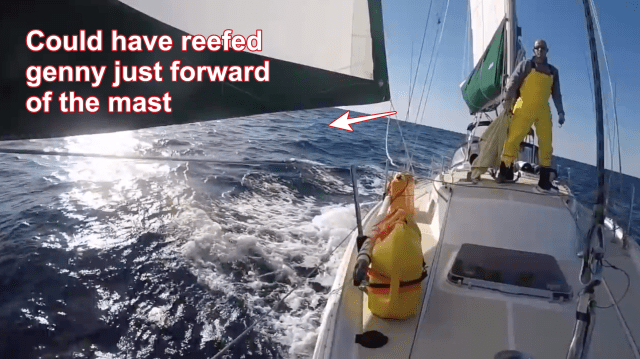
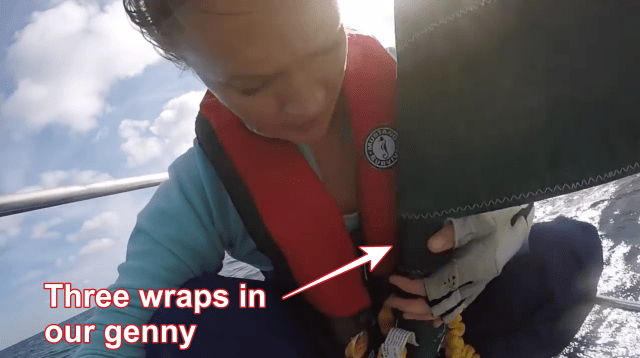
This was the first time we had hauled our Main sail down to the third reef.  We had our local sailmaker put a third reef in before our voyage to Cuba but we sailed that entire passage primarily under Reef 2 and that worked well.  Now it was time to re-configure the reefing lines in our boom to pull Reef 3 at the clew and we also used our Cunningham to pull the Main down taught to Reef 3 at the tack.  Thankfully, our previously-broken Cunningham was one of the items on our very long list to replace before we shoved off for the Bahamas.  It was not a piece of equipment we had used before as we’re not as much racers as we are cruisers, but good on Phillip as he added it to the list as a “just in case” and it proved invaluable here.  While you can always tie a reef down in the main sail manually with sail ties, it is very hard to conjure the muscle needed to fight the wind in order to hold the canvas down while tying a knot.  But, after 40 minutes of tugging, pulling and grunting, I was able to put a very flat, secure and satisfactory third reef in the Main.  Phillip and I then tugged, pulled and grunted and were able to put a very satisfactory second reef in our offshore jib.  This was very little canvas out, but our boat is not as heavy as other builds (Tayanas, Westsails, etc.) and she heels very easily in 15+ winds.  A steady 25 knots was the most we had sailed in offshore for an extended period of time.  But, with less canvas up, we were thrilled to see Lord Nelson was able to hold most of the time.  But, because he was still susceptible to the occasional one-two wave punch that would send our Niagara careening off the back of a wave then pulling speedily on the next one back to weather and overpower him, Phillip and I had to hold these shifts sitting attentively behind the wheel ready to grab at any moment as the auto-pilot lost its footing approximately 2-3 times an hour during these conditions.

Again, not too bad of a situation.  Many crews hand-steer all the time.  So we were still living in luxury land with an auto-pilot that held the majority of the time.  But, per onion theory, we had added one layer in having to maintain post behind the wheel with a constant eye to the wind and waves to allow us to grab the wheel and take over in the blink of an eye.  Also, the additional effort exterted to repair the auto-pilot, reef down the sails and move safely around the now pitching and tossing boat, I would say our increased exhaustion would really put us two layers thick.  A state in which remained all day as the winds held fast at 22+ and the waves built to a steady 6-8 feet, with the occasional 10-foot monster.

With that setting, cue my worst night shift on our boat:

We were tired.  Not exhausted but generally worn down from the rough day and both Phillip and I knew holding night shifts in these conditions was going to require even more attention and focus than the day had mandated.  But we settled in.  Phillip was up first as I crashed hard down below.  While it has taken us several years to build my sea skills and Phillip’s trust in my ability to single-hand the boat when needed, we are very much now an equal team.  Phillip and I maintain a two-hour night shift rotation when underway offshore and when one is holding the helm the other goes down for a very much-needed and often very-deep sleep.  I was so deep in mine, Phillip barely woke me when he clattered down below to clean up and shut the companionway hatch.  He said I just grumbled something incoherent and rolled over when he told me he had just been swamped by a wave and “about a gallon of water” had crashed down into the cabin.  Didn’t bother Off-Shift Annie.  She went right back down.  ZZZZZzzzzzzz.

But I would experience my own swamper.  Just wait.  For now, Annie you’re up to hold your first night shift in this mess.

Phillip and I had both agreed, that in these conditions, considering the pretty intense movement of the boat and our need to sit behind the wheel to take over each time Lord Nelson could not hold, that we would remain clipped in at the helm during our respective shifts.  So, I clipped in near the binnacle and settled in.  Our auto did great most of the time and I only had to take over a few times when a ten-footer would shove our bow violently to the east, leaving Lord Nelson shrieking in panic.  Holding the wheel in conditions like those is actually calming.  Pam Wall taught me this trick as she often tells her student sailors that when the seas feel rough and the boat feels out of control.  It’s kind of like riding shotgun in a very fast car on dangerous, winding roads.  It’s much more frightening when you’re not holding the wheel.  “Here, steer!” Pam will shout to her students.  “I promise.  You won’t be afraid at all if you hold the wheel.”  And it is so true.  It gives you a much stronger connection to the boat, her stability and her capability to handle those conditions.  For that reason, for most of that shift, I hand-steered as a means of maintaining focus and attention and a calm disposition in those conditions.

My first shift turned out to be fairly uneventful, albeit tiring.  However, when Phillip and I changed shifts, he (wisely having checked our battery state before coming topside) decided we should crank and motor-sail for a bit to give the batteries some much-needed juice.  On our boat we have a 450 hour bank, but we have always been told (and we always try to follow the rule) that you should not draw the batteries down below 50% to preserve their lifespan.  At that time, with the cloud cover that day and added energy drained by Lord Nelson’s impressive efforts holding the wheel, we had pulled off about 160 hours and, if we continued through the remaining six hours of the night without putting juice in, we would easily exceed our 50% mark (i.e., 225 hours off).  Hence the need to crank.  So, Phillip cranked and I fell deep into slumber.  That is, until I heard a piercing wail from the engine.  Not ten minutes after Phillip cranked, our Westerbeke 27A (“Westie” we call him) had overheated.  As you have probably noticed, we have names for most of the crucial systems on our boat because, trust me, calling them by name makes them fight harder in the clutch.  And we were definitely in the clutch.

I shook my head to try and flail off the fog of sleep, and unfortunately the first thing I saw, after I heard the loud beep, was the light indicating the bilge pump was going off.  A leaking boat and a faulty engine are not a combination you want to have on any boat anywhere, but especially not 100 miles from shore in some “stuff.”  That’s one too many onion layers for me.  I decided to wait to tell Phillip about the bilge pump light, though, until we handled our first emergency: Westie.  I checked around the engine, as Phillip manned the helm, for leaking raw water, coolant, etc. anything that would indicate our engine was struggling to cool himself.  Nothing.  We cranked again.  Waited and watched as the engine quickly came back to temp.  Phillip shifted into gear and not a few minutes later, Westie rang out again in protest, his temp needle quickly passing 180 and broaching 190.  Phillip shut the engine down, shaking his head.  We didn’t really have a good answer for it.  And, in the darkness of night, with most of our efforts geared toward handling the boat in those conditions, it didn’t seem we were going to be able to solve that particular puzzle right then and there.  We hoped the batteries wouldn’t drain to a life-threatening level before we could get sun once again on our solar panels and troubleshoot the problem the next morning in daylight.

I also then told Phillip about the bilge pump light I had seen go off.  “I saw it, too,” he responded.  I think both of us had momentarily withheld the information from each other hoping perhaps what we had seen hadn’t really happened, but now that we could both confirm it, it had to be true.  We considered the “rocky rolly water,” which on our boat is the water that accumulates in pockets unseen—we have yet to find them or find signs they are damaging anything in their accumulation, we hope and suspect it’s above the headliner—but it comes “rolling” out in various places only when the boat is “rocking” while underway.  Hence the name.  It’s a fairly harmless amount and, as I mentioned, we haven’t seen any deterioration in any critical area because of it.  Nothing like rotting our mast-step stringers or anything.  Ha!  What, too soon? ; )  And, while our boat is farily leak-free, it is not 100% in heavy rains and a heavy sea state and it’s likely it never will be.  There are just far too many tiny little screw holes and entry points to keep all water, when coming forcefully from all angles, out.  So, I checked the bilge.  The water was sitting below the top of our center keel bolt—a very low, non-alarming level—and didn’t seem to be rapidly increasing.  The bilge pump was also not going off frequently enough for either of us to even try to time it.  It must have been once every 45 minutes to an hour if I had to guess.  So, we attributed this, too, to a non-crucial issue and one we were similarly not going to be able to thoroughly investigate and solve in those conditions at night.  So, a little water intake and an overheating engine.  C’est la vie, for now.

After assessing the bilge situation, Phillip settled in to hold the rest of his shift and I headed back down below to indulge the rest of my sleep-shift.  The first few days of the voyage, and particularly during this 24-hour period, Phillip and I had been sleeping in full foulies as it took far more energy to get out of those nasty things than we needed to exert towards it.  And, if something were to occur topside that would require our immediate attention (a line chafing, a sail blowing out, etc.) it would be best if we were able to jump from the settee and immediately spring topside to handle it.  The loud crinkle and discomfort of sleeping in full third reef gear in no way hindered our ability to fall out of consciousness for two hours at a time, trust me.  Case in point: the minute my salty body crashed back on the settee I fell into a dead sleep.  When Phillip shook me to, I felt like it had been another mere ten minutes and he had unfortunately ran into another wake-the-crew-worthy problem right at the commencement of his shift.  Boy, was I wrong.

“It’s time for your shift babe,” he said as he continued to shake me.  I literally felt like I had been asleep for two minutes.  An hour and forty-five slipped by in an alarmingly-small spec of time.  As I sat up on the settee, I could feel that I was tired.  This was confirmed when I slipped on my pfd, dragged my body up the companionway stairs and sat down heavy behind the wheel.  It was going to be a long shift.  But we did have good news.

During his shift, Phillip had stolen downstairs on a quick calm spot to grab Nigel Calder’s engine book—the holy grail of diesel engine maintenance manuals.  If Nigel ever reads this (Ahhh!  Such flattery!), or if any of you out there know him personally, please send Nigel our forever thanks.  He has enlightened and saved us more than once out there.  Thank you Nigel!  Phillip is a great Captain and a tenacious student when it comes to our boat and her many complex systems.  He had spent the majority of his shift both watching the helm and reading Nigel’s book to try to glean some knowledge into why our seemingly fully-operable engine was overheating.  And, he told me he had read that sometimes in heavy conditions, i.e., big seas that pitch and toss the boat, the extra pressure and energy exerted by the prop to churn and propel the boat in those conditions can cause an engine to overheat.  Aha!  Phillip had potentially found our battery-charge solution.  Perhaps we could not put a load on the engine in those conditions, but we might could run her without a load (in neutral) just to put juice in the batteries.  This was the theory.  Cross your fingers.

Phillip passed the key up to me and we both watched wearily but eagerly as the engine roared to life and begin to increase in temp.  140.  160.  Then right up toward 180 where we always like to see Westie’s needle broach this point then do a little light hop back and hold just under 180.  Without shifting the transmission into gear and running Westie under no load, it did the trick!  Westie was purring and holding temp and our batteries, currently nearing 180 amp hours drawn off, were now getting a lifeline of juice pumping in.  Thankfully we also have a high-output alternator on our engine that pumps in about 70-80 amps/hour when the batteries are really low.  “Go Westie, go!” I whispered from the helm as he held full on during my shift.  So, things were looking up.  Lord Nelson was doing a fabulous job, again holding 90% of the time without so much as a squeal or complaint.  The sails were in excellent shape, holding flat and firm with the 23 knots of wind on our stern.  We were still tossing about in some pretty big seas, but the boat was handling it very well.  It seemed like I was going to have, all told, a pretty uneventful shift (considering our prolonged run in those conditions), but just when you start to think that, and you’re on your last 15-minute stint, that’s when it happens.

I was holding the helm, thankfully strapped in and thankfully attentive to our heading and wind direction in case I needed to grab the helm at anytime, when I heard it.  This thunderous crush of water over my left shoulder.  While visibility that night wasn’t ideal, the cloudy sky had obscured our ability to see the horizon and visually spot waves before they assaulted the boat, there was definitely enough light for me to see this monster.  I can’t tell you how big it was.  Maybe ten feet, maybe twelve, but she was crumbling and churning toward me, taller than the bimini.  I instinctively put my hands on the wheel knowing I would likely soon have to take over when she lifted our stern as if our boat weighed nothing and came crashing in over the stern rail.  I was astonished at how much water could come in instantaneously.

I was sitting just like this and where I had once been perched high and dry, now an entire bathtub of water sloshed, well up to my thigh in the cockpit. 

I didn’t have time to think about it though.  The wave had caused our boat’s stern to kick out severely to starboard as our bow jumped over to port.  The boat was turned now almost ninety degrees, with the other 8-footers behind her threatening to hit right at the beam.  Lord Nelson threw his hands up and screamed in revolt.  I clicked auto off and flung the wheel hard over to starboard watching for probably a good 5-10 seconds while the boat steadily charged her way back on course.  I was shocked to see when I finally had the boat back on course and could allot the mere seconds available to take my eyes off the compass to look around the cockpit and the water was still draining.  The cockpit was still filled up to my ankle which was propped up on the bench, serving as my brace for the heeling.

At that moment I had to just laugh.  What a wonderfully-powerful thing.  The Gulf.  To be able to completely fill the cockpit anytime she wanted to, but what a wonderfully-capable boat to take it, drain it and keep going.  It was just … uncanny.  While I can say it was a little frightening, sure, it was, but mostly it was thrilling.  And I’m not an extreme sports, risk-my-body-for-fun adrenaline junkie.  All evidence to the contrary with the silks and kite-surfing and all, I’m really not.  I ski very slowly because I worry about injuring my knees … again.  I don’t do silks drops because I fear injury or another wicked skin burn will result.  And, while I love to kite-suf, it’s rare I attempt the many and numerous ten-foot launches Phillip will throw down in one session because I’m afraid of busting an ankle on the landing or crashing my kite.  I’m never thrilled at the threat of bodily injury or a life-threatening adventure.  But this felt nothing like that.  We have a very capable boat and crew and while a rush of water in the cockpit isn’t ideal, it didn’t feel threatening in any way.  It was just … thrilling.

And Phillip cracked up laughing when I was reliving my whole “cockpit swamper” to him during shift change, trying to convey how much water had actually come into the cockpit, and he assured me his own swamper was “Waaayy bigger” because it had actually tumbled into the cabin below.  “Remember?” he said.  And I did vaguely recall him clattering around down there trying to sop up water and seal up the cabin while I was in half-zombie mode.  “Whatever, my wave was way bigger.”  It was kind of fun having a wave contest out there.

But, last fun event of this night shift saga.  I know, there’s more?  Of course there’s more.  The onion theory, remember?  We still have one.  Wait, no … two more layers to add on before this storm would let us out of its grip.  Toward the very end of my shift, after the cockpit swamper and after it appeared Westie had put in enough juice (not under load) to allow us to make it safely to morning on batteries with only about 90 hours now pulled off, I went down below to check our battery status one more time and then headed topside to kill the engine, which I thought would be nice for Phillip to at least have a shift where he didn’t have to listen to Westie’s constant rumble and—on top of everything else we were closely monitoring—also watch the engine temp to make sure it stayed at 180.  Ha.  Thinking.  I should just stop doing it out there.  The minute I killed the engine, I heard an awfully-dreadful noise.  An intense straining of some sort.  It sounded like cables perhaps being pulled against something they shouldn’t be or straining under too much effort?  I thought immediately of the steering cables and—for the first time since this troublesome night began—fear pulsed like electricity through my nerves.  If the steering cables were about to be sheered through, we really would be in some serious danger out there in 6-8 footers.  There would be nothing thrilling about waves that constantly thrashed and swamped us broadside eventually threatening to tip us if we couldn’t steer in them.

I immediately jumped up and begin toppling the contents of the port lazarette out to look at our steering quadrant and the steering cables.  As I did, the sound intensified which worried me more.  I didn’t want to be right on this one.  After a few minutes of content-spillage I was finally able to lean in upside down and get a look at the cables. They appeared fine but the sound was definitely coming from somewhere near the quadrant and definitely sounded steering-related as it seemed to intensify at certain times when Lord Nelson was working hard to get the boat back on course after a monster wave.  But the cables on port looked fine.

I spilled the contents of the starboard lazarette.  The cockpit was beginning to look like the front yard at Sanford & Sons.  I can’t count on two hands all of the stuff we fill in those lockers and it was scattered everywhere—our life raft, dock lines, bungee cords, our bail bucket, our fishing gear, snorkel gear, various hoses for washing the boat and deck, our grill, our wash bucket, a crate of cleaning fluids, you name it.  It was all splayed out on the cockpit floor and benches.  I crawled over all of it to drop upside down into the starboard lazarette and look at the cables on that side.  Thankfully they appeared fully intact, but the sound was even worse on the starboard side.  It groaned and shrieked out with each turn of the quadrant one side to the other.  I looked at the wheel stoppers, the pulleys for the cables, the saddles clamps that attached the cables to the quadrant, anything I could think of and then I saw it.  There on the back of the quadrant, the hind curve of the quadrant was actually touching the fiberglass brace that supports our rudder post.  The quadrant was, very vocally, grinding a notch into the fiberglass.  I hung there limply for a moment pondering the oddity of it.

That’s the kind of crazy stuff you can’t even dream up that occurs out there.

It was a problem I couldn’t fathom.  One we’d never thought would occur for sure.  One that just baffled me.  While I was a little relieved to know the steering cables weren’t shredding and tearing their way into pieces, the fact that the quadrant was dropping was not very comforting either.  What if it continued to drop?  What if the pressure became too much and neither Lord Nelson nor the crew could steer.  What if the rudder dropped right out.  What a crazy stupid thing to happen.  ”Holy crap!”  I kind of thought I was dreaming.

I popped back up to the helm and took the wheel to see what the pressure felt like.  Surprisingly it was almost imperceivable.  Almost nothing at all.  But you could definitely tell when the quadrant made contact because the squeaking grind would ring out and would hold while you went back and forth on that portion of the quadrant.  But, Lord Nelson was still holding just fine so it definitely wasn’t too much pressure for him, which was a good sign.  All told we had solved a couple problems and added a few more.  It seemed our onion was waxing and waning.  One other thing I saw when I was upside down in the starboard lazarette was a hole on the forward side of the fiberglass support for our rudder post.  Phillip later told me it is a packing hole.  Whatever it was.  I saw it leaking.  Not terrible, but definitely a little 2-3 driblet gush when the boat took a particularly-hard turn to starboard.  At least this provided some answer to our “Why is the bilge pump going off every hour?” quandary and, again, didn’t seem to be life-threatening.  Just a little gush every ten-or-so seconds.  “C’est la vie, for now,” I told myself as I headed down to wake the Captain.  Well … the other Captain (I can now say!  : ).

“Phillip, wake up babe, it’s your shift,” I said.

“What?  Wait … now?  It’s my shift already?” Phillip groaned.

Clearly he was suffering from the same I-just-fell-asleep-10-minutes-ago syndrome I had when he had woke me two hours ago.  Ha!  Get up babe!  It’s your turn.

“Yep, it’s your shift.  And the rudder is dropping and the boat is leaking.  Have fun!”

Aren’t boats great.  We did figure out that quadrant issue.  What a freak thing to occur, right?  We’ll share the very simple-but-odd solution soon.  If any of you know what happened and how to fix it, feel free to leave it in a comment below.

Next up on the blog – BV3: A New Breed of Geckos in the Keys.  Stay tuned!

VIDEO: 5 Days Across the Gulf of Mexico

Go offshore with us, followers! As Phillip and I sail our Niagara 35 five days across the Gulf of Mexico in some sporty bluewater conditions. This was one of our more intense offshore runs with 24 hours of 20-25 kts of wind and 6-8 (to sometimes 10) foot seas, but the boat and crew proved more than capable and we had a helluva time laying another 500 nm under our keel on our way to the Bahamas. We can’t wait to share the rest of the voyage with you through blog posts, photos and more fun videos! Hope you enjoy this first offshore leg! Buckle up! It’s one heck of a ride!

My First Delivery Request: a 1992 Catalina 28

“You are not writing about this,” was his only caveat, when Phillip and I agreed to do the delivery.  I knew I shouldn’t have given him a copy of None Such Like It when he was boat-shopping.  But, after the entire saga went down, he knew it was well worth telling the tale.  And, after an agreement to change some names to protect the … bold and brave, I was granted a writer’s exclusive.

Friends, followers, I’m excited to tell you about my first delivery!  And, I say mine, because while Phillip and I did help our buddy, Mitch, bring his Nonsuch from Ft. Myers up to her new home port of Pensacola back in June of 2015, I would easily say I was ranking First Mate at the time, nowhere near Captain.  Not that I am an official USCG Captain … yet (I’ve got just a few more documents to wrestle up before I can send my application to the Coasties), but the boys on this trip were kind enough to let me take more of the lead this time and humor me the title, Captain Annie, for this delivery.

And what a doozie!  As it seems they all are.  And, by that I don’t mean we were battling six-foot waves and thirty-knot winds in the Gulf (this time), because that’s not the kind of experience you have to have every time for it to be a good salty sea tale.  Besides, we all know what my biggest fear is anyway and it’s not out there in the big, open blue.  Say it with me … yes, docking!  That’s sh*t is scary for real.  What was important about this passage, and every passage we go on, is that Phillip and I encountered some situations we had never experienced before, learned some good lessons from it and found ourselves, as we often do, inspired by those we sail with.  In this case, we’ll call him Wild Phil Hickok!

Cue the Old Western whistle and cracking whip sound  *Whoo-psssh*

Wild Phil has been a long-time friend of Phillip’s and had been shopping for a few months for a good, reliable boat he could leisurely sail around Pensacola and to take the family (his wife and two boys) out to spend weekends on the hook.  He had focused on Catalinas as his boat of choice because he knew they were a trusted name and he liked the build quality, design and feel of the cockpit.  What he found was truly a gem.  A 1992 Catalina 28, reportedly in complete working order, down in Tampa (for less than $22k, I might add).  The boat was brought up to Carrabelle for the survey/sea-trial and when our very own Bob Kriegel with RK Marine Services here in Pensacola deemed her “above average condition,” we knew Phil would probably pounce on it.  Wouldn’t you?

It wasn’t long before Phil was inking the line and calling himself a proud new Catalina order and Phillip and I were soon enlisted to help deliver the boat from Carrabelle to her new home port of Pensacola.  Just as we did for Mitch when we were preparing to help him with his delivery, Phillip and I put together a pretty extensive provision and supplies list for Phil for the trip:

Yeah, I know.  A little over the top?  Well, there’s no harm in being over-prepared, right?  What did Phil think of mine and Phillip’s impressive  fore-thoughtedness?

Love that guy.  And, I really can’t tell you why booze is highlighted there.  My Mac must know we pretty well …

Following the recommendations of the surveyor, Phil had the marine service guys in Carrabelle do some work on the alternator and change the fuel filters while the boat was going to be there for a couple of weeks before he could come back to make the delivery. It was actually the same “Mechan-Eric” Phillip and I had hired to put in our new transmission after our first famous failure to deliver our own boat all the way home on the first try, and (way more importantly) he was the guy who approved my duct-tape and Dasani-bottle “catchment bin” to capture our leaking transmission fluid and pour it back in.


Ironic?  Not really.  There’s only one mechanic in Carabelle.  But it did bring back some very fun memories when we pulled up to Phil’s new boat and found it docked in the very same place ours was, just four short years ago, trying to make her own way home to Pensacola.

Phil’s Catalina, 2017:

Our Niagara, 2013:

It seemed Carrabelle was a rite of passage.  And while mine and Phillip’s adventure getting our Niagara home from Punta Gorda, FL—which included hacking off the flailing dinghy in the Gulf, having the old transmission eat itself alive, enduring a six-week separation while the boat was in Carabelle having the new transmission put in, only to have the new one leak little red tears into a Dasani catchment system that had to be dunked back into the engine every hour—was quite the experience, it honestly seemed like a little bit of nothing when we saw what Wild Phil had to go through before he finally got his boat home to Pensacola.  In just a few short days, Phil had already accomplished more feats and suffered more failures than many boat owners do … well, ever.  Phil was adamant about holding the helm, handling problems and getting as much experience as possible, good or bad, and I can easily say he’s now (just a week into boat ownership) done more than I have at the wheel.  So, kick back, buckle up, and let this tale begin.

The boys and I—Phillip, his buddy Keith, and our fearless owner, Wild Phil—set off for Carrabelle around 2:00 a.m. Friday, August the 11th.  These working stiffs had so much to do on Fri-DAY (and evening), we only had time to rest for a few hours Friday night before waking at 1:00 a.m. to drive straight to the boat and shove off at dawn on Saturday morning in hopes of getting the boat back to Pensacola by Monday mid-day at the latest so they could go back to work if possible.  Work …  At an office … Who does that anymore? ; )  A 5:00 a.m. Wal-Mart run to pack out the car, a nice sunrise drive, then a pack-out of the boat and we were ready to shove off around 7:00 a.m. Saturday morning.

What this did not leave us (and it was something I was little worried about when they told me the plan) was time to assess and scour the boat to really get familiarized with her and go through our spares inventory.  A lesson to myself later: I should have done this on my own right out of the gate.  On my next delivery I will, and I will probably make a “yacht delivery” checklist, so I am confident I, personally, know where all the sea-cocks and thru-hulls are (as well as the plugs), how to locate, check and fill all the engine fluids, whether there is water in the bilge (and note the level), etc.  But this time, I didn’t.  I unpacked the food, oohed and ahhed over the condition of the boat, chatted with the guys and took a selfie.  I’ll get better at this delivery Captain stuff, I promise.  Or hope, at least.  It really was an impressive boat, though, for the age and price.  Definitely Annie-approved!

Phil and his lovely wife, Pam, who was nice enough to shuttle us down to Carrabelle in the middle of the night.  As far as making the delivery with us?  She said: “You guys have fun!  I’ll see you in Pensacola.”

Little did she know, we wouldn’t quite make it that far … On the first try anyway.  Black crud, thick mud, and a sea tow stud are in store for you.  Stay tuned, friends, the tale of my first delivery will soon begin!


Captain’s Tribute

A little over 10,000.  That’s how many blue water miles I’ve racked up since I started sailing.  In preparing my Sea Service forms for my Captain’s License application, I’ve had to mentally trek back through my many offshore passages and day-sails to calculate the necessary “days underway” that I need for my USCG 6-pack, and it’s been a very fun journey.  In order to meet the USCG licensing requirements for a 6-pack, I was required to have 360 days on the water, with 90 of those days falling in the last three years and 90 of those days being in ocean or “near coastal” waters.  Luckily for me, the majority of my sailing has occurred in only the last three years so the first portion of that requirement was easy for me to meet.  (It actually shocks me some days to look back and see how much sailing I’ve done so recently.  When you look at the big picture, I really am fairly new to all of this.)

But boy did I take to it!  The day we splashed and re-named our Niagara, just three days after my 31st birthday, May 31, 2013.  With only 400 nm under my belt at the time.  What a ride it’s been!

If any of you are thinking about going for your Captain’s License too, you may be thinking: “What is considered a ‘day underway’ and what does ‘near coastal waters’ mean?”  Good questions.  According to my research and the folks at Mariner’s, a “day underway” is “at least four hours underway,” and “near coastal” waters means seaward of the boundary line.  The boundary line for the western coast of Florida, which is where I’ve done a good bit of my blue water sailing, is 15 nm. Unfortunately, I had not kept up with my sea time from the start.  I would have definitely done that if I had it to do over again because a) it’s humbling and rewarding to look back and reflect on prior passages and b) it’s good to keep up with your sea time in case you ever need to apply it for something like acquiring your captain’s license.  I would recommend any of you out there who may be thinking of getting some accreditation in the marine industry someday keep up with your sea time and have the captains you sail under sign off for you each time you complete a passage.  Here is the Sea Service form the USCG requires for obtaining any license.

You’ll see for each vessel, they ask your “average distance offshore.”  I’ll tell you it was a very cool moment when I was filling out the form for Yannick and I had to think … my average distance offshore during those 30 days across the ocean, had to be at least 1,000 nm+.  That’s wild but so exciting!   I have also since bought a log book so I can do a short, one page write-up on each of the passages I have made, the dates, nautical miles, destination, and one or two memorable moments from the passage.  It’s fun to go back through when I’m feeling nostalgic—or just a little too landlocked—and let my memories take me back to blue waters.

Sunrise on our way to Cuba, December 2016.

It’s been an enlightening, educational and humbling process going back through all of my sea time and reflecting back on those passage.  In doing so, I thought it would be fun to share with you all, the many lessons I have learned from the many captains I have sailed under, the primary being my person, my partner, my forever adventure buddy: Phillip.


Captain Phillip

Where to begin …  To the man who—when I come barreling out of a slip at 5 kts and almost take out three boats with both my bow and stern—will say: “It was my fault, honey, I should have … ”  Phillip has had such patience with me from the beginning.  And because we were both so new to the liveaboard cruising lifestyle, it has been so much fun to learn, try, screw up and grow together, both of our hearts 100% invested in each other and our beautiful, frustrating boat.  The greatest lesson I have learned from Phillip is that no matter how hard, or trying or scary any aspect of cruising may be—from running aground, to docking debacles, to discovering you have rotten stringers—it will always be easier, less frightening and more fun to tackle when we do it together.  To my forever buddy and the many more adventures, mishaps and lessons we have in store.  Cheers!

March, 2016: Our first time (and drink – thanks B!) out on the hook after three months, re-building our rotten stringers, re-rigging and conquering about 1,000 other projects at the yard.  Ahhhhh …..


Captain Kevin

Kevin has been on this journey with us from the start, from our first boat-shopping days to the purchase of our 93.46% perfect boat and he taught us so much along the way, particularly on defining our cruising goals and how we really want to spend our time on the boat.  The best thing I learned from Kevin?  “Just shove it out.”  A great de-docking technique that will guarantee no wayward backing or unwanted collisions.  Fun video for you here from one of our day sails with Kevin aboard his stunning Pearson 36 cutter, Pan Dragon, where Kevin demonstrates this super simple, never-fail trick.  Just shove it out!


Captain Brandon

“Go slow, hit slow.”  The best thing Brandon ever taught me?  Only go the speed at which you’re willing to crash into something.  That’s a good lesson.  We also learned a thousand things from Brandon during our time at the shipyard, one of the most important was: Always label anything you take apart, so you’ll know exactly how it all goes back together.  That way you won’t have to, you know, re-step your mast just to flip a stupid little aluminum plate ninety degrees.  That was fun.  But, one final, very important lesson from B: How to dock under sail.  “Because what you are you going to do when your engine goes out?” Brandon asked as he shamed us into finally, for the time, docking under sail (fun video of that adventure for you here).  And, notice he said “when” not “if.”  Because it’s going to happen.  It’s a boat, right?  Thanks for everything you’ve done for us B.  Cheers!


Captain Mitch

Mr. While You’re Down There!  Lord, did we have a time with him bringing our boat home for the first time from Punta Gorda, FL to … well, as many of you know, we didn’t make it all the way to Pensacola the first time.  We only made it to Carabelle, minus a few essential boat parts.  (And if you don’t yet know that story, holy crap, go get yourself a copy of Salt of a Sailor stat!)  One of the most memorable things I learned from Mitch?  Sight sailing.  Or, sailing by the stars as I called it.  Mitch taught me how to sail at night not by straining your eyes at the compass or the GPS but by getting on your course, then putting some part of the boat (a stanchion post, the spreader tip, the clew of the sail, anything) on a star and using that to hold your course.  It was a fantastic revelation and one that made me love sailing at night that much more.  Thank you Mitch.  Oh and “While you’re down there, could you get me some curly fries.”  Mitch.  There’s just none such like him.  Fun video for you here of his Nonsuch 35, aptly named Tanglefoot.


Captain Ryan


The ambassador of offshore sailing adventures at SailLibra!  What does Captain Ryan say about sailing across the 500+ plus, sometimes gnarly miles of the Gulf?  “Easy stuff.”  As long as you don’t panic, you think first and act second.  After several fun, windy romps across the Gulf on his offshore adventure boat, Libra, I definitely learned from Ryan the art of staying calm.  Even when sailing through the narrow, reef-lined inlet to Cuba in 10 foot seas and 25+ knot winds.  “Easy stuff.”  But, he’ll be the first to warn you: “Oh, if I’m panicking, yeah, you should totally panic.”  A good sense of humor.  That really helps out there too.  Fun video for you here from mine and Phillip’s sail from Key West to Pensacola on Libra.


Captain Jack

Jack Stringfellow.  I swear that’s the man’s real name and wasn’t he destined to be a captain with that one?  I’ve only sailed under Captain Jack one time but, to date (and to be honest I hope it stays that way) it was the most extreme conditions I’ve ever sailed in.  From my recent Captain’s exam, I know it ranks a 10 on the Beaufort scale.  We sailed two days on a Leopard 48, into brutal headwinds, topping out at 43 true, 48 apparent, but the boat and crew handled it beautifully.  What did I learn from Captain Jack?  He’ll be the first to tell you, Jack can get a little … wired.  He’s a very Type A personality, very task-oriented and very (very!) energetic.  It’s one of the things that makes him a great captain, but he also taught me the importance of the need for a “safe word.”  Because everyone gets a little wound up at times.  His safe word?  TRANQUILLO!  Fun video here from our very windy delivery of the Leopard, a 400 nm, 60 hour sprint across the Gulf, Pensacola to Naples.  Whew!


Captain Ben

I can’t wait to get back to the Bahamas!  But I’m so glad I went when the opportunity struck.  Remember this trip?  My spur-of-the-moment jaunt off to the Bahamas to sail with Ben Brown on his 47’ Beneteau, Cheval, in the Abacos Regatta in 2015?  What a fantastic adventure that was.  And what did Captain Ben teach me along the way?  The beauty of Bossa Nova.  You see, Ben is a long-time musician.  A sax player, and a fantastic one at that.  He played for the Cheval crew several times during my trip and it was the first time I was ever serenaded on a boat.  I found music and the water go together.  Almost like they’re one in the same.  Now, even when there’s no music playing, when I look out on the water gracing our hull, I hear music.  Thanks to Ben, it’s often Bossa Nova and more often than not it’s the song Ben played for us that morning on Cheval — “When she walks, she’s like a samba, that swings so cool and sways so gentle … ” Can anyone name that tune?


Captain Yannick

“Don’t tell me I did a good job, if I didn’t do a good job.  If I f&*cked up.  I need to know.”  Love that man.  Captain Yannick.  Our fiery French captain across the Atlantic freaking ocean.  He was so driven, so focused, so phenomenally energetic (working on boat project after boat project, day after day across the ocean) and such a diverse, eclectic personality.

I’ll bet you didn’t know: Yannick was a film student, a fighter jet pilot, a desert race marathon runner, even a published author and a raging Daft Punk fan.  His was an incredible and surprising friendship to form out of our 30 days across the ocean and he still texts me often, just to say “WHOO!  HOO!”  The most important thing I learned from Yannick was confidence.  If you have something to contribute, speak up and say it.  Don’t use your “recommendation voice.”  And, like much of the French do, which I appreciate: Don’t placate.  If a crew member fails at something, placating them by telling them they did a “good job” is not going to help them improve.  A very bold, hearty sailor he is and Phillip and I will be forever grateful for the opportunity Yannick shared with us in letting us sail with him 4,600 nautical miles across the Atlantic Ocean.

To all the captains I have sailed under and learned from: Thanks for the lessons, the laughs and the many-invoked Annie “Whoo Hoos!”  But, mostly, to the man who made this entire journey of mine possible.  From completely ignorant second mate (more like deckhand) on our very first sail across the Gulf together, to now an ocean-crossing, aspiring captain, the sailor who has inspired me, challenged me and encouraged me every step of the way.  I can’t wait to sail the rest of the world with you my love.

April 3, 2013 during the survey/sea-trial of our Niagara.  Where it all began.

Top 5 Lessons from Sea School

Ahhh … Sea School.  What a great experience.  It was five full days of classroom and hands-on training primarily on how to respond to emergencies on-board a vessel but also personal safety, emergency medical response and how best to prevent emergencies in the first place.  Phillip and I went to the Sea School in Bayou la Batre, Alabama.

You actually stay there on the “campus” for the course, sleep in dorms (no co-ed … doh!) and eat three square meals cooked daily in the kitchen.

Total cafeteria style food, but it’s perfectly edible and fills you up.  The whole set-up really starts to make you feel like you’re on a ship with fellow crew mates, sharing chores, clean-up, meals and plenty of sea stories during every break.  Many sea school graduates have also left their mark or insignia on the block wall that leads to the classrooms.

Lookie there.  Annie Girl!  And a nanner!

And while I’ll admit, many of your days look like this.  Eight hours of classroom lessons with a quiz at the end, and it seems hard sometimes to just stay awake …     ZZZZZzzzz

Some days look like this!  Yowza!

In all, it was a great balance of hands-on versus book learning lead by some great instructors.  While Phillip and I learned a TON, I thought I would share here five of our favorite takeaways from STCW training at Sea School:

5.  First Aid and CPR

I’ll be the first to admit, I had NO first aid training prior to this course.  While I had a general idea of how to administer CPR, I learned in our first aid class that things have changed and the approved method is now different.  Rather than 15 chest pumps followed by 2 breaths, they now recommend 30 pumps followed by 2 breaths.  We also had a very knowledgeable and insightful instructor for this course, Vietnam veteran (26 years in the Navy) and career firefighter (24 years with the Mobile Fire Department) Karl Ladnier, who opened my eyes to the reality of the force needed to correctly administer CPR.  He told us with the first few chest pumps you’re going to feel some “crackles.”  He said this was the cartilage breaking up.  That would be followed by more cracks which likely meant you were breaking the patient’s ribs, and you know what he said: “I’d thank anyone who broke a few of my ribs to save my life.”

Here is a photo of Karl during our firefighting training.

You cannot be timid, Karl said.  CPR requires a lot of force or it will not be effective.  We also learned what the true purpose of CRP is.  While the hope is it will revive the patient to full thriving order (like it does often in the movies), the reality, as Karl explained it, is that that rarely happens.  Only in a very small percentage of the cases does the administration of CPR itself bring a person back.  Rather, the CPR is much like putting the patient on a “machine” where outside forces are physically pumping the body’s heart to move blood and blowing in air to maintain oxygen, simply to keep the body alive, but the minute you “pull the plug” or stop CPR, the body will go immediately back into cardiac arrest.  Most times the CPR is only intended to prolong the period of time in which shock from a defibrillator machine might save the patient.  And, this is only if the CPR is administered within the first few minutes after the cardiac arrest.  You see?  All good, true, eye-opening things to know about something I thought was quite simple and often saved lives.

A snapshot of Karl teaching us in class.  (You weren’t really supposed to have your iPhone with you in school so I had to sneak it … Shhhh!)

4.  Firefighting!

Boy did Phillip and I learn a TON in this section of the course.  I had no idea there were different types of fires (Class A, B, C or D) that each call for different types of extinguishers.  I’ll admit, I thought the canister fire extinguishers we all have on our boats were designed to put out any fire.  But, it turns out, the fuel source of the fire can have a great impact on what agents will actually extinguish it and what agents may only feed it further, spread it or cause you more danger in trying to put it out.  For instance, if you were to use water or even a foam fire extinguisher on an electrical fire, you could inadvertently shock yourself because both water and foam conduct electricity.  Also, using water on a flammable liquids fire can splash the burning liquid and spread the fire to areas that were not yet ignited.  Who knew!

I can tell you this newbie firefighter didn’t.  

After spending a day in class learning about the different types of fires and the different types of extinguishers that should be used to put them out, as well as how to administer them, it was time for a field day!  Off to the fire hut we went to enter a burning room (a repurposed cargo container) in thick smoke and heat up to 800 degrees, with oxygen packs on to learn how to spray a stream of water to put out a fire.

That’s Phillip in his suit there.  He actually had an issue with his oxygen hook-up and was without air for close to a minute.  But the ever cool Marine in him didn’t panic and handled the situation perfectly. 

And there he goes!  Off to fight the fire.


Okay, it’s clear I was having a great time donning all that hefty gear.  I mean, learning is allowed to be fun, right?  I pick July for the FireGals calendar!  Smokinnnn’

What we also learned during this exercise was how to properly walk up to and away from fires and effectively attack the fire to make sure we wouldn’t spreading the fire to more places or put ourselves in the center of a burning fire holding an empty extinguisher.  It was surprising to see how short-lived these extinguishers were.  Some only 17 seconds.  That can be a long amount of time if you know how to effectively approach a fire, but a very short time if you don’t, then you find yourself in the heart of the fire with no more extinguishing agent to use.  We also learned a very valuable lesson to never turn our back on a fire, because you never know what it might do.  This was a hard one for many of us to remember.  Here is a great video showing some of our exercises and what the instructors were teaching us:


And, I can report only one small, teensy burn from this training.  (And I, of course, lucky Annie, was the only one to get burned, but I was honestly kind of proud of it.  Look at that hideous thing!  I hope it leaves a little scar. : )

3.  Launching, Righting and Entering a Liferaft

Liferaft training was one of the primary reasons Phillip and I signed up for Sea School.  To really get a feel for the liferaft.  Phillip and I purchased a 75-pound 4-person liferaft in a soft pouch (not a valise or canister) which we keep in our port lazarette when we sail offshore and had read a lot about them in making that purchase (and great article from SAIL Magazine for you all here on how to choose the best liferaft).  But, Phillip and I have never actually deployed our liferaft or practiced getting in, out, righting it, etc.  So, the training at STCW was invaluable in this aspect.  We learned in class how to launch the liferaft manually or using the hydrostatic release.  How to cleat the painter line to secure the raft to the boat during deployment and also how to manually inflate the raft and enter the liferaft safely from the vessel.  I also learned each life raft’s painter line is manufactured with what is called a “weak link” that is designed to break under a certain amount of pressure if the raft is still connected to a sinking vessel (so the raft won’t go down with the ship).  Good to know.

In the pool, we practiced getting in and out of the liferaft, which can be a more physically straining than you realize, particularly considering you will likely already be pretty exhausted at that point, and how to right the liferaft by using the handles on the underside and standing on the side of the raft.

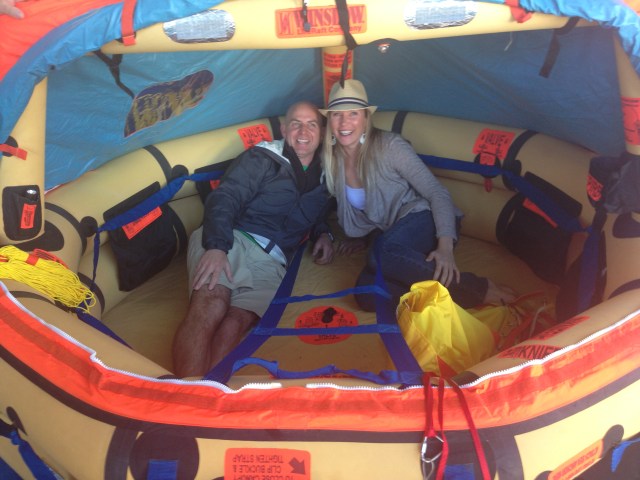
This is the 4-person raft we used during our pool training:

So liferaft learning.  Check!  I’m hoping if Phillip and I ever have to use ours, we’ll look this chipper and dry when we get in.  What do you think the odds are? ; )

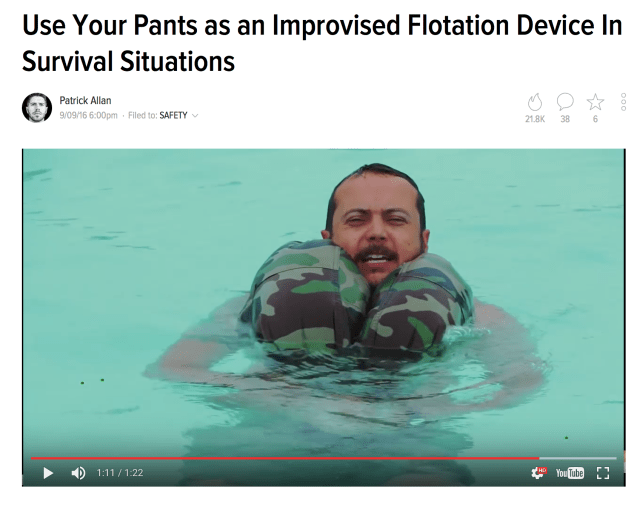
2.  Using Your Pants as a Floatation Device

This was definitely my favorite take-away from STCW school, probably because I didn’t think it would actually work and I was shocked to find how well it did in fact work, and how easy it was to do.  While you can do it with a long sleeve shirt, too, by holding the neckline tight around your face just under your nose, breathing in through your nose and out (into the shirt) through your mouth, the shirt method was more difficult and more tiring than the pants.  The pants trick is a great resource for anyone who voyages often offshore and may someday find themselves treading water without a floatation device for God knows how long.  So … the method:

I found a good post and video for you here demonstrating the technique.

While this guy uses the method Phillip said he learned in the Marines, that is flipping the pants over your head to scoop air in, the method we learned in STCW class seemed more efficient with less use of energy.  (It can be a bit harder than you think to tread water and effectively flip wet pants over your head to capture air, particularly when you will probably be pretty exhausted by that point already.)  Rather our instructor had us put the pants, deflated, around our neck, hold the waistline opening under the water with one hand and scoop air down into the water and into the waist opening with the other, while the pants are already in place around your neck.  This proved to be a much easier, quicker method, particularly for the necessary periodic refills.  I was really blown away by this trick.  It can get very tiring treading water and this is a fantastic way to use something you probably already have on your body to give you much-needed rest at a time when you are probably tired, a bit panicked and in need of a moment to just float and assess your situation.  One other tip we learned: shoes will really weigh you down if you’re treading water.  They should be the first to go, BUT pull the laces out of them first as those may prove very useful for tying or fastening things later.

1.  The SEA STORIES

As Karl, one of our favorite instructors put it: Stories start one of two ways, “Once upon a time,” or “This ain’t no shit.”  Pardon my French but I think that accurately captures it.  This one, Numero Uno on our list, was actually Phillip’s pick.  One of his favorite takeaways from our week in Sea School were the Sea Stories.  Most of Karl’s stories fell in the “no shit” category.  It seemed for each teaching point in the book dealing with how to attack certain types of fires, how to check a hot door, how to approach an injured victim, on and on, Karl had a real-life personal firefighting story that would make you shake your head in disbelief but put some real life experience to the lesson to really make it stick.  After twenty-four years serving as a firefighter, he had clearly racked up some stories.  He told us about crazed people who had pulled a weapon on him, sad children who went back in to save their dogs and never made it back out, fellow firefighters who had made simple but grave mistakes, and of course some very funny stories as well.  The best one involved a beautiful topless woman and a request that he help hold up her chest.  I won’t repeat the details here, but trust me, it was rich!

Many of our fellow students also had some wildly bizarre stories to share as well.  One was a long-time tug boat captain who had dealt personally many times with fires aboard the ship, a breach of the hull, fouled props, failed engines, you name it.  It seemed everyone had so much to contribute in the way of real life experiences.  (Thankfully  we had a few too from our voyage across the Atlantic Ocean, that were fun to share.)  One, however, that our personal safety and pool instructor, Larry, focused on in discussing the design elements and equipment in the liferaft was Adrift.

Have any of you read or heard about this book?  Steve Callahan survived 72 days at sea in an inflatable liferaft and he shared his harrowing tale in this sobering book.  It really is eye-opening.  Larry, our instructor, also told us of another recently confirmed survival story about a guy who floated in a fishing boat from Mexico all the way to the South Pacific, spending 438 days and drifting over 7,000 miles at sea.  It’s unreal.  But it is also very real.  What we learned primarily from this course is how to deal with emergencies, yes, but primarily how to prevent them at the outset, how to follow procedures and safety precautions designed to ensure you never have to deal with an emergency in the first place.  But, if Phillip and I ever do find ourselves facing an emergency out there, I’ll at least know we have a good working foundation to initiate the best response in light of the situation.  For anyone thinking about preparing for extensive offshore voyaging or, in particular, working in the maritime industry, this would be a great foundation for your training.

You’re looking at two fiery grads here.  Five days at Sea School.  Done.

Good Stress

It’s actually called eustress.  Have you heard that term?  I first saw it in Timothy Ferris’s Four Hour Work Week.  Definitely an exciting, kick-in-the-keister read if you’re looking for a book to make you rethink and reform your work habits.  But, I remember seeing the word for the first time and having one of those Aha! moments.  Ferris opens the book with a scene where he is preparing to perform in an international tango contest.  He is nervous, anxious, scared, excited—many of the same emotions we feel when we are stressed—but he is feeling them for a good reason.  Because he is doing something exciting and challenging.  I remember stopping mid-sentence on the word, snapping my head up and laying the book in my lap.  Eustress.  What a great concept.  It is a form of stress, in that it is exciting, it makes you a little frightened, a little anxious or worried, but it’s good for you.  It’s invigorating and healthy.  That is what I am just now learning cruising can be.  Good stress.

Actually a recent article in Cruising World (Good ole’ Fatty, does it again) inspired me to write this post when one particular line stuck me like a harpoon.  Cap’n Fatty was quoting a female sailor who had, like his daughter, grown up on boats, but who was just now starting to learn how to actually handle, maintain and sail her own boat and she said: “I felt like there were a thousand decisions to make.”

That is exactly how it sometimes feels when you’re living aboard cruising.  Deciding which weather window to seize, which route to take, which port to go to, when to reef, when to fuel up, where to provision, when to make repairs and how best to make them, where to moor, when to leave.  Then it starts all over again: which weather window to seize, which route to take, which port to go to …  On and on.  It can sometimes feel overwhelming making all of the decisions necessary to keep a boat and crew in good running shape and actually cruising her around different parts of the world.

A big part of mine and Phillip’s decision for me to go for my Captain’s License this summer was the goal that I not only become a better sailor and boat owner, but also a much more helpful mate and partner for Phillip.

Since we bought our boat in 2013, I will be the first to admit, I have been lazy.  I have.  I have relied on Phillip to handle the helm 100% of the time, to make all of the decisions about when we would leave, where we would go, which ports we would stop in.  All of the navigation and weather decisions I left to Phillip.  He would occasionally run things by me, probably more as a matter of courtesy than anything, because I didn’t have the knowledge to actually help him make the right decision.  (Although we all know there is no “right” one, only that an un-made one is the wrong one.)  But, this last trip in April/May, when we brought our boat back up from the Keys, I was infinitely more involved and I felt just like that gal said.  Like there were a thousand decisions to make.

Phillip and I watched the wind graphs and radar the days before leaving and decided when was the best time (both which day and what time of day to ensure arrival at the next port in daylight) to leave.  I pulled the boat off the dock.  You all remember that harrowing, heart-pounding moment.  *gulp*

Together, we planned the route together from Stock Island across the Gulf Stream, into San Carlos Bay to Ft. Myers Beach.  I was at the helm when we snagged a mooring ball there.  While at Ft. Myers, we assessed again the movement in our rudder post as we had noticed still some slight movement starboard to port in the rudder during our passage up and Phillip and I talked at length about the best temporary fix as well as the possible permanent fixes once we got home to Pensacola.

After Ft. Myers, we decided our next stop would be Cayo Costa, a national state park north of Captiva and a place we had never been to before.  We had been told by fellow cruising friends that it was a beautiful, secluded spot but a little “tight” coming in.  Meaning, we would have to navigate carefully around the shoals to find enough depth, a decision which also required us to watch the tides and try our best to time our entry during high tide.  Decisions, decisions.

I was at the helm when we pulled into Pelican Pass and I recall how stressful it was, watching the depth gage and trying to steer my way toward depth without knowing whether the shoal was on my port or starboard, or dead ahead, much less which way to turn to find deeper water.  I think we got down to 6.5 at one point and I found that’s not a number I like to see on the B&G.  And, the big lesson learned there: If you pick your way into an anchorage, lay down a freaking track on the B&G so you can pick your way back.  We ended up getting into Cayo Costa just fine but it was a mutual half-educated, half-guessing game and it was stressful.  But the good kind.

And well worth it.

And, the most important part was, Phillip and I were actually now doing it together.  I suddenly saw all of the work and thought and research and worry he put into all of the passages and trips we had taken before while I did not.  Sure, I’m a hard worker and will help with any sort of manual labor aspect of cruising, but it instantly dawned on me how little mental effort I had been putting in while Phillip had taken on the lion’s share.  For the first time I appreciated all that he had been doing.  And, Phillip, for the first time, appreciated having a true, equal partner.  Someone to help carry the mental load, to talk through all of the variables and possible outcomes and help make those thousand decisions.

We need challenges in our life.  Things that frustrate us, cause adversity that we must overcome and make us feel alive.  Captain Yannick, in fact, chose to bear down the very difficult path of buying, maintaining and sailing a boat across the Atlantic Ocean so he and his family could move aboard and go cruising as a means of keeping himself occupied and stimulated after retiring as a Navy fighter pilot.  While I’m not sure cruising can ever be quite as stressful as re-fueling a fighter jet mid-air, I do believe there were moments during our Atlantic crossing that pushed Yannick to his mental limits.

But it is much more rewarding to worry and stress about something you are passionate about and love to do, rather than something you don’t like or even dread doing. I remember worrying myself sick over motion deadlines, asking the wrong questions in deposition, disappointing my partners.  I was an absolute stress bomb.  Twenty pounds heavier, out of shape and shoved into pantyhose every day to go sit and work and worry in front of a computer all day.  Bad stress will kill you!

Cruising stress, good stress, I can assure you, will not but you should fully expect to feel worried, scared, anxious and nervous at times.  I guarantee you will feel very much alive.

And while I do still worry sometimes about disappointing my partner, now Phillip.  It seems as long as I keep trying, I never do.  We now make all of our cruising decisions and mistakes, together.

Captain’s School: Conquering Fears

“I figured that was the best reason to do it.  Because I was afraid to.”

This was something a very good friend of mine told me years ago.  (Sonnie, if you’re reading this, thank you!)  She was talking, at first, about starting triathlon training because she was afraid to swim long distances, but she found the principle so inspiring she applied it to many other “obstacles” in her life—becoming a single parent, moving to another state, starting a new job—and she succeeded in all of them.  The theory always stuck with me.  So simple.  So true.  If you’re avoiding doing something you want to do because you are afraid, that is the very best reason to do it.  Conquer your fears!

That’s what I am doing this summer.  As many of you may have seen in the announcement at the end of my most recent YouTube video, I will be joining in the Pensacola a la Habana race this April with SailLibra in order to get more days on the water for a goal I have set for myself this summer.  While the big goal is to get my Captain’s License, the bigger accomplishment I seek to achieve is to get over one very big fear I have had for a while.  One I have had for too long.  It frustrates me, frightens me and makes me want to do just as Sonnie said: Do it because I’m sick of being afraid of it.

What am I afraid of?

Steering the boat.  Not so much when we’re out there in the big blue.  (There are many, hundreds, of reasons why I love offshore sailing, but one is … there’s not many things to run into out there.)  And not so much when we’re on a steady tack and just holding a heading.  But I am terrified of steering our boat in and out of the dock, through tight channels and around shoals and other obstacles.  I have a huge fear of crashing her into pilings, other boats, rocky bottoms, big concrete sea walls.  I’m seeing this all in my mind as I write this, just as I always do when I think about docking our boat.  And, that’s awful!  I want to travel the world by sailboat.  I want to go cruising!  While it’s great that Phillip is an excellent helmsman and I’m a pretty kick-ass First Mate, I shouldn’t let that fear get the best of me.  Something could happen to Phillip.  He could fall overboard.  Become incapacitated.  Or heck, maybe I will want or need to single-hand at some point.  Just to give him a break or because, whatever, life happens.  Some of my very best friends are single-handed female sailors because their husbands passed away immediately and unexpectedly and they inspire me to no end because they still get their boats out and go.  (Bridgette, Pam, I am so proud of you!)  All of that to say, you never know what the future holds and there is no excuse for living in fear.  This is the year I conquer my fears.

So, this summer Video Annie is going to sea school!  We’re focusing on education, training and, most importantly, sticking Annie behind the wheel.  Even when she’s scared.  Even when the boat is nearing the bock.  Even when it’s a difficult situation and she wants to throw her hands up and have someone else take the wheel.  Captains Randy and Ryan with SailLibra have been gracious enough to offer me time on their day charter boats (an Irwin 37 and Beneteau 35) while our Niagara is still down in the Keys.  Phillip and I are planning to bring her home in April and I’ll plan to take the helm the majority of that trip and our many trips this summer.  I am docking our boat dangit!  And then I’m de-docking it (Annie term) and docking it again.  I’m sick of getting this nervous knot in my stomach every time I take the wheel.  I want to look like this behind the wheel.  All kicked back and confident.

“Yeah buddy!” my Dad would say.

While the helm work is the pinnacle for me, Phillip and I also want to increase our training and education.  We have signed up for an STCW class (Standards for Training, Certification and Watchkeeping) in April and I will also begin Captain’s School in May.  After counting my days on the water (I can’t believe I have racked up so many in just over three years!), I only need a few dozen more to be able to apply for my license so I will be gathering Sea Service Forms and all of the other elements necessary to apply.  While I am excited and will be so proud to obtain my Captain’s License, it is all part of a bigger goal to become a more educated, knowledgable and a confident sailor.  I will be way more proud when I pull our beautiful Niagara into the slip and dock her all by myself.  Then de-dock and dock her ten more times in a row not because of luck but because I know how and can do it in all kinds of conditions, comfortably and confidently.  That is a day I will be incredibly proud.

So, my time has come.  I’m going to push myself and bring guys along for the ride.  Watch, learn and grow with us.

Step aside fear!  And give me that helm!

#93: Cuba Voyage Finale: Gulf Stream Crossing and Landfall in Cuba

The current of the Gulf Stream is no joke, particularly when it is pushing you into head winds.  Watch as we reef up and cross a pretty kicked up sea state across the Gulf Stream, sing to our first Cuban sunrise, deal with an issue with the furling gear on our headsail, navigate the entry to Marina Hemingway and make landfall in Cuba.  HaveWindWillTravel is traveling this year!  There’s a great Patreon update for you as well in here as we will soon be getting a video update from each of our previous Gift of Cruising winners and get ready to give our 4th gift away — a 100% free offshore voyage on SailLibra at the $500 reward level.  WHOA.  Become a Patron to be eligible to win and help us create cruisers out of each and every one of you!  Hope you all are enjoying the journey to Cuba.  We can’t wait to share that beautiful, culture-rich country with you.

How to Reduce Heeling

We’re not perfect sailors, we just are sailors because we have a sailboat and we get out and go.  We don’t have any piece of paper or certificates that even tell us we can sail.  We just do, which means we sometimes do it imperfectly.  And it seems we certainly did on the way to Cuba, as we received many comments on our sail trim in response to “Heavy Heeling” video, which is great.  Most were very helpful, dead-on and worth sharing.  Particular thanks goes out to our good friends, Kevin, our broker with Edward Yacht Sales who helped us find our beloved Niagara (a match made in heaven!) and Brandon, our trusted yacht repairman with Perdido Sailor, Inc., who rightfully gave us some much-deserved ribbing after watching our last video and then some very helpful sail trim tips that I felt were definitely worthy of passing on to you all.  That way when YOU set sail on your own bada$$ voyage to Cuba or elsewhere, your sail trim will be primo!

While our sail trim in the last video wasn’t terrible (as the sails were balanced enough for auto to hold and the boat was performing very well), there is always for improvement.  Here’s what we could have done better:

1.  Flattened the Headsail

belly

Brandon was quick to point this out.  “You have got to flatten the sail in head winds,” he said.  “The flatter the sail, the less you will heel.”  And, I’ll be the first to admit this is a little hard to do (just for me personally) because you have to really crank on the winch, until your genny sheet is as stiff as a guitar string.  The lines on the winch will scream and yelp, and you’ll think something is probably about to break, but you’ve got to make yourself do it to truly get the best sail shape.  It also helps to turn up into the wind for a short time to let some wind out of the sail while you crank her in.

2.  Moved the Genny Car Back

car

This definitely would have helped us pull the headsail taut and get a much flatter shape.  This also would have helped us point upwind better, too.

3. Furled the Genny More

mast

We have a 135 genoa, so she is pretty big and comes back (when fully out) almost to the dodger, which means, we’ve got a lot of furling to do when we really want to reef her in.

3-wraps-in-genny

We had about three wraps on the forestay during the “heavy heeling” footage from our last video, with the genny out to a point about a foot or two aft of the mast.  It probably would have served us better that first rough night and morning to have reefed her just forward of the mast (probably two or three more wraps) the evening before at sunset.  We did that later, toward the end of day two of our voyage and it was more comfortable.

4. Run Our Reefing Line on the Clew of the Main Down to the Boom

clew

Kevin pointed this out to us and it was a definite “Aha!” moment.  If you recall, Phillip and I had dropped the main when we were preparing for this voyage to have our local sailmaker, Hunter Riddle with Schurr Sails, put a third reef in our main.  I showed footage of us in our “Heavy Weather Planning” video re-running our reefing lines when we put the main back on, and it turns out Phillip and I had done it wrong.

clew3

When Phillip and I did it, we ran the reef lines for Reef 1 and Reef 2 of our main at the clew from the end of the boom straight to the respective Reef points in the sail and secured it with a bowline, not recalling exactly how they had been run before.

clew4

As Kevin pointed out, we should have taken each reef line, gone through the grommet for the reef point and then run it down to the boom and secured it with a bowline to the boom.

clew2

That would have enabled us, when pulling our Reef 2 at the clew line in the cockpit to pull the sail both aft and down at the same time, instead of just aft.  Thanks Kevin.  We will be re-running those before we go offshore next time.  That will also alleviate the need for the additional strap that we affixed from the clew to the boom during our voyage to Cuba.

5. Pulled the Reef Down to the Boom 

baggage

“All that baggage is extra windage,” Brandon said.  And he was right.  Setting the reef in our main, because it is set with two separate reefing lines, one at the tack and one at the clew, does not always result in a perfect result.  Sometimes the tack point is lower than the clew, or vice versa, and the reef looks a little crooked.  Here, we had them level, just not down flush with the boom.  We should have continued to pull both points down until the foot of the reefed sail was sitting on the boom.  (And if you want to get real crazy you can flake and secure down the rest of the sail and lash it to the boom, if you have multiple reefing grommets in your main to really secure the sail down and prevent windage from baggage, or so goes the adage ; ).

6. Moved our Jerry Cans Aft

jerry-cans-too-far-forward

This one is not really a sail trim tip, but it will affect how your boat rides in the water so it is relevant.  All that effort we went to in our “Provisions and Preparations” video to move as much weight aft as we could to enable our boat to ride better in heavy seas, and then we tied two five-gallon jerry cans of fuel right at the bow.  Brandon thought this was really funny.  Our best answer?  To keep the walkway on the deck clear when we had to go to the bow to handle the sails, which I guess is a plausible answer, but probably not the best one.  It’s not very common that you have to go up to the foredeck to mess with the sails or even if it is, it’s not too much more trouble to step over some jerry cans while you’re already bobbing and bouncing and tethering in.  We should have moved them back further.  Although they definitely would have gotten in the way of this awesome photo.  I mean, if you’re going to head to the bow in some rough seas, you better be sure to get the money shot!

voyage

Hope you all have found some of these lessons helpful.  Phillip and I are both learning as we go and we definitely find a new or better way to do something each time we take our boat offshore.  We also definitely make plenty of mistakes and always try to share them.  Wait until you see our next video.  Can anyone tell me why it might not be a good idea to pour some of your jerry can fuel into the tank on starboard in seas like this?

Anyone?  Anyone?

#90: Cuba Voyage II: Heavy Heeling

Get ready for it to blow!  These weren’t super heavy winds but they were on the nose and had Plaintiff’s Rest really heeled over during the second night and day of our voyage to Cuba.  Our Niagara 35 proved she was up for the task though, practically sailing herself across the Gulf.  Follow along as we share some storm sail tactics in here as well: rigging up of the inner forestay, setting the second reef in the main and checking for chafe on the furling lines.  Hope you all are enjoying the Cuba Voyage series!