Even after crossing the Atlantic, I still believe some of the worst wind and sea state I have faced has been in the Gulf of Mexico. As Phillip and I prepare to sail across it to Cuba this winter, we want to be ready for whatever the Gulf may dish out. That means heavy weather sail planning in the form of a strong, small storm sail, a third reef in the main, a back-up genoa, and a convertible inner forestay. Follow along as we rig our Niagara out for heavy weather offshore sailing. Only 28 days to go!
Hey Crew! My first ever offshore boat tour! This was such a spur-of-the-moment, whirl-wind and might I say WINDY fun trip. I got invited last minute to join a yacht delivery crew taking this very nice 2013 Leopard 48 from Pensacola to Naples, FL. It was a fortuitous union of talents, good sailing sense and great senses of humor among the crew to make for one very memorable trip and a bumpy offshore tour for you! Video Annie is addicted to offshore voyaging. Are you? Let us get you booked on s/v Libra — voyages@havewindwilltravel.com
Also, specifically for our NEW followers and subscribers, Phillip recommended I make a short video outlining ALL of the very cool things we have going on at HaveWind, so you can be sure to get the full benefit of following along, from free books and blogs, to movies and videos, as well as voyage opportunities and giveaways. If you feel like you’ve got the HaveWind groove, no need to watch (just click it open and give it a quick thumbs up for the YouTube love – ha!). It will just now reside on the front page of the website for new subscribers because HaveWind is certainly growing! Hooray!!
If docking has ever been a sore spot for you and your significant other or if the inability to dock your boat alone has hindered your cruising, Phillip and I hope this video demonstration can help. Being able to bring a boat in safely single-handed is a crucial skill for any sailor both for ease of docking and in case of an emergency where the Captain or a crew member is somehow unable to assist with docking. Thank Pam Wall at PamWall.com, as well, for this easy single-handed docking trick. Give it a try and let us know if this handy trick works for you in a comment below.
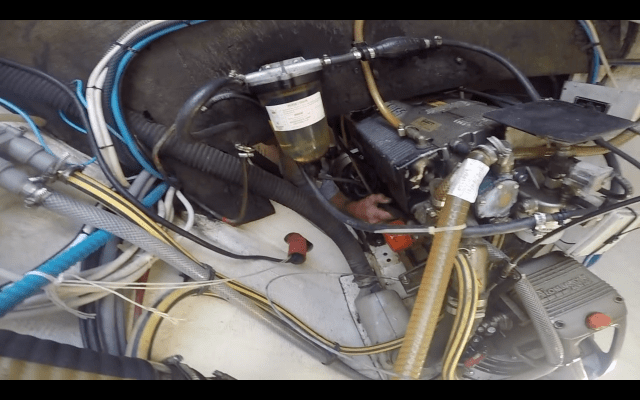
Now did that happen at 8:58 a.m.? 8:59? Heck no! It happened at 9:02. Right after the start of my shift that morning. Are there times that I like to hear that piercing elongated beep of the high-temp alarm on the engine? Sure, right when I’m about to crank the engine and right after I kill it. Not anywhere in between. But, that’s what the crew of Andanza heard at 9:02 a.m. May 29th, as we were making our way out into the Gulf.
The word “cut” hit my brain first so that’s what I did.
While Johnny only said to “cut it back” when he heard the alarm, alarms freak me out so I kind of jumped at the kill switch. Phillip looked at me a little funny and I just shrugged. At least I killed it instead of revving it up or something worse, I thought. You’re supposed to cut the engine when it overheats, right?
We cranked the port engine to keep us going and Yannick jumped down into the starboard engine locker with Johnny in tow to eyeball everything. When nothing visibly answered their inquiries, they tore down Yannick’s bed on the starboard side—the first of many, many times Yannick would have to do that on this trip (he got surprisingly good at it!)—and inspected the engine from another angle.
Where’s Johnny??
Two hours in and they were greasy.
Phillip and I had dealt with an overheating engine on two occasions previously: 1) where the thermostat was defective and was not opening up completely, and 2) when we (seriously) thought a snail got sucked up against our thru-hull and temporarily blocked the raw water intake. Seeing no snails around this time I mumbled (very un-confidently I might add) something about the thermostat. This high-pitch, hard-to-hear tone of my voice was later coined by Yannick as my “recommendation voice.” We’ll get there.
It was also Johnny’s first instinct to replace the thermostat, so that’s what he did. The rust-colored coolant they had drained from the engine was then poured back in and we then waited for her to sufficiently cool so we could re-crank the engine to see if she held temp. While Yannick had many (many!) spares aboard the boat, an entire new coolant system for the engines, he did not. The crew had a very depressing conversation while waiting for the engine to cool about potentially pulling right back out of the Gulf to order and wait for a new raw water pump to be sent from Italy if that was the problem. Those darn Italian engines! No one even wanted to consider it.
Hoping while waiting that the cause was indeed just the thermostat, this sparked a conversation between Yannick, myself and Phillip about the defective thermostat we had once installed on our Niagara and how we discovered it. The thermostats on these engines are really pretty cool. It reminds me of those springs they put in people’s arteries to hold them open and prevent clots. In other words, something that works automatically simply because of its property elements. Don’t quote me on this (or feel free to offer your two cents in a comment below) but it’s my understanding the thermostat automatically regulates engine temp by using the elemental properties of wax. Yep, wax. When wax heats and melts, it expands. The thermostat capitalizes on this property by relying on the automatic heat=expansion to push on a piston that opens a valve and allows coolant to flow in. Once the engine starts to cool, the wax contracts, shrinks down and a spring pushes the valve back closed again.
See? I think that’s cool. It was also nice for Phillip and I to be able to bring some experience to the table by relaying a thermostat-related event that had happened to us and the “thermostat trick” (Annie term) we had learned in the process. I’ve uploaded the video from this entire starboard engine overheat incident as well as the thermostat trick Phillip and I taught Yannick that day in this week’s Ch. 6 (Patron’s Extra): Thermostat Trick:
I kind of joked lightheartedly about this in None Such Like It—mine and Phillip’s first passage as delivery crew—when I imagined Kretschmer’s response to a similar situation:
“Orange fluid starts to pour out of the faucet in the head and he’d say: “Oh, that’s nothing, just some compensating fluid for your alternator. A slight over flow. I can fix it with a toothpick.”
While the thermostat trick may sound kind of normal to those who have dealt with a defective one. For someone who has never experienced it, the proposition might sound like a toothpick fix for “compensating fluid.” I found it almost unbelievable Phillip and I were actually gaining experience by simply being on boats when things broke.
Things break on boats? Noooo … Of course they do. So, “while you’re down there” Mitch, fix it! Ha!
Using the thermostat trick, we found the thermostat Johnny had just taken off the starboard engine on Andanza was not opening all the way, so it was not letting enough coolant in to sufficiently cool the engine. Put in a new one, whose wax contraption does its job and—voila!—a properly cooling engine. That was our fix that morning and, thankfully, we seemed to have saved ourselves a potentially costly and time-consuming repair. I honestly think we kind of collectively willed the starboard engine to just work that afternoon. And, thankfully, she did! And she held temp! Hallelujah!
It seemed the Wind Gods were proud of our will power as the breeze started to freshen in the early afternoon and we hoisted the spinnaker. It was actually Brandon who had encouraged us initially, during one of our very first test sails on the Freydis out in Pensacola Bay, to raise the spinnaker with his famous: “Alright, time to fly the chute!” I’m not sure why, exactly, Phillip and I haven’t been more inclined to fly the spinnaker on our boat—having owned her three years now and never raising the chute once—but I believe, after hoisting it on Yannick’s boat and seeing how truly simple and easy it can be, Phillip and I will be far more inclined to do so on the Niagara when the winds are right. It was nice Brandon had encouraged us to raise it with him on the Freydis, though, so the Andanza crew could all get a good feel for the process of raising it, unfurling it and furling it back up before we set off on this passage because the crew was all smiles and elbow nudges as we confidently pulled the spinnaker out, raised it up and began to unfurl her.
I’m not sure there is anything more beautiful on a boat than a spinnaker flying. There’s just something magical about it: sheer canvas filled with possibility and potential. The billowing green, white and red filled me with the same kind of child-like awe I had when I saw an entire horizon of spinnakers during the Abacos Regatta I did in 2015. So many colors, vibrant in the sun.
“I never would have thought,” Phillip laid a hand on my shoulder as we both stood at the bow of the boat just watching the spinnaker. “That would have been the first sail we would raise on this trip.”
A true sailor, that man. I love him for the way he sees things. The thought hadn’t even crossed my mind, but Phillip—of course—saw it that way. It was true. While technically, we did sail over to Ft. McRee for the “last hoorah” sendoff with friends the night before, for Phillip and I, this trip (as does any voyage from Pensacola) had not truly begun until we headed out the Pensacola Pass and started to lose sight of the shore. Then we’re not just day-sailing. We’re not just tacking back and forth for fun in Pensacola Bay. We are GOING. And the first sail we hoisted to get us to France was the spinnaker—the big, billowing, green, white and red spinnaker.
That was a pretty cool feeling. We made decent time that day too, around 5-6 knots with a nice breeze on our stern.
Once we were settled into passage, making good way, our very next mission was to have a safety briefing with the crew. Yannick called us all into the cockpit, had us bring each of our respective ditch bags up and we went through to account for and discuss use of all of our respective GPSs, flares, the EPIRB, etc. and how best to respond to emergencies. We also talked about how to stop bleeding and treat wounds, cuts or other significant injuries like fractures, how to respond to a fire aboard, radio for help, etc. Yannick had a great resource he used to make sure he had covered all of the necessary safety topics:
I tried to find an English version … sorry. It seems only French and Italian at this time.
Yannick also set off a “man overboard” on the chart plotter and it was shocking to see how quickly the boat and the “man” separated. If you needed any motivation to move slowly and cautiously on deck, set off your MOB and watch “yourself” get immediately swept away.
With that minor major chore done, the crew was officially on passage, on schedule and free otherwise to fill the time as they pleased. It was around 2:00 p.m. in the afternoon. I remember it vividly. It’s the same feeling I usually feel when Phillip and I leave our dock and head out into Pensacola Bay and the sails have been raised and trimmed, the lines in the cockpit cleaned up, we’re on a steady tack—at least for the next foreseeable amount of time—and you realize time is yours. You are sailing. The boat is handling everything and you are free to do whatever you want to do. I often just sit and stare at the horizon and the water swishing by the hull for a few minutes doing nothing other than that. Just appreciating the movement of the boat and looking out.
And, while it is always an incredibly freeing feeling when Phillip and I are just headed out on our Niagara for a day sail or over to the anchorage for the weekend, the feeling now was magnified. Because now I was going much further. Now I might not see land again for thirty days. The next time I did, it might be France! All of those realizations fell down on me like feathers and I closed my eyes and let them brush by and pile around me, then I sunk into the soft pillow of my own freedom. My shift having ended at noon, I wasn’t on again until 2:00 a.m. so I had plenty of time to just soak it all in.
I laid on the trampoline, closed my eyes and let the sun seep through my eyelids and listened to the hulls cutting through the water. That was the moment the passage truly began for me.
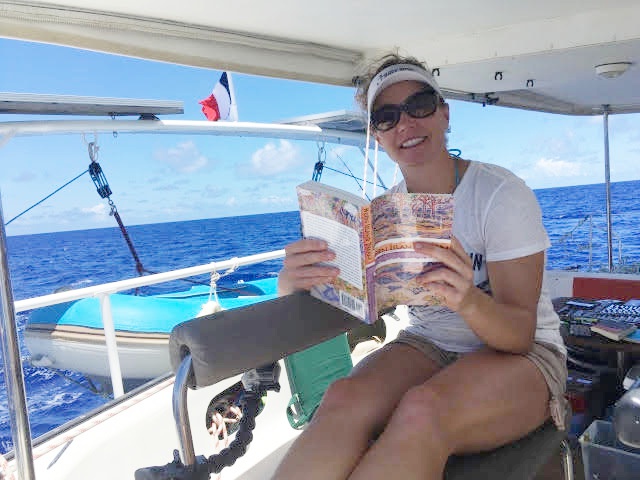
I opened a book I had been reading off and on for the last three months—one I had enjoyed but had always struggled to make myself sit down and open again. What with all the important things I could clack around and conquer on the computer when I had a solid, pumping wifi signal, why sit back and read when I could be productive, right? It’s hard sometimes, when work is so available to make it go away. Well, now I had no signal. I had no internet and all of my work, at least for the next foreseeable amount of time, was done. All of those hours Phillip and I had spent the past month clacking away on our computers late into the evenings, working on Saturdays, working on Yannick’s boat, our boat, all of it allowed me now to open a book and with the gentle background of babbling water underneath me, just read. I read for three straight hours that afternoon, completely enthralled in the story. I read mostly every day all day those first days on passage.
I could have worked some then, writing content for clients, editing photos, making movies, but I didn’t. I just read and finished a book, in two days, that I had been struggling to read for three months: Herman Wouk’s Don’t Stop the Carnival(on recommendation of Brittany from WindTraveler – thank you Brittany!). It was glorious.
“Steaks,” Phillip said, snapping me out of the mini carnival that afternoon on the tramp. “We definitely have to do the steaks tonight.” We had so many provisions on board, the decision of what we should have for dinner was often difficult, but I knew he had hit the nail on the head with this one. Grilling out on the starboard transom and enjoying a group dinner in the cockpit was something we wouldn’t always be able to enjoy when the weather turned snotty or the winds and temps were too cold, so although a glassy Gulf did not offer much in the way of speed, it did offer a spectacular calm setting for a gourmet meal of grilled steaks in the cockpit.
Yannick put on some French music to really get us in the mood and the crew cheersed “Sonte!” to our first night on passage and watched as the chute continued to remain taut and full and pulling us along at 5 knots further and further away from shore.
The crew decided to leave the chute up for the night as the wind prediction was so low. The sail actually billowing too much and requiring a crew roust in the middle of the night to furl and pack her away was actually a bigger concern than being overpowered. We were expecting some very lackluster winds in the Gulf for the next few days. I almost couldn’t believe as I laid down in mine and Phillip’s berth that I would be waking up in a few hours to hold my first night shift on Andanza. The thought of being alone at the helm, in complete and total control of the boat, was—to be honest—a little frightening but also exhilarating. Often some of my favorite moments on passage with Phillip had been during my night shifts.
“Here I go!” I whispered to Phillip as I left him snuggled down in the warm covers and stepped out of my cabin at 1:45 a.m. to get ready for my shift. Before going to bed, Phillip and I had made sure all of our “night gear” (our life jackets, head lamps, our EPIRB, a flashlight, etc.) was readily accessible in our locker by the stairs so we could easily don and doff by our berth. A surge of excitement pumped through me as I started suiting up. This is really happening.
I found Johnny smiling up at the helm. At what? I don’t know. It could be a million things: just the fact that we were out there, making way to France, or because it was his first night shift, too, or maybe he had just heard a dolphin or … anything. An inexplicable smile was not an uncommon sight on that boat. We had a brief chat about the conditions and how his shift went. “It’s nice out here,” Johnny said as he headed down below to rest.
The wind was holding at a nice 10 knots on the starboard stern and the chute was moving us along slow and steady. That was all I really needed to know to take over. The auto-pilot was doing all the work, the batteries had got a lot of juice from the solar panels all day, so the boat was totally self-sustained for the time being as long as the wind and auto-pilot held. Those were the two things I really needed to monitor. Otherwise, it was sit, listen and enjoy the night air.
The wind was cool but not cold. I was wearing a light fleece and leaning out from the helm so I could feel the wind on my face, hear the water dancing lazily against the hull and see the faint starlight on each chop. The stars that night were so crisp, each one a startling white contrast against the vast black of the sky. It was actually easy to lose focus on the instruments with a free open gallery spread in every direction above you. They managed to keep pulling me back, though, with a gently billowing sail and light, finicky winds all throughout my shift. While a steady ten knots of breeze on the starboard stern holds the chute just fine, when the winds would sink down to eight knots, then seven, the big, ethereal chute would billow and luff and threaten to collapse.
I hate to say it frightened me a little, but it did. I knew if the winds were not holding strong enough to justify keeping the spinnaker up, I was to wake the Captain and suggest we drop the sail. The crew would then be roused and we would drop her. Nothing to it. But, what if the wind were to die fairly suddenly and the spinnaker flopped and flailed at the forestay, caught on something and got snagged. The spinnaker sometimes seems, to me, like a fragile silk sheet up there—just waiting to go astray, drag her beautiful body across something treacherous and sharp and rip a horrid hole in her center. And I was sure, each time the winds dropped below eight knots, that was going to happen on my shift. But, as soon as that thought entered my mind, the wind would puff back up to ten or so and she would hold steady another fifteen minutes before torturing me with these types of nagging hypotheticals again. It was a beautiful shift, mesmerizing yes, but also tiresome worrying over the delicate spinnaker like that. I’m sure I did it to myself, but it’s not like you can just turn it off. Plus, the worrying kept me alert so I indulged it a bit and sat in awe that we were really flying the chute overnight, our first night on passage.
Phillip seemed to share my sentiment when he came up ten minutes early for his 4:00 a.m. shift and looked first thing out at the green, glowing canvas in front of us shaking his head a bit in disbelief. I just smiled back at him, knowing exactly how cool this trip felt so far.
Video extras from our passage are available each week on Patreon with free access as well to my complete Atlantic-Crossing movie once it’s complete. It’s almost 90 minutes now about I’m about 80% done. Whew! Editing, editing, editing … Thanks to my many followers and supporters who make this all possible. Get inspired and get on board!
(And a “worm dance” to boot … do NOT miss that!) We were headed to the shipyard to work on a Sunday but Brandon said it was too pretty not to sail. Watch as we take a well-deserved break from the yard and hop aboard Brandon’s Gulf Star 45 to fly the chute!
Exciting news kids. Weather depending (always the case, right?) Phillip and I will be headed out today for our first weekend on the hook since … last year?! This boat is ready to go!
And, I’ll keep working hard over here to bring you along every step of the way through videos, photos and blogs. If you’ve been inspired by the journey, get on board!
Because sometimes it just does, although our takeaway here was: check your chafe points. But, we were surprised to see our mast (even with a rotten base) stood up to some of the heaviest forces she has ever seen. This was, easily, our worst sail ever on the boat. Lots of lessons to be learned and much to discuss about the standing rigging next time. Enjoy!
Thanks to my Patrons who help me share the journey. Get inspired. Get on board.
So … accidental jibes? Apparently not much fun on a Nonsuch (and probably not much fun on any such). After assessing the minor loss of the outboard tiller extender and choke, we were able to get that big ass sail settled over to starboard and get on a nice downwind run. That also meant we could finally kill the engine, which was a relief. She’d been running another twelve-or-so hours since we’d turned her off the evening before to check the transmission fluid and Phillip and I were eager to let her cool so we could check the level again to make sure she wasn’t bleeding out.
While Mitch’s Westerbeke isn’t super loud, it was nice to have that industrial rumble gone. It was still dark out, still cloudy, but just more serene with only the sound of the wind in the sail and water gently lapping along our hull. It was almost 6:00 a.m. by then and the sky to the east was starting to bloom into a bright pink. We knew the sun was about to rise. Sleepy or not, there is no reason to ever miss that. It marks the start of a new day, a new canvas for adventure and─in our case─another safe night passage behind us. We were getting that boat closer and closer to Pensacola.
Neither of us said much as we watched this blowing pink ball start to peek over the horizon. It seems slow when you’re staring right at it but if you look away just for a minute, to another point on the horizon, or some spot on the boat, or your own body, whatever, when you look back, you notice it has changed. The vast expanse that was once a brilliant yellow-pink is now fading to purple and then blue. It’s happening right before you and always quicker than you want it to but you can never stop it. Time. She just keeps passing right before you.
My Lorde-inspired “not done sailing” shift that night and the Mitch-silencing sunrise the next morning were probably some of the most memorable moments for me on this trip. They’re just sights and feelings I have no way of replicating so I just have to remember them. I think we all felt we had kind of made it over a hurdle that night, probably because we had. This offshore passage was definitely the longest of the trip and the furthest offshore, not to mention the same passage that had cost Phillip and I a dinghy, an outboard and some busted davits the last time. Let’s just say it was good to get those particular nautical miles behind us and wake to a new day with all equipment working and all signs pointing to the Florida panhandle. Getting the boat across the big bend of Florida was certainly an accomplishment and now─just five or so hours out of the East Pass─we were getting close to achieving it.
But (how many times have I said this?) just when you start to sigh and let your guard down, Mother Nature likes to scooch across the floor in socks and zap you. Then she laughs about it. Just as we started to settle in for coffee and a nice morning sail, the winds started to kick up, some gnarly clouds started to bubble up to the east, then we saw it. A white crack of lightning across the sky.
“We need to crank soon,” Phillip said. With the way the weather was building we knew we were going to have to drop the sail soon. Yes, the big huge one that we had not thirty minutes ago raised. Sailing is such fun. The engine was still a little warm but I was able to get the transmission fluid dip stick off in order to get a peek. She had a nice pink coat on the bottom of the stick, so we were fine there. The oil was a little low but not dangerously so. Phillip decided to forego topping it off this time so we could get the sail down in case the storm jumped on top of us.
We were ready to crank. Phillip tried once, twice, three times a lady, but no dice, which was baffling because she had been running solid for hours, days even, on end. Phillip was stumped, irritated, frowning at the ignition. He didn’t want to try again and have it not crank for fear of pulling in too much raw water and overflowing the intake.
“I don’t think I can kill it again,” he said. Crank? I thought. You mean you don’t think you can crank it again? But, it must have been a fortuitous Freudian slip because just as the words tumbled out of his mouth, Phillip’s face lit up in a bit of an “Aha!” realization and he lifted the lazarette lid to check the kill switch. We had done this before many times on our boat─accidentally left the kill switch in the up position, so it prevents the engine from turning over. It’s not a hard thing to do. Like leaving a light on when you leave a room. And, Mitch’s boat was still somewhat new to us and the accidental jibe had left us all a little flustered. That definitely did the trick. Once the kill switch was down, the engine roared to life and I jumped topside to get the sail down. Yes, the big one. (If it wasn’t already apparent, I, personally, am not a huge fan of the huge sail on the Nonsuch.)
The winds were blowing a good 15-18 by then and it was definitely pushing us around as we turned into the wind to drop the sail, which pointed us right toward the storm. I could see the boys back at the cockpit trying to sheet the sail to center. It was clear they were having trouble. Right when I saw it, I knew. It was my fault. I had put it there.
“The chafe guard!” I hollered back as I made my way to the cockpit. The sail on the Nonsuch is so big the main sheets actually run behind the bimini. When we had first got the sail settled far out to starboard on our downwind run, I noticed the main sheet lines were rubbing hard on the corner of the bimini frame. Worried about chafe (which I’ll grant myself is a legitimate concern), I had wrapped a towel around the lines at the chafe point and duct-taped it (a very unique method, patent pending). But, lesson learned: do not put the chafe guard on the line, which needs to move, put it on the immovable fixture, which does not. I should have put something on the bimini corner if I was worried about it because where was my chafe guard now? After our accidental jibe, the heavy winds, the flapping around of the sail during our turn-around? It had slid down the line and was now jammed in the pulley at the base of the cockpit. I tried scooching it up the line enough to allow us to sheet in and get the sail centered but she wasn’t moving fast enough. As I mentioned, we’d had the sail waaay out to starboard so there was a lot of line to pull in.
“Get me a knife!” I shouted to Mitch and he grabbed the utility knife we kept near the companionway, for this very purpose I suppose. I started sawing away on the duct tape and─for a brief moment─felt a bit like I had been transported back in time. Back to that fateful night when the three of us were hacking the drowning dinghy off the back of mine and Phillip’s boat. Phillip had been at the helm then, too, and Mitch had handed me a knife and watched as I sawed through lines. I was struck by a strange reminiscent feeling. Maybe I need a new sailing nickname: The Hacker or something like that.
But, I finally made it through the layers of terry cloth and freed the line. Like I said, it had been my fault for putting the guard on the line, so I deserved to deal with the aftermath. Many lessons to be learned in sailing. With the sail centered and another hack job completed, we were finally able to drop the sail. Putting the sail cover on, though, was a bit challenging in the heavy winds. She’s just massive! Running from the mast back to the cockpit, I guess that must make her thirty feet at least, with a grommet and toggle about every two feet. I was sure after Mitch got the strong track put in on the mast to make raising the sail easier, the very next thing he was likely going to want would be a stack pack to make lowering and covering the sail easier. If you give a mouse a cookie …
When it was all done, the three of us fell into a heap in the cockpit and kept an eye on the storm. I swear every time we seemed to get offshore in that boat, there was a lightning storm on our horizon. I’m serious, they were everywhere! Maybe it was the time of year (late June) or just that part of the state, but I can confidently say there wasn’t a day that went by that we did not see lightning. Thankfully, though, it seemed this one was content to just eff up our sunrise sail and then back off. It left us little wind, however, that was─of course─right on the nose, which meant we had to continue motoring.
It was more favorable once we turned toward the pass so we raised the sails around 1:00 p.m. in order to kill the engine (remembering this time to push the kill switch back down) and check the fluids again. Yes, those pesky things. Trust me, if you see anything dripping out, you need to keep a close eye on them. Recall the oil had been a bit low when we cranked right before the storm. Well now, five-or-so hours later, it was really low. And, so began the adventure of adding oil to the Nonsuch. We had yet to do this and─this may sound crazy─but when Phillip and I first looked at the engine, we were a little unsure of how exactly you would go about it. The oil cap is literally back about a foot and a half from the front of the engine with maybe ten inches between it and the ceiling of the engine room. It would be difficult to get a funnel in there, much less a bottle of oil above the funnel to pour in. We all kind of scratched our heads a bit then I offered up the one thought that always seems to pop in my head when we talk about catching, pouring or saving fluids.
“Maybe use a water bottle?”
The boys seemed to be on board with this, so I began cutting the bottom end off of a water bottle. Mitch insisted he could do it and Phillip and I decided he would need to get used to doing it at some point, so we handed him the water bottle oil bin with about a cup of oil in it. I can’t tell you how many times we asked him: “You got it, Mitch?” “You sure?” “Can you see the opening?” “You sure you got it?”
“Gees guys, would you shut up already. I got this,” Mitch finally said. And, turned out, he did. I was a little surprised, but he displayed some real finesse wiggling into that position and gingerly dumping bottle after bottle of oil in. We kept checking the fluid level and determined she looked decent after we had put about a half quart in. Certainly a good bit. The transmission was still slowly dripping around the shifter arm and we put a dash more transmission fluid in there too─for safe measure─then deemed her fit to travel. The wind was still steady enough at the time, though, to allow us to keep sailing and, with all of us sweaty, sticky and dirty from the fluid ordeal, Phillip decided it was time for a dip.
I have to say, I have never (knock on teak) fallen off of a sailboat when it was under sail, but nor had I been allowed to float behind one while it was under sail. What a rush! With the wind pushing us along at about 4 knots, Phillip tied a throw line behind the boat and we took turns letting the boat drag us along by that or the ladder.
It felt just like a roller coaster ride. I cinched my wrist in right and tight in the line and let it tug me along, sometimes slowing so my body would ease toward the boat as a wave rolled under, then pulling me hard and fast with a swift tug as the boat coasted down the front of the wave. I was all giggles and “Wheees!” the whole time. It felt so good to let the fresh cool water wash over you. I had never done that before and I was so glad Phillip had the idea.
But again, it was short lived. I tell you, Mother Nature had some real fun with us on this trip. As soon as we got dried off, we saw some big thunderheads rolling up on the horizon. We were close enough to shore for cell service now and the radar showed a big green pile of crap coming toward us. It was time to crank and get that big ass sail down again. Yes, again.
“What the heck was that?” Mitch asked right after Phillip cranked. He was leaning over the back stern rail. I’m going to presume he was checking to make sure raw water was coming out as we had taught him (points for you Mitch), but he also pointed out, behind the boat, at a huge blob of black floating behind us. It was maybe two feet in diameter, with a rainbow-like sheen to it. Obviously oil. And, since we had just cranked, it had obviously come from us. Now we knew where all that oil we had replaced went. I can’t say I know exactly what happened or why such a big blob blew out but we didn’t take it as a good sign. We made a mental note to pick up some more oil (along with transmission fluid) once we docked in Apalachicola. But, at the time, we needed to keep motoring in order to get the sail down for yet another impending storm.
I could feel it in the air by then. Fifteen minutes prior I had been hot, sweaty and thrilled to death to dip and be dragged in the cool water behind the boat. Now, in my bikini, goose bumps began to form on my arms and my wet hair began to turn chill on my head. The temperature drop was palpable. I’m sure if the barometer on the boat was working, it would have shown a drop as well. We all donned our foul weather gear and prepared to drop the sail. Mitch insisted we all put on our life jackets as well. Oh alriiight. I’m not terrible about wearing mine, I’m just not super eager. But, he was the Captain this go-round, so Phillip and I did as we were told. It was probably for the best, too, because that particular sail-drop was the worst we’d endured. Coming into the East Pass, the water was churned up and the Nonsuch was bucking and kicking over 2-3 foot waves, which made the sail flop and misbehave. The wind had picked up too and was batting her and us around.
“Hang on!” Phillip shouted from the cockpit, “but tie her good!” Okay. “I’ve got winds over 30!” he said. Oh shit. It seemed to have come up so suddenly, but that seemed to happen often with the storms we saw on this trip. Mitch and I clung to the flinging sail, hugging her every 2-3 feet and working a sail tie around. The salt from the sail ties filled my mouth as I clenched them in my teeth and gripped the sail. After Mitch and I got them all tied, we decided to forego the thirty-foot, 15-grommet sail cover for the moment. You can imagine why.
And, two small gripes here about the Nonsuch as well, because I think it’s good to share. There is a row of pointy nubs around the perimeter of where a dodger would go if there was one. There is not, so that just leaves little spike-like stickey-ups (yes, that’s what I’m going to call them) along the top of the companionway placed just perfectly to step on if you’re trying to wrestle and tie the sail down, particularly over the bimini. For barefeet, they’re worse than Legos. And, while we’re on that─Gripe No. 2─the sail is really hard to reach in the center of the huge-ass bimini. I’m a pretty sporty gal and even doing an acrobatic tiptoe on things I shouldn’t be standing on, I still couldn’t reach it. Mitch, with some difficulty can, but he’s 6’4”. Not all sailors are! The big sail is just a bit awkward to man-handle. That’s all I’ll say.
With the sail finally contained, though, the crew thoroughly pooped, we hunkered into the cockpit and watched a wicked lightning storm brew to the east of us. Lightning seemed to bubble up and percolate, until the cloud would finally boil over and a shocking white streak would jet out. We watched in silence, and probably within just a two-minute time span, as three big bolts broke free and stabbed the ground. Phillip told Mitch and I to go below and put all of the handheld electronics in the oven (another helpful trick he’d learned from his vast cruising/sailing resources). If you do and the boat gets hit by lightning, it at least won’t zap your phone, laptop, GPS, etc. He’s a smart man that Phillip. It was strange to think not one hour prior we had been swimming and frolicking on a joyous sailboat amusement ride and now we were geared up in foul weather and life jackets putting the electronics in the oven. It was shocking how quickly things sometimes changed. But, we felt prepared. The sail was down and lashed. The engine was running strong and we were all tethered in. The three of us sat in the cockpit and watched as the sky to the northeast grew a dark grey and wicked cracks of lightning continued to spear the shore.
Thanks to my Patrons who help me share the journey. Get inspired. Get on board.
Lost Bay Regatta 2015! Watch as we get heeled over with quite a few “puffs” crewing aboard s/v Hula Girl and get challenged to a true hula hoop throw-down. Enjoy!
Thanks to my Patrons who help me share the journey. Get inspired. Get on board.
Hurricane Patricia blesses us with 30 knots of breeze and 4 ft swells all the way into the bay. Hope anyone out there that day made it out safe. Patricia sure packed quite the punch!
Thanks to my Patrons who help me share the journey. Get inspired. Get on board.
Take a ride on our Broker-Turned-Buddy, Kevin’s, Pearson 36 Cutter. We joke, because many of Kevin’s now boat-owning friends were initially clients: Kevin doesn’t sell boats. He sells friendships. Thanks again, Kevin, for the awesome day sail. Enjoy!
Thanks to my Patrons who help me share the journey. Get inspired. Get on board.