Shipyard Project No. 4: Repair of Rotten Engine Stringer

And you thought you were going to get to paint the engine today.  Silly you!  I thought I would give you guys a flavor of just how frustrating some of these boat projects can often be.  If Phillip and I could just wake up, list one thing we wanted to accomplish on the boat that day, and actually be able to do it—just by sheer will—we’d be some might happy boat-owners.  But, no matter your will power or persistence, what you are able to get done each day on the boat is dictated entirely by what the boat has in store for you.  What’s hiding inside that project?  Maybe it’s hidden deck rot.  Maybe it’s a thirty-year bolt that’s bonded for life.  Maybe it’s a piece that breaks upon removal.  A bad design.  Faulty wiring.  Failing parts.  Only the boat knows.  And she will only tell you once you roll up your sleeves and get your hands in there.

Get in there people!

Our goal that particular day was to do exactly what you all said you wanted to see: start the engine paint project.  All that stood in the way of that lofty goal was aligning the engine first.  Typically that’s not too bad of a job. A couple of hours turning bolts and checking with feeler gauges.  “No problem,” we thought.  “We’ll be painting by noon.”

The boat had other plans.  This was one of those surprise projects we hadn’t planned for.  Projects beget projects …

You see, it’s not often a boat owner aligns his engine.  I would imagine some never find the need to do it during the course of their ownership. But, anytime you remove the prop and re-insert it, you have to realign the engine to within the tiniest thousands of degrees.  To be such a rugged, hearty engine, it does have a delicate side.  Or so I’m learning.

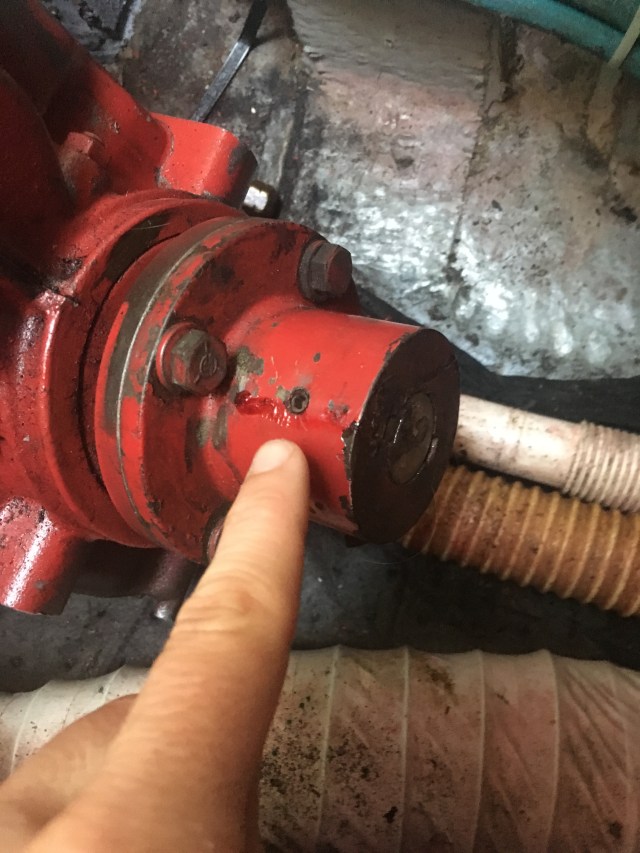
I’ll be honest I did not know at first what this is.  Do you?

It is an engine mount. And, while that title seems totally self-explanatory (“Ahh, they’re used to mount the engine to the boat”) I still did not know precisely what they did.  Turns out, they are adjustable.  These are precisely how you align the engine. You adjust the engine mounts with many tedious quarter turns to align the engine so the prop has a perfect straight shot to the transmission.  As many of you have noticed from our photos, some crazy nut put our engine in backwards. And, don’t worry, I’ve heard all the jokes: “You can only go forward in reverse!”  They are rather funny, but with this set-up we have two engine mounts on the forward side of the engine—one on starboard and one on port—and a single engine mount in the center of the cradle on the aft side of the engine.

You can see the engine mount here on starboard in the far left corner of the photo:

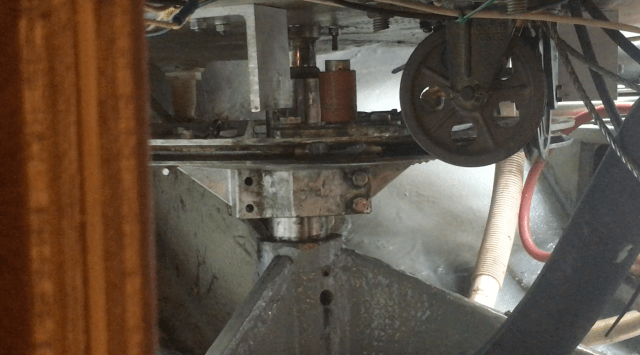
In the back, we have a cradle that supports the engine with a mount in the center:

I’ll bet you can imagine engine mounts that have been sitting undisturbed for some time don’t like it when you start shoving a wrench around their neck and trying to twist them. They respond like Oscar the Grouch. Much like the one stubborn bolt on our steering quadrant, we had one engine mount that simply would not let go. And, of course!  (Because this is how the Boat Gods show they really love you!) Luckily we had engine mount replacements for the two forward mounts, which were still serviceable but pretty far gone, the one mount we did not have a replacement for was the one that was giving us trouble.  The Aft Grouch!

Shane with Perdido Sailor tried many times to get her to budge, but she was bonded for good.  So, we were forced to order a new mount from Westerbeke (which put us behind another four days on aligning the engine).  Now, are you starting to feel me on the boat project frustration?  But we were trying to keep the optimism.

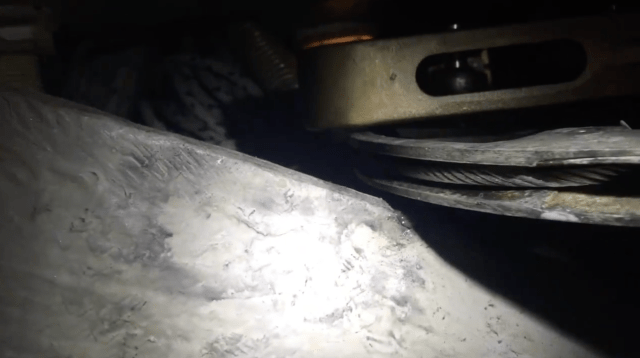
“No problem,” we thought.  “Just a small delay.”  But, when Shane started to remove the engine from the stringers and raise it up on blocks so we could install the new mounts when we had all three, this happened:
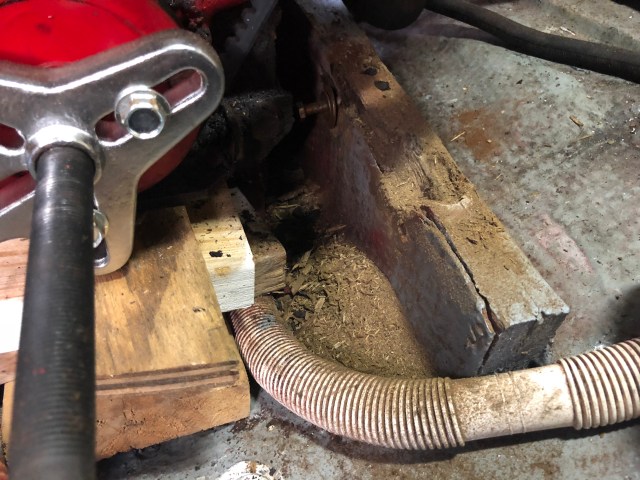
Another rotten stringer!  I mean … 

Shane was actually reluctant to tell me because he knew what we had gone through the last time we found rotten stringers on our boat.  I guess if you want to ever consider yourself lucky when you’re facing what may seem like a very bad boat problem, take comfort in that moment knowing if you ever face that problem again, you’ll know exactly how to solve it.  The easiest project to do on the boat is one you’ve done before.  Because you already know all the mistakes not to make this time around!  When Shane asked me if I wanted him and his guys to get on the rotten engine stringer repair, I said: “Nope.  I’ve got this one.”

As many of you may recall, back in 2015, Phillip and I discovered the stringers under our mast step had been rotting for some time.  Enough so that the mast was crushing its way down into the boat with a visible bump showing in the stringer just under the mast step.  This is what launched our extensive “Hard Times on the Hard” season of footage in the shipyard when we spent three months on the hill repairing our rotten stringers, replacing the rigging, and doing about a thousand other things while we were there.  That stay at the yard is what easily prepared us for this comparatively short period on the hill (only 4.5 weeks this time, as opposed to 3 months back in 2016).

Russ with Perdido Sailor and I worked side-by-side for a solid week carving all of the rot out of our stringers under the mast, cleaning and smoothing the work area, creating thick way-overbuilt coosa-board fillers and laying down 163 (yes, 163!) pieces of glass into the backbone of our boat.  She’s now stronger than ever.  If any of you have not yet seen that project, I put together a great montage video below for Brandon showcasing the repairs, or you can watch the detailed videos (Part One and Part Two) I created for our YouTube channel, or scroll through the photos below.
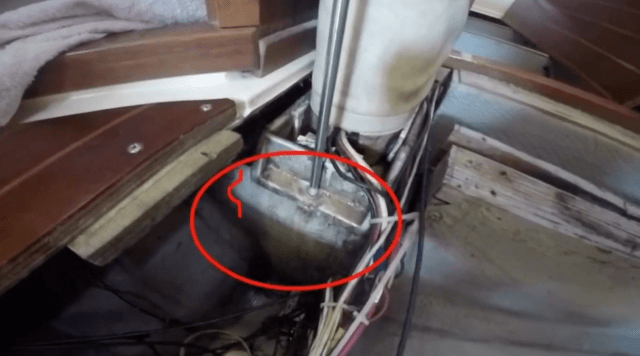
   

That was a … monster job. But one that we tackled alongside the guys at the yard.  And, Phillip and I learned a great deal about structural repairs and fiberglass work while we did it.  While it was definitely not fun or cheap, it was undeniably necessary to repair the boat and highly educational.  And, it has started to pay for itself over time.  Because you know who handled the repair of this rotten stringer portion under our engine?

Yours Truly.

While the guys at the yard were great to set me up with the right tools and supervision, it turned out to be a project I could totally handle on my own.  (Which to be honest, just felt pretty fucking cool.)  Once I started digging into the stringer, I found it, thankfully, was not rotted the entire way through—just a portion which, no surprise, laid right underneath our raw water pump.


Before we replaced our Sherwood pump with a Johnson a couple of years back, we had battled leaks from our raw water pump and rebuilt and replaced that Sherwood several times with still no luck.  We put the Johnson pump in in 2017 and haven’t had a drop down there since.  But, Sherwood had already done his damage.  However, I was pleased to find it was just a small portion of the stringer.

I will say, just like our stringers under the mast step, these stringers under the engine were not glassed on top.  This just baffles me.  So, the vertical surface where water will probably sit and where bolts will likely be drilled into—that area—you’re not going to glass.  Just the sides and leave the top as fresh, exposed wood?  While I love our boat and most of the design features, these stringers left un-sealed and exposed on the top was just not a good idea.  But, c’est la vie.  I’ve said my peace.  It is what it is.  We had rot. I had to fix it.

I showed the boys at the yard the amount of damaged wood I was able to pick and scrape away and I recommended I then cut a square portion out that we could replace with coosa inserts (much like we had done with the rotten stringers under our mast) and glass them in to build the stringer back up.  Once I got the okay, I was set to work.

The hardest part of this job (and it was a very uncomfortable four-or-so hours for me squished and sweaty down in the engine room) was cutting out the square notch. There is just not a lot of room down there and the configuration forces some very hard angles of your body and wrists in order to accomplish square cuts.  Plus, that marine plywood (when it is not compromised by rot) is some pretty dense stuff.  It took a while with a Ryobi handheld blade and an air blade saw to get it knocked out, but I did it!


I then made templates (beginning first with construction paper) for the coosa inserts.  I made Phillip cut the coosa (as payment for my services down in the engine room ; ) and they ended up being a very nice fit.


Our first step (again, much like we did with the mast step stringer inserts) was to “butter them up” as Brandon says, and glass them into place.

The next day I floated some of the gaps with 610 for a nice flush fit.

Then Brandon had the good idea to make a batch of resin and use a syringe to inject it down where the fiberglass walls of our stringers had started to pull away from the wood and then clamp them back to the wood for rigidity.  This is the port stringer, which did not have rot, but we still needed to glue the fiberglass walls back into place:

Brandon also recommended we then lay a sheet of glass over everything over to seal it all up, allowing no more water intrusion.

I will say I got some props from the boys at the yard for handling this one on my own (and on my own time, so my own dime).  I was quite pleased, as well, with how it turned out.

Shane helped us to cut and lay glass on the other stringer as well, just for added measure.

It truly is amazing he fits down there, but I can’t tell you how many times he went up and down the ladder and squeezed himself down there to do hours upon hours of work.  “Think small thoughts,” he was say, jokingly, as he made his way down.

And, very much Brandon-style, Brandon recommended (while we already in there glassing) to go ahead and add two extra supports on the front of the engine near the transmission to help keep Westie extra secure.  Do any of you know what these support beams are called?

Gussets!

I was learning something new everyday.  And, the “rounded corners” you make with resin and 406 (because fiberglass does not like 90-degree angles) are called fillets.  I’ll spare you the crazy conversation Shane and I had him trying to explain to me how to make fillets for the gussets.  I was a lost cause at first, but the boys stuck with me and dumbed things down a bit so I could pick up what they were putting down and *voila!*  It was totally worth it!

We also painted the entire area around and under the engine, including the stringers, so everything would be pristine for the re-mount.  I knew a fresh coat of Bilgekote grey would make the perfect back-drop for our bright-and-shiny Westie-red!

Next up, we paint that puppy!  Who’s excited?!

Shipyard Project No. 3: Replacing the Coupler and Cutless Bearing and Re-Bedding the Strut

Many props to our prop for hanging in there with us for so long (even though we were blind to her suffering!). We’ve been battling this problem for several years now and simply did not know what the underlying problem was. We did not know the “key” to the issue was the fact that the key kept coming out.  Here’s what we were dealing with:

Our prop shaft and coupler both have a matching notch that fits a key which helps the shaft sit tight in the coupler so it can be rotated smoothly by the transmission.  You can see the key here.

Yes, the one with the red goop all over it.  That’s Loc-tite, what we thought would be the answer to this problem.  You see, this key kept coming out.  Phillip and I are pretty diligent (we try to be, at least) about checking on our engine.  We always check the oil, transmission fluid, and coolant levels before starting.  And, if we are motoring for a significant number of hours while underway, we try to make a habit of pulling back the sink (which gives us access to our engine) and checking on Westie as he is motoring along hour after hour.

We look for oil or coolant leaks, water leaks, any loose parts, etc.  And, during our trip down to Cuba and our fantastic sails back up along the coast to Pensacola in early 2017, we noticed this key kept coming out.

Often we would find it halfway out, spinning around like a wild tea-cup ride at Disney, as the shaft was spinning.  Or, we would find it spit out about six inches forward of the transmission into the bilge. Phillip and I would start to wager bets as we would be trucking along under motor and heading down to check on the engine: “Do you think the key is halfway out by now, or already spat to the bilge?”  (Most times it was already jettisoned by the time we checked.)

Phillip and I knew this key issue was a sign that some bigger problem was likely the cause and that there was something going on that wasn’t right with our coupler or shaft.  We just did not know what.  I can’t tell you how many times we located and re-Loc-tited that sucker back in place. Dozens, if not more.

While this little key popping out might seem like a minor problem, we were worried, if it continued or worsened, the transmission could potentially lose the ability to turn the shaft.  That would be a huge problem.  So, the key was legitimately discerning.  Our first thought was to have a new key machined that stuck out a little further past the end of the shaft, with a hole drilled through it, that would allow us to run some seizing wire through it to prevent it from coming out.  That would solve the problem, right?

If that was the root problem.

As we continued cruising, to the Bahamas this past season in 2017-2018, and watching further changes occur with our prop shaft, we soon learned it was not.

Our first discovery: There’s a set screw for the key!

I’ll just have to admit, we did not know that.  For whatever reason, each time we were checking and re-hammering in this stupid little key, we just didn’t see it, or if we did, we did not know it was a set screw for the transmission key.  So, “Aha!” Moment No. 1 was making this discovery, finding the set screw had indeed rattled itself far too loose, and re-tightening him down onto the key to hold it in place.

And, of course, we goobed that guy up with red Loc-tite, too.  That seemed to be our solution for many boat problems at the time.  “Just Loc-tite it.  It’ll never come loose.”  Right, cause that’s how it works on a boat.  Nothing ever rattles.  Nothing ever breaks free.  At the time, we were using the same method with the three nuts on the back of our rudder post cap underneath the cockpit floor and you now know, from our rudder post reinforcement post, we have since come up with a better-than-Loc-tite solution there as well.

When the set screw, much like the key had, started to break free from its repeated Loc-tite baptisings and allowed the key to continue to spin out, we knew we were going to have to do something else when we hauled out in 2018.  At the time, machining a new key was the best conceivable answer.  And, in the meantime, we just continued our “locate and Loc-tite” drill to get us back from the Bahamas to Pensacola to really troubleshoot and solve this issue.

But, then something funny started happening.  Not only did the key continue to drift forward and come out.  Toward the end of our Bahamas voyage, the shaft itself began to move forward.  Yes, the shaft.  This is not the best angle, but in this photo it is sticking about an eighth to a quarter of an inch out.


This movement of the shaft itself (not just the key) prompted Phillip and I to inspect the coupler further.  We found the set screws on the coupler had also rattled themselves a bit loose, so that the coupler did not have a good tight grip on the shaft.  Phillip tightened these down.  This was during out trip back up the west coast of Florida on our way back from the Bahamas.  And, to get us back home to Pensacola so we could haul-out and investigate this further, for good measure I cinched them down with seizing wire.

At least I thought I did. Turns out I’m not the best cincher. Or maybe it would be seizer … I’m sure I’d make one helluva Ceaser!  But, knowing what I now know about how to run seizing wire (which I just learned from the boys at the yard – thanks guys!) I know this is a total useless loop.  Hell, that design probably helps both screws loosen one another …

Way to go Seizing Wire Annie.  Thumbs down.  But, I can confidently say my seizing skills have since improved after we got a custom lesson from the boys at the yard.  This is why we love working with them.  I’ll show you the trick when we get the coupler issue figured out.

Cue the haul-out!

When the boys at the yard got their hands on our boat, they noticed several things immediately that were adding to our issues with prop shaft movement.  First, they could feel and, actually with their hands alone, re-create the forward and backward movement of our prop shaft inside the coupler.  Again, not the best quality video, but it was sent to us from Shane at the yard and you can easily see the movement of the shaft in and out with just Brandon below pushing and pulling it.


This was their first cue that something far more serious was going on with our prop shaft than a loose set screw on the transmission key.  The boys could also feel that the strut had a little play in it, as they could physically move it from side to side—just a hair, but hairs can make a mess out of things offshore.  They recommended it would be best to remove, clean, and rebed the strut for a more secure fit to the boat and tighter hold on the prop shaft.

That was a fun morning I spent unbolting that guy.  Can you find the Annie in this picture:

Thankfully, I will say, almost every single part of our boat is accessible.  While it may be uncomfortable and require the talents of an inconceivable contortionist, it is reachable.  We can access, remove, and repair just about any part of our boat, because it was designed to do just that—be accessed, removed if need be, repaired if need be, and otherwise worked on!  It’s one of the very great features of our boat.  I was happy to find our four strut bolts were (with just a smidge of boat yoga) rather easily accessible right behind Westie on the engine room floor.


The shipyard guys, when they disassembled the strut, also noticed our cutless bearing was worn out.  While this surprised Phillip and I as we had replaced that cutless bearing only a few short years ago in 2014, if you consider the amount of play we had in our prop shaft, and the number of miles we put under our keel while that play was occurring, it made sense.

Lastly, when Brandon removed our coupler, he found the coupler itself was wallowed out with the movement of our shaft and it simply (tightened down its full capacity) could not get a good grip on the shaft.

When Brandon removed both the prop shaft and the coupler from the boat, he showed us the movement he could exert with his hands on the shaft.  Brandon explained the coupler should slide on and have an absolute snug fit with no movement.  He and Shane also said we were lucky the shaft was going forward.  This happened when we were in forward gear because the propeller is trying to work itself forward through the water.  If we had backed down hard enough in reverse, the prop would have been working to move itself backwards through the water and could have worked its way right out of the boat with the condition our coupler was in.  Now, I have a new boat nightmare.  Thanks boys.

Here is a video of Brandon showing us the movement in the coupler and having fun at my expense. You will be surprised by the play in our coupler.  You can hear it audibly in the video.  You’ll also enjoy Brandon’s response to my joking that he had “purchase discretion up to $800.”  “Oh, it’s $799 then.  $799!”  Gotta love those guys at the yard.


So, with this revelation, we were in for a re-bedding of the strut, a new cutless bearing, and a new coupler.  But, if we were going to replace the coupler, we wanted to re-engineer it so the coupler would not allow the key to come loose or the shaft to try to move forward again after the many more miles we plan to put on our boat.  For this reason, Brandon hired a local machinist to create a cap that bolts onto the end of our coupler to hold the shaft in place. He kept a window hole in the cap so we could see the shaft and visibly confirm its location in the coupler.  The machinist also included a threaded hole in the center that we could use to twist a bolt down to pop the shaft out if it had, for whatever reason, seized up in the coupler.  Overall, it was a better, stronger design for our boat and eliminated all movement in our prop shaft.  Here is the new coupler!

And, fun little lesson for all you boat project fanatics today.  Notice Shane’s method for fastening seizing wire in the photo above. While everyone can do it differently, I definitely liked his idea of purposefully routing the wire in a way where one bolt’s attempt to unthread and turn to the left would result in a tug on the other bolt toward the right, and vice versa.  Meaning, as the bolts try to loosen themselves they are, in fact, tightening one another.  Thanks Shane!

Little things like this can make all the difference out there on a two-week passage where you are working all systems so hard twenty-four hours a day.  Phillip and I know we will sleep better and have more peace of mind knowing this system, too—our prop shaft, the coupler, the cutless bearing, and the strut—have all been inspected, re-mounted, secured, or re-engineered to be stronger and more stable for our rough passages.

This is the reason Phillip and I decided to devote the time and money this summer to haul-out and do these “mission critical” repairs and upgrades as we have some big cruising plans this fall.  And, some big destinations to announce!  We can’t wait to share our plans with you (you know, the ones written in sand at low tide ; ).  But, next up, we’ve got some more cool shipyard projects to share with you.  Hope you all are enjoying our boat labor this summer!  You get to pick next week’s topic.  Because:

I can’t make heads …

… or tails of it!

Would you like to see our swap to the composting head or re-painting of our Westerbeke engine.  You decide.  Leave your vote in a comment below!

Shipyard Project #2: (Re)moving the Quadrant: Bonded Bolts and Other Obstacles

Maybe they should change that B.O.A.T. saying to “bonded or about to.”  I’m sure many of you have faced this.  One of the hardest parts of a boat project is the initial disassembly. Trying to get bolts that have been in place for thirty-plus years to budge.  Or how about a stainless steel bolt in an aluminum piece?  I know you’re cringing now.  But, at least I can say we had access to our curmudgeon bolt.  I had a follower post recently in order to get to bolts he needed to access to re-bed his strut, he had to remove two diesel tanks.  Just to GET TO said belligerent bolts.

Shout-out to follower, Rob Miller, who tacked that job!  Rob, you’re my hero.  In our case, with access, albeit uncomfortable and tight, to our bolts, I’ll consider us on the lucky side.  Here’s what we were dealing with.  These are the components of our rudder/steering system:

The quadrant (which is in two half-circle pieces) mounts on the rudder post by fitting onto that slotted “keyway” mentioned in the diagram, and it is then bolted together, four bolts at the base, inserted in opposite directions, which thread into opposite piece of the quadrant.  You can see here, the two bolt heads on port (your right) and the two holes that the shafts of the bolts on starboard are threaded into.

We knew in order to drop the rudder we were going to have to get these two quadrant pieces apart in order to remove the quadrant so the rudder post could be lowered.  For this reason, Phillip had the idea to spray (well, I should say Phillip had the idea to send his bendy grease monkey down in the lazarette to spray) PB Blaster on the four bolts under the quadrant periodically for a few weeks before we hauled out hoping that would help loosen those suckers.

But, as many of you know, when you allow two different metals, here stainless steel and aluminum, to sit together for years upon years, the metals can undergo a chemical reaction and literally bond themselves together.  When the boys at Perdio Sailor got in there, that is what they found.  The bolts holding our quadrant to the rudder post had thoroughly seized.

With Brandon in the starboard lazarette (which stinks, that one is super tight and uncomfortable) and Shane in the port lazarette (which is a bit more spacious, but not as much for a 265-pound guy), the boys made several attempts to get the bolts to budge.  First they tried manually.

Then with a cheater bar.  Then with the impact driver.

Then with heat (lots and lots of heat) followed by the impact driver.

Thankfully, three of the bolts finally gave up the ghost with heat and impact and came out, but we had one last stubborn holdout on the port side.  The boys continued to battle it with the impact driver, then heat, then impact, then cursing. Still nothing.  More heat, more impact, more cursing.  No movement.  Shane finally dropped his wrench and said “I’m cutting it out.”

Breaking a Bonded Bolt

I’ll be honest, I didn’t exactly know what “cut it out” meant, but watching the guys at the shipyard—who have to deal with obstacles like this every day—think through a problem and engineer a solution is the exact reason we like to haul-out with Brandon’s exceptional team and learn from their thought-processes.

Shane’s idea was to cut the bolt head off, so he could at least pull the two quadrant pieces apart and remove them from the boat.

Then he could try to drill into and perhaps extract the obstinate shaft or, if that would not work, he could drill the shaft out, enlarge all four holes slightly and either re-tap them for new bolts, or go with through-bolts instead. Shane chose the latter and we now have four bigger, stronger, more-secure bolts, locked down with Nylocs, holding our quadrant on the rudder post.

And, it was educational for Phillip and I to learn how the crew at Perdido Sailor work around, what might seem to us, an insurmountable obstacle.  You’ll also notice Shane really cleaned and spruced up our thirty-three year-old quadrant.

Thirty-three … pssssh.  That pretty gal would get carded in bars.  “Can I see your ID Ma’am?”  : )

Proof TefGel Works

In addition, to ensure this unwanted bonding did not happen again (because you never know, we might need to remove the quadrant again someday down the road), Phillip and I used TefGel during the reassembly to ensure, this time, the stainless steel bolts did not try to bond with the aluminum quadrant.

Our tiller arm served amazing proof of the power of TefGel to prevent different metals that are in contact from bonding over time.  Phillip and I installed our below-decks hydraulic auto-pilot (which we lovingly call “Lord Nelson,” because it came from a Lord Nelson boat) back in 2016 when we were hauled out to repair our rotten stringers under the mast and replace the rigging.  In order to remove the rudder from the boat, the tiller arm also had to be removed. This is the bronze tiller arm mounted above the quadrant.

And, although the arm had been in place for two years untouched, with TefGel in the mix, the stainless steel bolts that hold the bronze tiller arm on the rudder post easily unthreaded.  Proof: TefGel works people.  Use it!

Alright, one problem solved. What’s next?  Alignment of our steering cables!

Re-Aligning Our Steering Cable Pulleys

When Brandon first crawled down into our lazarette to inspect the quadrant and steering system, he noticed immediately that the alignment of our steering cable pulleys to the quadrant was not ideal.  (Even though the cables are off) can you see what Brandon saw in this photo?

The base of each steering cable pulley was about one-quarter to one-half inch lower than the “seat” (the center of the groove) in the quadrant for the cables.

This meant our cables had to travel uphill to fall into the seat of the quadrant.  Not something you want them to have to do.

It should be a perfectly-aligned straight shot from the pulley right into the seat of the quadrant.  All of these years, and I hadn’t noticed that.

Just another reason we love having professionals, like Brandon and his team, crawl all over our boat looking for potential issues.  “Look in every locker!  Check anything you want!  Sure, wiggle it. See if it works.”  I say that because we want the Perdido Sailor guys to find anything they can that needs to be fixed while we’re in the shipyard.  And I stress “need” because there is a time and money factor; no boat is going to always be in 100% pristine condition.  But, we want them to find problems while we’re in the yard, because that’s when we want to fix them—when he have great tools, supplies, and experts readily available to help and supervise, rather than finding the problem when we’re out there underway with less resources and knowledge to devote to it.

And, the joking and ribbing that goes on at the shipyard is just part of the fun.  Here, Phillip had missed the measurement of the additional height we would need to be jacked up in order to drop our rudder by just a couple of inches, and the guys never let him forget it.  If you don’t do it absolutely 100% perfect (because we all do that, all the time, right?), they’ll pick on you.  But, the more they pick on you, the more they secretly like you.  Shipyard Fact No. 64.

When Brandon saw the steering cable issue, he had the idea (since he knew we were dropping the rudder which would mean the quadrant would have to come off) to lower the quadrant just a bit to make it line up better with the pulleys.  I immediately laughed when he said it.  Just as a knee-jerk reaction, because I knew how very little room we have between the quadrant and the aft strut.  How do I know this?  Because I saw that tiny little space disappear one exhausting night in a beat-down underway when our rudder had tried to make a sneaky exit out of the boat.

That was a fun night.  And, a fun little video for you here of our quadrant literally grinding its way into the aft strut that supports the post, why it happened and what we learned the very simple remedy was: tighten the cockpit nut that threads the shaft up higher into the boat.

But, lack of space between the quadrant and the aft strut in order to properly align the quadrant with our steering cable pulleys did not hinder Brandon either.  I swear, they don’t see obstacles, they see solutions taking shape. And Brandon certainly had one here:

Cut it.  Re-engineer it.  Make it work better.  You gotta love that guy.

Brandon had his main guy, Shane, modify the aft strut by cutting a nice even chunk out of it that would allow us to mount the quadrant back on the rudder post at a lower spot to make it align perfectly with our steering cable pulleys.  Here is a video of Brandon checking Shane’s work after Shane and I reassembled the quadrant for inspection:


And, do you know what “get in there and square that up a bit” means?  Another disassembly of the quadrant by Shane and I to finalize the cut and sand it out, then reassemble the quadrant and steering cables …. again … to make sure everything worked and operated perfectly.  I’m telling you, by Day Two at the shipyard, I am quite confident I could disassemble and reassemble everything on the rudder post myself.  What an awesome confident feeling!

#diystrong

But, it will all be worth it when our quadrant now has free space and no chance of making contact with the boat if it the cockpit rudder nut gets a little loose in heavy seas (although Phillip and I now know to check and occasionally tighten that nut), and our steering cables are no longer having to step up to fall into the seat of the quadrant.  Now they are perfectly aligned.  Little things like this I’m sure will add years of awesome cruising years to our beautiful boat. And, while we continue to learn the more we work on our boat, I know she still has many lessons to teach us.  And, I know we’ll be ready to learn them, whether they occur at the yard or out in the big open blue.  It’s a great big school out there!

I know some days will look like this …

But many others will look like this …

And I wouldn’t have it any other way!  More shipyard projects to come.  Next up.  We’ll give props to the prop shaft by re-bedding the strut, replacing the cutlass bearing, and re-engineering a new coupler.  Stay tuned!

Shipyard Project #1: Reinforcing Our Rudder

Let’s talk about our rudder.  While Phillip and I are quite pleased with the majority of the systems on our boat and their original design, this was one where—if we could have been there at the factory in Ontario when the Hinterhoeller crew was putting our boat together—we would have asked them to make a slight modification to this rudder design.  Here are the components of our rudder:

It is a very sturdy, yet light-weight, high-performance rudder, with a keyway to grip the steering quadrant and a very hearty nut on the cockpit floor that turns and locks down with set screws to hold the rudder tight, the only issue we had had with it is where the rudder post penetrates the cockpit floor.  If you can imagine how much pressure is put on our rudder when we are steering down waves in a gnarly sea state, that pressure is magnified at the fulcrum point where the rudder fits through the cockpit floor.  And the only thing holding it firm there is a rudder post cap secured with three 1/4” bolts.  Here is a photo of the rudder post cap with the nut and plastic bushing, followed by one (with the plastic bushing and nut removed) and the top of the rudder post dropped down a few inches during our rudder drop.

As many of you die-hard HaveWind followers might recall, we first noticed a problem with this rudder post design during our offshore beat to windward when we sailed to Cuba in 2016.

Yep.  That’s the one.  Try to imagine how much pressure is on the rudder in that photo and how much of that was being translated to those three little bolts on the cockpit floor.  It was enough to cause our rudder post to start moving side to side, athwartship.  Which, once we saw it, immediately caused Phillip and I to go upside down in the lazarettes trying to stop it.


This is what we found when we got down there:

Just three bolts (the third, on port, is concealed behind the rudder post) with initially only one washer and one nut on each.  Adding the additional two is what Phillip and I were doing down in the lazarettes on our way to Cuba.  And, while the additional nuts did stop the majority of the athwartship movement of the rudder post on the cockpit floor during that passage, you can see in the photo above where we have tightened them so much they are literally starting to crush the cockpit floor.  This is what really worried us: such a small compromised area holding such a critical, heavy, and load-bearing component of our boat.

We knew when we got back from Cuba, we wanted to take some measures to reinforce this area before we sailed to the Bahamas.  Our initial reinforcement plan—without having to drop the rudder—was to add large stainless steel flat fender washers to help spread the load of those three bolts.  Our buddy Brandon with Perdido Sailor (with whom we usually haul-out) helped us grind the washers down to fit around the cap that sits in the cockpit floor.

Annie making an immaculate cardboard template of the area on the engine room ceiling around the rudder post.

We then used the template to make custom washers to fit around the bolts that go through the rudder post cap on the cockpit floor.

We knew this would be a temporary fix for the season, though, and that, when we got back from the Bahamas and hauled out the following year, we wanted to drop the rudder and really do this project right.  And, we knew we would be hauling out again with Brandon at Perdido Sailor because his work is exceptional and he and his guys are willing to allow us to tackle projects there ourselves while they teach, supervise, and rightfully pick on us … that’s shipyard culture.  In researching how we were going to accomplish our rudder reinforcement, I mentioned in my Post-Bahamas Projects blog what we discovered when we talked to some fellow Niagara 35 owners through the Niagara 35 Owners Facebook Group.  We found one Niagara owner, who was had just finished crossing the Atlantic, and was in the Azores at the time, not wanting to haul out and drop the rudder at the time, decided to add a very substantial backing plate around the top of the rudder post to help reinforce and secure it.

I guess you could call this a topping plate, since he mounted his on top of the cockpit floor.  After discussing this at length, Phillip and I decided we wanted to mount our plate underneath the cockpit floor for cosmetic reasons.  Either way, top or bottom, we knew a large plate mounted around this hole would help spread the very heavy load of the rudder and help reinforce the cockpit floor.  We got with our buddy Mike, who helped us configure the initial custom-washer-fix and who is a talented machinist (and owner of a beautiful 1981 Tartan 37 – boat tour HERE! – you’re welcome! : ), about making a plate for the underside of our cockpit floor.  Say “Hey!” to Mike!

And this is the wonderful piece Mike made for us!

Look at that smile.  I mean, who wouldn’t be grinning from ear to ear knowing they’re about to have a tough-as-nails rudder rig-up on the boat.  Heck yeah!

After measuring underneath the cockpit floor and assessing the sufficient space we had down there (the closest item to the rudder post is our rudder indicator on the port side), we decided on the following fix:

An 8 x 8” stainless steel 1/4” reinforcement plate 

After playing around with the plate down below in the engine room, we found sitting it in a “diamond” fashion with one corner toward the bow, one to the stern, one to starboard and one to port, would allow the plate to sit centered on the hole and not touch any other instruments on the engine room ceiling near the rudder post.  Like this:

You’ll notice those holes on the cockpit floor by the binnacle base.  Those are for the rudder post stops.  I was in the process of re-bedding them when the plate came.  We do a thousand things when we’re on the hard!

Here is the design, after the center hole in the plate was cut, mocked-up on the top of the cockpit floor:

While this fix (i.e., drilling the three necessary bolt holes through this plate and mounting it underneath the cockpit floor) seems like a pretty easy fix, Brandon spotted another issue when we were dropping and disassembling the rudder.

Pssst: This is why we love this guy and always trust him with any boat repair.

When we pulled the rudder cap from the cockpit floor this was the hole we found that was cut for our rudder post.

Does that look perfectly round to you?  Hardly.  That’s an amateur Annie cut right there!  Not something we expected to find on our blue-water Niagara, but, as the boys at the yard said, our rudder install must have been done on a Friday shift, before a long weekend.  Humans are just that.  Humans.  Someone at the Hinterhoeller facility didn’t really take their time making this cut.  But, even if it was round, Brandon also found it was about a half inch too wide for our rudder post cap.  Meaning, not only was the cap itself only secured with three 1/4” bolts, it also was not supported in this hole with solid 360-degree contact all the way around.

“We’re gonna fix that,” Brandon said, and he ingeniously came up with the idea to mount the rudder cap upside down (from the engine room ceiling up through the cockpit floor), so it would reveal the gap we needed to fill on the cockpit floor.  This photo really highlights, too, the poorly-cut hole and the gap that we wanted to fill.

Brandon then advised us to coat the cap with TefGel (that way the 610 would not stick to it) and fill that wayward-cut gap with 610.  That is what I am doing here:

Annie’s got her gun!

We then waited for the 610 to firm up enough to hold its shape (about four hours), then popped the rudder cap out and now found our hole in the cockpit floor for the rudder cap was a nice, snug fit, way more supportive than what was there previously.

This way, as Shane with Perdido Sailor explained, the hole for the rudder post cap, along with the cap and reinforcement plate will all “operate as a system” to hold the rudder secure in the hole, even with the tremendous amounts of pressure that are put on it when we are offshore.

After we sanded our 610 filling and smoothed everything up, we then bedded the rudder cap down with butyl.  Love that stuff!

We mounted the plate underneath the floor with our three bolts, using our custom washers from last year’s temporary fix and secured it all with locking nuts.  This is the complete rudder reinforcement fix:

Pretty schnazzy huh?  As Phillip said to me: “Aren’t you going to sleep better when we’re underway offshore knowing this bad boy is holding everything together?”

Yes, yes I am.

And, added bonus for you Phillip fans out there.  I snuck a video of him explaining to a boat neighbor of ours (ironically both in the slip and then at the shipyard as well!) how we discovered this problem and our thought-process in designing the reinforcement.  Enjoy!


Phillip and I are both very grateful for the help and guidance shared through the Niagara 35 Owners groups, particularly the input from Larry Dickie, as well as our buddy Mike for the machine work, and the hard-working shipyard repairmen at Perdido Sailor, who helped us engineer and accomplish this feat.  We hope sharing this fix helps some of you analyze and upgrade your own rudder systems.  As always, if you have any questions about what we did here or just want to talk about it more, feel free to comment or share!  Happy sailing folks!

And, don’t worry … we’ve got plenty more project posts to come this summer.  Here’s the (short) list!  The ones with an “A” beside them are my babies!

BV20: Overnight Sail to Spanish Wells

Life is swell in Spanish Wells!  Or breathtakingly beautiful at least.  Phillip and I were happily shocked to find our favorite beach from our entire Bahamas trip tucked away on the north shore of what we thought was going to be an industrial little fishing island in Eleuthera.  We were also really excited to make the jump to this island because it would be the first we were back offshore since crossing the Gulf Stream to get to the Bahamas.  We love to travel offshore.  The sunsets underway are just indescribable.  I love when they bathe the boat, and everyone on it, in “sunset.”  Fun video for you all here, and photos below, from our sail down to Spanish Wells and the beautiful north shore we paddled there.  Lobster, cannonballs, and starfish await!  Dig in!

Spanish Wells is about 50 nm from Little Harbour.  We decided to make the sail overnight to arrive in daylight at Spanish Wells.  We left Little Harbour around 4:00 p.m. the day before and arrived in Spanish Wells around 7:00 a.m. the following day.  A nice, 15-hour run.  We didn’t have much wind and had to motor a good bit, but we didn’t mind!  We love being underway!

Love this man.

We installed AIS back when we had our mast down in the shipyard in 2016 and we have never regretted it.  It is so comforting to see large ships on the screen and know their direction, speed, and the closest point of approach.  It is also good to see their name and know you can hale them if you are unsure your vessels will pass safely.  We only receive AIS; we do not transmit.

Plaintiff’s Rest, happy on her hook!

Where you see that big yacht there is the entrance (through Devils Backbone) to Little Harbour.  We’ll take you there on the blog next!  There were so many mega, mack-daddy cruising yachts in there!

Favorite beach from our entire Bahamas trip!  The north shore of Spanish Wells!  Have any of you been here?

Little drizzle sand castles.  My brother used to make these when we went to the beach as kids.  It brought back a lot of memories for me.  Like someone left them there just for me!

It’s hard to even say when the water begins and the shore ends.  They just melt into one another.

Conchy yard art!   : )

Fresh caught lobster tails we bought from a local fisherman.  Only $5 a tail, can you believe it?!

Back to the boat to cook up the best dinner on the island!

Baked lobster with Phillip’s famous mushroom risotto.  I am one lucky girl!

Poor Phillip snagged his toe on a branch when we were walking the north shore.  Be careful when you walk folks!  Pick up your feet and dodge the ragged, jagged things!

Aren’t the colors in the Bahamas beautiful?  All roads, fences, signs, etc. are all so tropical and vibrant!

What’s up?  SUP, that’s what!  Time to paddle!

Or time to perch (while Annie paddles).

That’s Phillip way out there (the little spec on the horizon) paddling away.  We could see for miles across the neon teal water it seemed.

And, Phillip got our inflatable YOLO paddle board for me as a birthday gift years ago.  (You see?  Lucky girl!)  It has proven to be a very convenient and valuable little “toy” to have on the boat.  We like it because it packs down and serves as an extra vehicle to and from shore.  It’s also a great workout and a wonderful way to explore flat, shallow waters.

If you see a bridge over water, you must jump!  It’s an Annie rule.  CANNONBALL!

You know you’re living the good life sitting in the cockpit of your boat, drink in hand, and someone’s bikini is off!  ; )

#sunset  Never gets old.

It’s true!  You do!  Only once!  Live it up folks.

I’m star-struck!

Introducing: Speaker Annie (Listen In!)

Hello HaveWinders!  This is some very exciting news!  While I have, for five years now, written and filmed and produced and, at times, spoken to inspire others to pursue a more passionate, balanced, challenge-driven life, I have not yet done so professionally.  On a big stage.  Well, life is about challenging yourself, right?  And impacting others.  So, here I go!  My amazing friend, and inspirational speaker herself, Pam Wall, actually inspired me to this.  And, with Phillip as my forever-cheerleader, I believe I can reach a lot of people this way and be able to work more travel in while still working.  Win, win!  You can check out my new speaker website here (www.anniedike.com) and even give my first five-minute storytelling clip a listen here (www.anniedike.com/storytelling-competition).

Wow, I do wear a lot of hats!?  I hope you all are as excited as I am about this new Annie chapter, and I hope someday some of you may be able to watch and meet me at a speaking event.  I have been working very hard to fine-tune my talks, build strong tie-ins between my sailing stories and valuable life lessons and it has been a challenge, but a very rewarding one.  If you want to get a little taste of Speaker Annie, I have some more exciting news.  In an effort to push myself into this and really test my talents, I submitted a five-minute storytelling clip to a competition on SpeakerMatch, to be selected and critiqued by this Hollywood story-telling guru (he has worked with the likes of Will Smith, Julia Roberts, Reese Witherspoon … whoa).  And I WAS PICKED!  You can listen to my clip and even register to hear Michael Hague’s critique of me live on air Thursday, July 12th at 12:00 p.m. CST here.

I’ll be waiting eagerly on the line to speak with Michael Hague on air and find out what he feels fit to do with my story: tear it up, build it up, restructure the whole thing.  Bring it on Hague!  I’m eager to learn!  I’ll share with you all here as soon as I get some footage of myself speaking at a live event and testimonials from audience members.  If any of you have and upcoming conference or seminar that you think would benefit from a few salty, motivating tales, feel free to reach out.  It’s all about building your skills, adapting to changes, and finding balance while pursuing both your passions and your biggest challenges.  Through challenge comes creativity, to see new strategies, new solutions, and a new, happier, bolder you.

“I’ve been told: ‘You might be just a bit young to be telling others how to live.’  But the way I see it, you don’t have to be old to die, and you don’t have to be young to live.  It’s the living—challenging yourself to fill every moment with passion and presence—that’s the hard part.  If I can inspire just one person to that end, then I will do it until I truly am old, whenever that may be.” 

— Annie

LIFE IS SHORT.  FILL YOUR SAILS.

If you would like to hear my announcement in person, and some other HaveWind news, here is a short video clip below that I put together for my YouTubers (who were curious why Phillip and I haven’t been putting out our usual informative, speaking-into-the-camera type videos in a while) talking about why Phillip and I decided to pull away from the YouTube/Patreon platform last year, the upcoming videos we are planning to make for you all this summer (dropping and reinforcing the rudder, switching to a composting head, if I can get it to fit, and plenty of other boat projects), our cruising plans this coming season, and my Speaker Annie announcement, if you want to hear it in person.  Well, as “in-person” as a YouTube video can be.  It’s the first eight or so minutes of this video, followed by our video from Green Turtle Cay, which you may have already seen (remember the Bucketlust cRaZiEs?!).  Enjoy the Video Annie blurb!

BV19: How To Rig a Whisker Pole

Or how we rig it on OUR BOAT, I should say.  Ahoy followers!  You ready for a little virtual sailing lesson?  That’s right, float away from your desk for a minute, imagine yourself on the sunny deck of a gently-swaying boat, looking out over green, glistening water. Can you smell the salt in the air? I hope so!  But, there’s only one thing that’s bugging you: that occasional luff-crumple-pop of the headsail.  The light winds over the stern combined with a kicked-up sea state is causing your easy downwind run to be much more of a strain on your headsail than you would like. Every third wave, she luffs, curls, and then snaps back out with a vicious pop when she fills again.  I know you’re cringing right now hearing it.  So, what do you do?

Rig a whisker pole!

We’re going to share with you today a detailed step-by-step process, with photos, of our whisker-rigging method as well as some tricks and very important lessons we learned when first working with and learning how to rig the whisker pole on our boat while we were cruising in the Bahamas, namely the following:

  1. Where to attach the outer end of the pole (the Pam Wall Rule).
  2. What else to attach to the pole (the Captain Frazer Rule).
  3. And, where to attach the pole first (the HaveWind Rule).

All lessons are free today. Feel free to learn some at our expense!

No one likes to hear a sail pop and flail.  I always feel like it’s a dog yapping and running around in circles because thunder scared him.  You just want to hold him close and calm him down.  Yes, I would do that with our sails if I could.  In a heartbeat.  But, unfortunately, I can’t.  Trust me, I’ve tried.  Our jib just kicked and squirmed and whacked me solid across the face.  Thanks Wendy.  Don’t try to be a human whisker pole.  Be smarter than me.

As I mentioned in the spinnaker trainer video I shared in our spinnaker video last week and in our Bahamas Boat Project Recap, for Phillip and I, getting our whisker pole functioning and learning how to safely and comfortably rig it ourselves underway, was one of our big “sail plan” goals last year while we were preparing for our trip to the Bahamas. Our sail to Cuba in 2016—bashing for days into strong head winds—taught us many things.  One was that we needed to expand our sail plan and hone our sail skills to have more options to keep our boat and the crew sailing safely and more comfortably in a variety of wind speeds and directions.  Mastering the whisker pole was a key factor in that.

If you recall, in our Bahamas Boat Project Recap, I talked about what we had to do to get our whisker pole ready for cruising.  While she came with the boat, and rode with us idly for many years in two handy little stanchion post brackets on the starboard side near the bow, we had not actually used our whisker pole for years because she had a glitch.  She had a rather significant dent that prevented us from being able to slide the extension out to make it long enough to actually reach the sheet of the sail.  This meant for years we were lazy and just didn’t use her. Bad sailors!  You can say the same thing about us with the spinnaker.  We didn’t bust ours out on the boat for years just because we thought she would be big and cumbersome and we might rip her during the launch or douse.  Again, bad sailors!  Why would you skip out on allll this awesomeness over fear of failure!

We’ve since learned you have to just get out there and try stuff.  If you’re afraid you might damage a system because you don’t know exactly how it works, then ask a more experienced sailor to come out on a sail with you (offer beer or other booze and snacks, of course) and figure it out. Yeah, you might break something, or find something was on the verge of breaking anyway, but it would be better to break it or find our it was about to in the comfort of your home waters, not while underway across the Gulf or some other blue-water body, am I right?  As a good friend of ours often says (Tom, if you’re reading this), when the sailing gets boring, he smacks his hands together and says: “Time to break some shit!”  It is a saying Phillip and I have readily adopted on our boat, hand-clap and all.

You can’t be afraid to try something out just because you might break it.  And, I can say all of that lofty inspirational stuff now because Phillip and I were pansies for years and did not fly our spinnaker or use our whisker pole simply because we didn’t quite know how and didn’t take the time to figure them out, get them working, and get ourselves used to using them.  Shame on us, I know!  But, that’s why I can boldly write this post, because we have since done just that and I’m proud to share.

Now, the dent in our whisker pole.  That was a fun story.  Phillip had the idea for me (and specifically me, specifically in spandex) to take our dented pole to an auto body shop to see if they could work the dent out (much like they do on vehicles) to get the pole’s extension capabilities functioning again. And while I had every intention of paying them for their work, the guys had such a great time ribbing each other and working on this “oddball boat thing” they called it, seeing who could work the ding out the best, while I watched in spandex, that they just did it for free.  I tried and offered repeatedly to pay, but the owner, Travis, said it was such a fun show to watch, he was happy to help a local for free.  So, many thanks again to the great guys at Coastal Body Works here in Pensacola for getting these sailors up and going again!

Once we had the whisker pole working, we then started to toodle around with it on the boat and found that while a whisker pole can be very useful in light winds where it’s not quite enough to keep the headsail full or not the right angle for you to fly the spinnaker, what we learned during many of our downwind sails during our time in the Bahamas, was that it can also be useful when there is enough wind for your headsail, but a churned-up sea state, and accompanying erratic movement of the boat, keeps causing the sail to cave, crumple, and snap back with a bang.  Not cool.  This was one of our biggest “aha!” moments with our whisker pole.  You can see in this photo the sail is luffing and will soon snap back once the boat tips and it fills with wind.

As we all know, luffing and popping is not good for the sail.  And we had some decent wind here in this photo.  I believe it was blowing around 8-9 kts, plenty to keep the sail full … in smooth seas, but not enough to keep her taut when the boat is bucking around in churned-up 2-3 footers.  What Phillip and I did not know, initially, was that the whisker pole was something we could not only use to get more wind in the sail on a light-wind downwind run, but also something that could prevent luffing and popping in kicked-up seas.  Very cool.

And once you rig it in some funky seas, you’ll find the boat rides smoother.  The crew is more comfortable not having to listen to that occasional crumple and bang.  And, the boat is infinitely grateful for the more comfortable set-up.  Having made several mistakes in the beginning (don’t we all?) Phillip and I learned a few helpful tricks that allow us to easily rig the pole in most conditions and to even furl up the headsail quickly without having to un-rig the pole.  Pretty cool, huh?  Now, I will be the first to admit most of these very cool tricks were learned at the hands of other, more experienced, sailors: friends and mentors who have many (many!) more blue-water miles under their belts than we do, and from whom we love to learn.  So, a big thanks in advance to the ever-amazing Pam Wall and our fellow Captain and friend in Marathon, Captain Russell Frazer, and his exceptionally-skilled wife, Lynn, for sharing some of these tips with us.

Our Three Biggest Whisker Pole Lessons

  1. Attach the pole to the sheet, NOT the clew of the sail (The Pam Wall Rule)
  2. Rig preventers fore and aft (The Capt. Frazer Rule)
  3. Attach the pole to the sheet first, THEN the mast (The HaveWind Rule)

The Pam Wall Rule: Attach the pole to the sheet NOT the sail

I actually recall when we were speaking with Pam about this.  It was during a work/play trip to Ft. Lauderdale.  Sometime in the spring of 2016, I believe.  And she and Phillip got to talking about this whisker thing on the boat.  I wasn’t really sure what they were talking about, but I always hate to interrupt because of my own confusion (because it’s so frequent) so I did what I often do in a situation like that.  Pretend and nod and try to say stuff that won’t expose my ignorance. I remember Pam mentioning some sail training video she had been involved with but when she saw the final product, and the “whisker pole was attached to the clew!  The clew?!” (she shouted) she told the production company she did not want her name anywhere near it, because that was not right.

Now, did Pam’s comment make sense to you?  Me, I had no clew, pun intended.  At the time, that is.  I’ll be the first to admit how much more I still have to learn about sailing, but I have come leaps and bounds since my first few years with Phillip and, thankfully, that makes sense to me … now.  Phillip, who knew immediately what Pam was talking about then and who fervently agreed, won her salty, sailing heart over right then and there.  Pam’s a sucker for a good sailor.  Sorry, Pam, the word is out.  But, it didn’t come full circle for me until Phillip and I began rigging up our own pole on our boat and I then realized why attaching the pole to the CLEW was just about the worst thing you could do.

Imagine if, for some reason, somehow, someway, that pole got unclipped from the mast.  Because that never happens on boats, right?  Something that was once fastened becomes unfastened? It could get whacked, cracked, loosened, a number of freak things that happen often underseas on a pitching, yawing boat.  Now think what would happen if that pole came unattached at the mast and it was attached not to the genny sheet, but to the clew of your sail.  Do you see it?  A huge pole being flailed and clanged and beat around on the front of your boat? It’s like the genny is a big ring master and the pole at the end of her sail is like a big metal bullwhip.  She’s slashing and snapping just for the fun of it!  And, how do you get that pole secure?  Without getting knocked unconscious first?  The answer is: you may not.  Finding your headsail with the leeway to sling and bang that thing around however she would like is not a situation you want to be in.  While there may be a bang or two if the pole comes unattached at the mast and is attached only to the sheet, eventually the pole will likely settle to a fairly-secure place on deck or get tossed overboard and remain hanging from the sheet into the water.  Which outcome would you prefer to find yourself in?  The bullwhip or the dangler?

Now that the “clue” makes sense to you, take a very good lesson from Pam and apply it on your own boat: NEVER ATTACH THE POLE TO THE SAIL, ATTACH IT TO THE SHEET.

Thank you Pam.  Moving on.

The Captain Frazer Rule: Rig preventers fore and aft

While Phillip and I had thought about rigging a preventer forward, to the bow, and did that on our own initiative the first few times we used the whisker pole, we did not rig one aft. The preventer we ran to the bow was primarily needed, in our opinion, to prevent the pole from flying back and banging the shrouds.  We put waaaaayyy too much work into those shrouds when we re-did the rigging (from rod to wire) in 2016 to have anything slam into them.  Protect those shrouds people!  But, we had not yet run one aft, until we talked to a good friend of mine, Captain Russell Frazer and his wife, Lynn, who are both very experienced fellow sailors in Marathon, about our travels when we returned from the Bahamas back in March of this year.  Russell suggested running preventers both forward and aft so that you can roll the headsail up while still leaving the pole and its rigging in place.

This is another situation where rigging the pole to the sheet not the clew of the sail proves, once again, useful.  If the pole is attached only to the sheet, the sheet will then run smoothly through the mouth of the pole, allowing you to furl the sail up while the pole—held fast with the topping lift and two preventers—remains firmly in place for you to deal with at a safer time.  Imagine something crazy happened on deck (because that’s always possible), the seas kicked up and some metal piece flew off and put a nice rip in your headsail.  You want to get it furled (if you have a furling headsail) as quickly as possible to keep the wind out of it and prevent it from ripping further, or worse, shredding entirely.  If you have to go topside and un-rig the pole before you can furl the sail, you’ll have to leave your sail exposed and vulnerable while you do that, and if the seas are kicked up and things are flying around on deck, that’s not a time you want to be going topside and trying to wrestle a whisker pole anyway.  Instead, if you can simply furl the sail while leaving the pole securely in place until it is safer to go disassemble the rig, that would be a much better alternative.

So, the Captain Russell Rule: rig a preventer fore and aft.  And, thank Russell and his wife, Lynn, for that one!

The HaveWind Rule: 

Attach the pole to the sheet first, then the mast

 Boy, did it take Phillip and I a while to get this one.  Granted, we probably could have done a little more research before we got out there (this was on our way across the Gulf headed down to the Bahamas, our last day on a five-day run, almost to Key West), and we are doing it all so totally wrong.  Tssk tssk sailors!

We had decided to just “play around” with the whisker pole then, having not read much or watched detailed videos on the best way to rig it before just getting out there and tangling ourselves up in it.  We usually choose that method, though.  Part of it is kind of fun to figure it out yourself on your own boat and we would much rather be tinkering around with it hands-on, out in the sun, on the boat, than watching a video at home.  So, if it’s safe to learn OTB (on the boat), we like to do that.

But our efforts proved in vain here, as our first time trying to use the whisker pole we found ourselves struggling to keep a hold of our preventers and make everything work by attaching the pole first to the mast, then trying to finagle the swinging end of the pole, six feet away, to make it magically snag the sheet.  Silly us.  I know.  We just hadn’t thought it all the way through yet and were still tinkering.

After some experiments, we found it was much (much!) easier to first attach the pole to the sheet.  I usually do this while Phillip is holding the rest of the weight of the pole on the other side of the boat.  We have our two preventers, fore and aft, attached to the end of the pole at this time, and I usually have to push the pole out only about 2-3 feet over the side of the boat to get to the sheet.  We then use the pull line (I’ll call it that) that runs the length of the whisker pole and allows us to open the mouth of the pole from afar.  Once the mouth of the pole is attached to the sheet (not the clew remember!), I then push the pole slowly out while keeping a hand on my preventers.  You can either have these lying on the deck in preparation for cleating once the pole is up, or (if you’re really good and have them pre-marked or you’re just a much better guess of distance than I am) you can have them pre-fed under the lifelines and down to their respective cleats before you push the pole out.  We haven’t got that cool … yet!  Phillip then pushes the pole out its entire length while I keep a hand on the preventers and attaches it at the mast.  Then voila! the pole is up and holding our headsail out in a nice open and secure position.

We have found on lumpy downwind runs, this is a great way to get a little extra oomph out of light winds and some better rest for the boat and crew as she sails much more comfortably and quietly without the sail luffing and popping during the entire passage.

So, for a quick re-cap, this is our procedure, start to finish, of how Phillip and I rig the whisker pole on our boat.  As always, we welcome feedback, and hope this helps some of you bust out your own pole and start using it too!

How We Rig the Whisker Pole On Our Boat

1.  Check the integrity and functionality of the pole and its pull line (the line that runs the length of the pole and is used to open the mouth of the pole from afar).  Look to make sure there are no major chafe points in the line, or areas where the line looks like it might break).  Make sure the mouth opens and closes easily on each end of the pole. (Fighting that thing, once the pole is out and mobile, in seas is not something you want to do).  After years of no use, sitting up under the sun on our deck, we found our pull line had deteriorated and it broke clean in two the first time I pulled it (that’s why ours is wrapped around the pole in the photo here, we haven’t yet fixed it).  But a severed pull line is not something you want to happen underway when you cannot easily or safely reach your hands out to the end of the pole to detach it or you are forced to wrestle a pole on deck that is still gripped to your headsail sheet with a bad case of clench jaw.

2.  Once you confirmed the pole and its moving parts are working great, take the pole out of its holster and lay it athwartship (or hold it in hand or in your lap, with preferably two crew) while you attach the fore and aft preventers at the opening behind the mouth at the outer end of the pole.  You can then run the preventers out and back under the lifelines to their respective cleats if you would like, or let them fall free to the deck.  As Phillip and I get better at this, I plan to have two preventers with lengths pre-marked so I know how far off to cleat them in advance.  We attach our preventers to this opening (arrows below) behind the mouth of the pole, which is on both ends, where the topping lift also connects at the other end of the pole.


3.  With one crew member holding the pole on deck, the other crew member will raise the end of the pole by pulling and cleating the topping lift for the pole.  This is just an eyeball method to raise the pole roughly to the height of the clew of the sail.  If you are single-handed, I imagine you could attach the pole to the mast and deck cleats to secure it temporarily for this step, then detach them after you’ve lifted the pole so you can then attach it to the sheet.

4.  Loosen the sheet of the headsail so you will have enough slack to extend the pole out from the mast. (You can imagine how Phillip and I learned this one the hard way trying to wrestle that pole out.  It was just inches from the mast and we were pushing with all of our might, a definite set-up for a slip and fall, before we realized we were fighting the sail itself.)

5.  Attach the mouth of the pole to the working sheet of the headsail. Remember the Pam Wall rule: do NOT attach it to the clew of the sail.  Attach it to the sheet.  I usually have the pole extended about 2-3 feet over the side of the boat (with Phillip holding the other side near the mast), and I attach it to the sheet by setting the teeth (we’ll call them) on the sheet, then pulling the pull line from afar and the mouth then opens and drops down to snap around the sheet. My preventers, fore and aft, are attached at the time to that opening behind the mouth, and I am usually holding both preventers in my hands around the pole while I push it out.  You can see in the photo below, the pole is locked around the working sheet of our jib, right behind the bowline knot.  Our aft preventer has been computer-graphically inserted (as I mentioned we hadn’t yet learned to run one aft).

6.  Then slowly push the pole out (running the preventers through your hand on the pole, if they are not pre-cleated, so they do not go overboard), until the other end of the pole reaches the mast.

7.  Attach the other end of the pole to the ring at the mast.

8.  Secure or trim your fore and aft preventers making sure the pole cannot hit the shrouds. I like to push my weight against the pole toward the stern making sure it cannot be pushed back and make contact with the shrouds, if so, I will tighten the forward preventer.

9.  That’s it!  You’re sailing under the whisker pole!   Sit back and enjoy the no-luff-and-bang ride!

10.  When you’re ready to disassemble, remember, if you would like, you can furl the sail under pole, leaving the pole (secure under its topping lift and two preventers), firmly in place and then disassemble the rig once the sail is secure. Or, you can disassemble the whisker pole rig with the sail remaining out by simply following the previous steps in reverse.

I was so happy when we got this thing rigged up, I did a dance.  A pole dance.

Sorry, couldn’t help it.  Yes, that is totally me.  100%.  Every single rib.  All 40 of ‘em.  Yep.

Happy sailing folks!

BV18: Flying the Chute South to Little Harbour

If there is one thing the steady north winds in the Bahamas are good for, it’s flying the chute, headed south to Little Harbour!  Ahoy followers!  In blog time, we are just wrapping our stay at beautiful Hope Town, Bahamas (where we got lucky enough to snag a ball inside the harbor our first night there!) and sail this badass boat south to Little Harbour.  Under spinnaker!  I mention in the video below another video we put out last year showing exactly how we rig and hoist the spinnaker on our boat for any of you just launching yours (don’t worry, it took us years before we were brave enough).  Here’s the LINK to that trainer video.  Little Harbour turned out to be a fascinating little hurricane hole at the south end of the Bahamas.  We had some friends from Pensacola who were there at the same time on their Katana catamaran, so we got to rendezvous with them at the fantastically-fun and quirky bar, Pete’s Pub, and meet the infamous Pete, himself.  Pete is the son of Randolph Johnston, an American teacher and bronze sculptor who first settled with his family in Little Harbour in the 1950’s.  Some fascinating history there.  Hope you enjoy the video and photos below!

And, we’re off!  After a beautiful few days in Hope Town, we bid that quaint little cruiser’s gem adieu and set our sights on Little Harbour.  We had some friends, Tom and Christy, who were going to be there at the same time, sailing in on their Katana-built catamaran and we were eager to go meet up with them and have a drink at the famous Pete’s Pub!  There’s the Hope Town lighthouse in the distance.  Say “Au revoir!”

Anyone recognize this unique boat?  It’s Mary and Sharon on s/v Tipsy Gypsy!!  We met up with them several times in the Abacos (and both being fellow bloggers, but both partaking in some excellent goombay smashes at the time, we all forgot to take a photo together!).  But, true to boat code, I never forget to snap a pic of a fellow cruiser’s fine-looking vessel on the water.  Look at Gypsy go!  You can follower Mary and Tharon’s adventures here!  https://www.maryandtharon.com

It’s SPINNY time!  We love flying our spinnaker.  Well, I can say that now.  Phillip and I will be the first to admit, we waited waaaayyy too long to break this bad boy out.  I can’t really say why.  We were never in a hurry.  We thought it might have been a huge headache, or we would get it all snagged up and rip it.  Who knows.  We were crazy stupid. But, last summer, when we were planning our adventure to the Bahamas and knew we wanted to enhance our sail plan and sail options, we busted the spinnaker out on Plaintiff’s Rest for the first time (and found out she’s this beautiful red, white, and blue!) and learned how to rig her up and fly her with ease.  While it did take some finagling and some mistakes, we learned, they usually don’t lead to a rip in the sail if you are methodical about it and take your time to follow all of the lines and make sure the sail isn’t twisted as it is coming out of the sock.  Little things like that.  Now that we’ve mastered it, this is probably now our favorite sail on the boat!  Video link for you HERE again on exactly how we rig and hoist our spinnaker on the boat if any of you out there are just getting into it.

Ahhhh … happy place!

As I mentioned in the video, we found the inlet to Little Harbour to be a bit narrow and one you have to “play the tides” to get in and out.  Not a big deal, but we didn’t know when we would be leaving Little Harbour and we wanted to freedom to be able to come and go without having to wait on the tides.  For this reason, we decided to anchor on the outside in the big harbor outside of Little Harbour, and it was absolutely no mistake.  Wait until you see the crystal green waters that awaited us there.  Some of the most stunning we had seen in all of the Bahamas!

Dinghying in to Little Harbour!

This is Tom and Christy’s catamaran that they sailed to Little Harbour on, s/v Odalisque!

Looking out over the harbour.  We didn’t know it at the time, but Tom and Christy told us Little Harbour is a hurricane hole.  They have had winds of up to 130 mph there with little to no damage to the boats inside the harbor.  Good to know when Phillip and I find ourselves back in those parts and need to tuck in somewhere.  We’re happy to play the tide to sneak into a hurricane hole for cover!

Love this gal!  Hi Christy!

I can’t recall if this was the triggerfish tacos or not, but every meal we had at Pete’s Pub was out of this world!

The view from Pete’s Pub at night.  Just stunning.

And, hey hey, if we didn’t meet Pete himself.  A real ladies man, that one!  Heart of gold, too, and with such a neat history and story to share.  We made a lot of fun memories at the pub!

The sunset view on the Atlantic side behind Pete’s Pub did not disappoint either.  Gorgeous colors on the horizon and awesome craggy rocks where the water would splash up and put on quite a show!

After a fun night “on the town,” which in Little Harbour means “at the Pub” (it is the only restaurant bar on the island, but easily one of our favorite in all of the Bahamas), Phillip and I woke to these breathtaking waters right around our boat the next day.  I couldn’t take enough photos.  You could see every blade of grass on the bottom, every link in our chain, every glimmer of the sun.  I could stare at those waters all day long and be in absolute bliss!

One of the very cool things about Little Harbour, that struck Phillip and me, was it’s amazing history.  Not only did Randolph Johnston bring his family here to get away from American consumerism and just the hustle and bustle and noise of life in the states in the 1950’s, they also had to live in this cave for some time before they could complete their house.  But, they worked hard and persevered and the bronze sculpting foundry that Randolph established there back in the 1950’s is still the foundry they use today.  His son, Pete, carries on his tradition and makes some fabulous sculptures that he sells there in the gallery at Little Harbour.  I love when history meets art and makes the whole trip just that much more memorable.  Pretty cool huh!


Pete, finishing a very cool bronze sculpted shark!

This was a piece in the gallery that Christy really had her eye on, the evolution of the life of a man from baby, to toddler, to healthy male, to feeble old man, to death.  It really was a very unique piece.  You better get on it before Christy does!  If she hasn’t already!  (And she drives a hard bargain, trust me!  : )

Perfect tagline for not only Pete’s Pub, but just about every little quirky bar in the Bahamas.  You never know who is a millionaire, billionaire, boat bum, river rat, and the best part is no one cares because it doesn’t even matter.  We just “cheers!” and carry on!


We hope you enjoyed our trip to Little Harbour.  Next time, we will take you back out into the Atlantic Ocean on our way down to Eleuthra to our most breathtaking beach in the Bahamas (well, consider we haven’t been to the Exumas yet) but the north shore on Spanish Wells made my heart stop.  Thankfully, Phillip was able to get her kickstarted and going again.  He always gets me fluttering.  ; )  Stay tuned!

BV17: Marsh Harbour to Hopetown!

Enough with this maintenance in Marsh Harbour! It’s time to get sailing and set our hopes on Hopetown. This was one of our favorite stops in the Abacos. Many cruisers live here full-time on a ball in the harbor which gives the place a very welcoming, community feel. There are lots of quirky little shops, beautiful flower-lined roads and bike paths, great restaurants and the stunning Hopetown Lighthouse, one of the oldest manual Kerosene-lit lighthouses in the world. Phillip and I were incredibly fortunate to score a ball in the harbor our VERY FIRST night there (some people have waited years for one) and enjoyed a stunning three-day stay at Hopetown. Enjoy the snorkeling in Marsh Harbour, our sporty sail over to Hopetown, and a bike tour around picturesque Hopetown in the video and photos below.  Stay tuned next time for a trip to Little Harbor, a little-known hurricane hole at the south end of the Abacos where we were welcomed by friends who had just built an amazing little bungalow there. Plenty more to come!

On our way back to Marsh Harbour.  We were thrilled to find that a Delta flight opened up recently from Atlantic directly to Marsh Harbour, so that makes leaving the boat in the Bahamas while we fly back and forth to handle issues at home much easier!

I love the view from a plane window.  So much to see!


While we were thrilled to return, after leaving out boat in Marsh Harbour for six weeks while we flew back to Pensacola to handle some work things (and another huge thanks (and yet she still deserves dozens more!) to fellow Marsh Harbour live-aboard, Diane, who sent us amazing photos of our boat every couple of days while we were gone), we had plenty of work to do to open up and clean the boat and re-provision and prepare her for another two months of cruising in the Bahamas.  We spent the first day cleaning her, filling the batteries and propane, grocery shopping, turning the engine over, etc.  And, we were pleased to find our baby was just as excited as we were to have us back and she was full of juice and cranked right up on the first try!  Way to go Plaintiff’s Rest!

We were pleased to find, having left our Kanberra gel bins full while we were gone, that the boat smelled super fresh when we opened her up for the first time in six weeks and there was hardly any mold on the ceiling.  (In Pensacola, pre-Kanberra, we used to have tons of mold that we had to constantly wipe away with Clorox wipes during the summer).  This Kanberra stuff is the real deal people!

Filling the batteries.  Ours are Trojan wet cells that we have to fill with distilled water about every 30 days – 6 weeks.  I always laugh because Phillip looks like a coal miner when he does it!

We were thrilled the find our fancy wine bags were still in tact!

It had rained a good bit in Marsh Harbor while we were gone, which was actually a good thing because it kept the bilge flushed out and fresh.  We emptied her one time down to bone-dry to watch anew for any possible new leaks.

Then after all that work, it was time to go snorkeling in Marsh Harbour!  I got some great footage of the fishies and plant life in the video.  Hope you all enjoyed it!

Post-snorkel meal at the Jib Sheet.  Oh yeeaaaahhhh!

We packed away our Bahamas courtesy flag while we were gone.  She was only a little tattered from her first six weeks in the Abacos!

Back to our happy place!  Sundowners and read-time in the cockpit of Plaintiff’s Rest!

I made a new friend at the marina, too.  This amazing Labradoodle was so cute.  She would sit in this chair, looking very much like a human being, and watch as people walked by.  She was darling!

Sunrise over Harbourview Marina!

Time to de-dock (that’s a word in Annie land) and get this boat moving over to Hopetown!

It was a great day sailing, with winds of 18-20 kts.  On the nose, but we’ve got much better at reefing down our offshore 90% working jib (“Wendy”) so now anything up to 20 kts is still comfortable for us on the boat.  That did not used to be the case with our 135 genoa!

Following our waypoints on the Explorer charts to a “T.”  I love those charts!   They make cruising the Bahamas, even with a six-foot draft effortless.  Just follow their lat and lons and play the tides and you are golden!

We couldn’t reach anyone via the radio to see if there was an open ball in the Harbor at Hopetown (we were pretty sure they’re wouldn’t be as folks had told us cruisers covet those balls and hold them often for years), so we dropped the hook on the outside and dinghied into the Harbor to get a lay of the land.  It was kind of nice, too, to traverse that narrow inlet for the first time in our tiny little rubber boat, not the big beauty!

And, we totally scored!!  After talking to a few boats, asking around about a potential open ball (and having a few of them lightheartedly chuckle at us), we were finally sent to a guy named Dave on a catamaran who unofficially monitors the balls, and he got us in touch with this amazing guy, Truman, who runs the balls at the Harbor, and as luck would have it a couple was leaving that afternoon, so we were going to spend our evening ON THE BALL!  Phillip and I knew exactly how lucky we were and we were super excited!  But, the ball would not open up for a another few hours, so we headed to shore to grab a bite and explore!

And Hopetown, of course, did not disappoint.  Stunning Atlantic shores, crystal blue waters, stretches of white stunning beach.  It was everything we hoped it would be (no pun intended … okay maybe just a little one ; ).

We ate here at Brandon’s Bar on the beach, an awesome little salty lunch spot overlooking the Atlantic Ocean!

Pensacola representing!

These pictures don’t really do it justice.  But the sunsets and sunrises in the Harbor at Hopetown were breathtaking.  It was all you could do to just sit and watch and look around.  Something about all the boats floating around you and the colors on the water were just mesmerizing.

Time to go see what this lighthouse is all about!

Beautiful little flower-lined streets guided us along the way.  One of my favorite things about the Abacos are all the rich, luscious colors that greet you just walking the streets.  All of the pathways and roads are also very narrow, which means no freaking stink-pot, tank-sized SUVs.  Thank goodness!  Just little golf carts and foot traffic.  I have to say there is no part of me that misses the consumerism and traffic of the states.  None.

Helllooooo.

You cannot NOT go to the Bahamas and NOT get conch fritters (three times at least to compare at different places! ; )

There’s the lighthouse!  One of the last remaining manual, kerosene-lit lighthouses in the world.  This beauty was completed in 1864 and used to guide ships around the treacherous Elbow Reef.

We signed the book!  S/v Plaintiff’s Rest was here!  101 lighthouse steps we never fear!

Isn’t the view from the top amazing?  The striking colors of the water is always what catches my eyes and breath when we view the Bahamas from up high.

Got myself a little Hopetown Lighthouse trinket (and proceeds for buying this beauty go toward lighthouse preservation and restoration).  Cute huh?

Then it was time to explore more of that awesome little island.  We rented bikes (24 hours for $24, very reasonable) and spent the next day and a half biking around Hopetown.

It was even cooler to see the lighthouse from our ball in the Harbor after we had walked all the way to the top and saw the view from up there.

We left this little thank-you note and our “ball fees” ($20/night) on Dave’s catamaran, along with a bottle of white and one of my books as big thanks for his help in enabling us to score a ball our very first time there.  We certainly enjoyed our time and can easily say Hopetown is one of our favorite stops in the Abacos.  But, gees, it’s hard to even pick favorites.  There are so many.  Hope you all enjoyed the video and photos.  Next time, we will take you to Little Harbour at the south end of the Abacos and Pete’s Pub!  Stay tuned!


BV16: Leaving our Boat Behind: In Another Country, In Another’s Hands

Pffhhhhh … I have to let out a long huff even as I read that.  It was so hard to leave our boat behind.  I feel like I’m still apologizing to her, but I also feel like (or hope at least) that she understands.  Somehow we have to pay for all this Bahamas fun, and more importantly, pay for all the work and maintenance she requires.  B.O.A.T. right?  You all know what that stands for.  So, we had to leave our baby behind for a bit (January 21st – March 10th) during our Bahamas trip and fly back home to Pensacola so Phillip could handle some things at the office.  While my job, thankfully, goes wherever we go (HaveWorkWillTravel! : ), his does not, although he is able to do a good bit of work remotely via emails and phone calls.  Although it may not appear from our photos and posts, we do spend about 30-40% of our time while cruising working remotely.  We are incredibly thankful for our phones and laptops and the internet which allows us to do that.

While we were planning our trip to the Bahamas, Phillip and I knew that we were going to have to leave the boat there for some stretch of time to fly home for a bit, so we chose Marsh Harbour because it is a pretty protected harbor with a marina where we could keep the boat tied up secure for a month or more and it also has an airport for flying to/from the states.  While Marsh Harbour was a solid choice and proved a good decision, we did not know at the time (back in November when we were making plans) there was another good option in the Abacos: Treasure Cay.  It’s amazing the things you learn when you actually go somewhere and start talking to the locals.  While at Treasure Cay, we learned from some other cruisers who were staying there that they offer a November-through-February special, offering cruisers a monthly rate at the marina for only $500.  Five.  Hundred.  I know.  Don’t ask me what we paid at Marsh Harbour.  But, we didn’t know about the Treasure Cay option, and we had to make a decision ahead of time.  But next time … Treasure Cay is a fabulous (safe, protected) place to make “home base” while cruising the Abacos.  Several cruisers we met booked a month or two there while they sailed around and gunk-holed all the wonderful islands in the Abacos, knowing they always had a safe place reserved for them at Treasure Cay so they could duck in and hide when the northern fronts came fast and fierce.  The next time we do the Abacos, if that deal is still running at Treasure Cay, we will likely do that.

But, we were very pleased with the staff and amenities at Harbourview Marina.  The dock master, Ron, and owner, Troy, were exceptional.  They are very hands-on and they make sure every cruiser feels welcomed and has everything they need for a comfortable stay at the marina.  Ron helped us dock up to the fuel dock and move to our permanent slip in some pretty heavy winds and he was very calm and competent and made sure our boat never suffered a scratch.  He also checked on us every day as he walked the docks to make sure we had power, water, wifi and knew how to find groceries, restaurants, a cab, etc.  We learned when we returned to Marsh Harbour in March that Ron had also boarded our boat many times while we were gone to adjust the lines to make sure our boat was always floating safely right in the middle of the slip and that none of the lines suffered any chafe.  That’s service.  Troy was also a pleasure to work with and the minute we told him we were planning on leaving the boat for a month at the marina, he immediately asked how to get access inside in case he needed to check the batteries or bilge or move her in an emergency.  You could tell these were “boat people” who truly cared about boats the way we do.  Troy, Ron, and the entire staff at Harbourview, we can’t thank you enough!

Here is a pretty cool video, with some great drone footage, showcasing the marina at Harbourview:

We got a very good slip, too, at the marina that was seated back away from the T-dock (where the winds cause the boats to romp around a bit) and was wedged in between some monster yachts, which also helped to block her from wind.

Phillip and I were also happy to find we were surrounded by several long-time Marsh Harbour liveaboards who would be living aboard their boats while we were gone, walking the docks every day, and who said they would keep an eye out for our baby while we were gone.  To Dave on Southern Heat, if you’re reading this (you and Rocket Man!), thank you!  Dave is actually a fellow writer and wrote a rather harrowing account of his own passage across the Gulf Stream in his book Summer Heat.  But, I must share a story with you all that showcases how generous and compassionate cruisers really are.

Our last day aboard the boat (January 21, 2018) we were doing all of our final checks, cleaning things, packing, etc.  My last chore was to empty the fridge, and I hate to see food go to waste.  So I shoved all of our very enticing fridge food (think half-empty jars of salsa, mayo, and other condiments, some cheese, butter, milk, sodas, etc., I think there was even some salad stuff, carrots, cucumbers, etc.) into a trash bag (making it even more enticing) and began knocking on nearby boats to see who wanted to be the winner of my food charity for the day.  While I tried, first, the several boat owners we had already met (so I wouldn’t seem like such a crazy person), for whatever reason, that morning they were all off and away, their boats locked and empty.  So, I started knocking on new boats!  And, the first boat-owner to heed my call was the infamous Bob aboard he and his wife’s beautiful trawler, Islandia.

I had never met Bob before but he is a cruiser through and through.  “A trash bag full of half-eaten food?  Sure!  We love food!” was his immediate response.  He was a lot of fun to chat with and had actually raced years ago on a Niagara up on Lake Ontario so we gave him a fun little tour of our baby, exchanged boat cards, and asked if he wouldn’t mind keeping an eye on our Niagara while we were gone.  Bob said he’d be happy to and he graciously accepted our food and helped us get off the dock.  Bob’s wife, Diane, was not on the boat that morning but, after returning later that day and finding the food we had left her, she took it upon herself to start sending me pictures and updates on our boat.  These are the kinds of people that await you out there: cruisers who will open their hearts, their hands, their fridges, and their boats to you, for the simple reason that you are a cruiser, too, and we all “get it.”  There are no distinguishing titles, no type of boat that is seen as better or greater than another (not in earnest anyway, only in jest), no importance placed on what we do for a living (or don’t do) or how much money we make (or don’t make) or the types of clothes we wear (or don’t wear!).  We are all just cruisers, owners of boats that cause us lots of angst, cost us lots of money, and afford us the tallest tales and sweetest memories.  Boats equalize people in a way I have never found any other common thread to do.

And this amazing stranger, a fellow boat-owner who knew Phillip and I were anxious to leave our boat behind unattended took it upon herself to send me these numerous email updates and keep a watchful eye on our boat the entire time we were gone.  Mind you, this is a woman I had never met, and these are the actual emails and photos she took the time to send me while we were back in Pensacola and our beautiful baby was staying all by herself in Marsh Harbour.  Not at my request, just of her own accord.  I was shocked and thrilled when I received an email, out of the blue, from Diane just a few days after we left.  And the photos and updates continued to roll in.

Diane, this tribute is for you!

Jan 24th:

Hi Annie, took this picture a few minutes ago.  All is well.  We are expecting quite a blow for the next 4 to 5 days, so we will check your boat every day.  Diane and Bob


Jan 26th:

Hi Annie, you guys did a superb job of tying off your boat.  [We subsequently learned this was also mostly due to Ron, who continued to board our boat and adjust lines accordingly.]  The wind has shifted 45° and it’s pretty much been blowing a steady 15 to 20 and sometimes 25 kn.  And yet your boat is right in the middle of the slip looking great!  Bob and Diane


Jan. 27th:

Good morning Annie and Phillip, Thanks in advance for the dinner invite.  That will be fun!  Today a rainbow landed on your boat!  Cheers!  Bob-Diane

Later that same day:  Yes, that was so cool that the rainbow landed on your boat. We are in the middle of a power outage on the dock, don’t know how long it will last. Any special instructions for your boat once the power gets turned back on?


Jan. 31st:

Hi Annie, so your boat is doing well in strong winds and extreme tides.  Most of the sailboats are aground here.  Once the super moon passes the tides shouldn’t be so extreme.  We are leaving the marina for a week, so I’ll send you another update next Wednesday.  Cheers!  Diane and Bob


Feb. 7th:

Hi Annie, we are back at the dock.  Your boat is still looking pretty darn good!  Cheers!  Bob and Diane


Feb. 8th:

Hi Annie, That’s crazy about 60 mph winds!  Fortunately it’s becoming calmer here.  Winds are slated to hover here around 10 to 15 for most of the week.  I was out on my paddleboard today, so I thought I would snap a shot from a different perspective.  Diane


Feb. 9th:

Subject: “Waving at You!”

Hi Annie, you’re too funny, going out to dinner will more than suffice.  We are headed out of the marina for 4 or 5 days, taking advantage of the nice weather coming up.  I’ll be sure to send you an update as soon as we return.  Fair winds!  Diane and Bob


Feb. 17th:

Here is your boat on Wednesday and again today.  She continues to look great!  We are headed out for a week so I’ll send you an update on the 24th.  Cheers!  Diane


Feb. 24th:

Hi Annie, These photos were taken a week apart.  She’s looking fabulous.  We fly home on Feb 27 and return March 7.  I’ll send you another photo on Tuesday before we depart.  Cheers, Diane


Feb. 26th:

Subject: “Sunset at the Marina”


March 9th (the day before we flew back!)

Hi Annie, we were delayed a day getting back due to the snow.  Got in yesterday to very strong northwest winds complete with whitecaps at the dock.  But again you [meaning, Ron] have tied the boat so perfectly it never touched the pier.  Had a gorgeous sunset last night and now the winds are finally abating.  One of our guests may not make it in today so it’s possible we will still be on the dock when you arrive tomorrow.  You must be getting excited to return to the Bahamas!  Diane


March 10th

Finally it was time for Phillip and I to fly back to the Bahamas and reunite with our beloved boat and I got to wrap my arms around this amazing woman (whom I had never met) who gave me such peace of mind and comfort the entire time we were away from our beloved boat.  (Who did fabulous on her own by the way!  She was charged up, dry, not moldy, thanks to our Kanberra, and ready to crank right up and go!  Way to go little boat!)

Thank you Diane!  You were a God-send.  Phillip and I (and our boat!) will forever sing your praises!  One cruiser to another, we can’t thank you enough!