Pack Smart, Pack Safe & Book Giveaway #3

“Thru-hulls?  Oh, hush!  Nothing goes through my hull.”  You gotta love Mitch!  And every other new boat owner out there who is in that particular stage of boat-buying grief: Denial. When he thinks he is the only person in the world who just bought a boat that can’t sink.  As Phillip and I are preparing our boat for the big, blue water passages ahead, I have a much greater appreciation now for all of the gear, supplies, and spares we need to carry aboard not only to make our boat comfortable and well-stocked so Phillip and I enjoy the passage, but more so the safety gear and supplies we must pack to keep her and the two of us SAFE.  And by that we mean supplies that both: 1) ensure the boat is prepared to handle rough conditions, inadvertent collisions, fire, power shortage, or one of any other hundred equipment or engine failures that can happen out there; and 2) in the very unlikely, but possible, situation where Phillip and I need to ditch or distance ourselves from the boat, that ensure we, too, are prepared to do that as safely as possible.

While these are not the things you want to think about when planning for a voyage (i.e., a potential emergency), it is something you need to prepare for.  And, the more I have truly opened my eyes to cruising this past year and pushed myself to learn and master the more difficult tasks such as navigation, steering, docking, weather planning, and emergency response, I see the need more than ever for the safety gear we carry aboard.  I am also noticing that each time Phillip and I set off for another 4-5 day (or even 30-day) offshore run, we learn a few more lessons and add a few more very handy items to our safety gear and spares list.  I will share below the new spare items we have added to the list this year as a result of our experiences in sailing from Florida to France with the esteemed Captain Yannick on his 46’ catamaran and mine and Phillip’s longest-ever five-day offshore passage to Cuba, both in 2016.  And, since our Holiday Book Giveaway #3 will be a signed copy of my third sailing book, None Such Like It (of the tale of our Amateur-Kretschmer-like experience delivering Mitch’s Nonsuch across the Gulf of Mexico), I’ve included a fun excerpt from the book below from our efforts to fully prepare Mitch’s boat to safely handle an offshore passage.  Enjoy and good luck on the trivia!

None Such Like It, Chapter Two: DENIAL

Having gone through the process of trying to outfit a new-to-us boat for a pretty extensive offshore passage on the Niagara, Phillip and I knew, if we were going to be making this trip with Mitch, that that we needed to start making lists early.  It’s amazing the things you remember to bring the second time around.  Before Mitch even went down to Ft. Myers, Phillip and I jotted down critical safety equipment, spare parts and other items that would be needed for the boat and crew to safely make the passage from Ft. Myers to Pensacola so Mitch could verify whether any of the items were already on the boat while he was there for the survey/sea trial.  We sent Mitch with our rudimentary checklist and told him to inventory the items, note what was missing and what might need to be replaced, replenished or re-certified before we headed offshore in the Nonsuch.  

LIST FOR MITCH

  • The house batteries─What’s the situation?
    • How big of a bank?
    • Starting battery and house?  2 bank?
    • Charged by the alternator?
    • Power cord, battery charger, etc.?
  • Is there an autopilot?
  • What safety gear does the boat have?
    • Flares
    • Fog horn
    • Life jackets
    • Smoke signals
      • Check expiration dates on all of those
    • Ditch bag?
    • First aid kit
    • Emergency underwater epoxy kit
  • Does the boat have a 12 volt (cigarette lighter) charger?
  • What spares are on board?
    • Impeller
    • Oil filter
    • Fuel filter
    • Alternator belt
    • Zincs
    • Gaskets
    • Hose clamps
    • Fuses
  • What fluids are on board?
    • Oil
    • Coolant
    • Transmission fluid
  • Is there a repair kit for the sail?
    • Sail tape
    • Needle, thread
    • Whipping twine
    • Cotter pins, etc.
  • Make sure the head functions
  • Does the boat have a life raft?
  • Do all sea cocks function just fine?
    • How many and where─identify and try all
  • Dock lines, fenders, etc.?
  • Cockpit cushions?
  • Make a list of what tools are on board
  • Make a list of galley supplies on board dishes-wise─pots, pans, silverware, etc.
  • What’s the bilge pump situation?
    • How many bilge pumps?
    • Are they wired together or separately?
    • High-water alarm?
    • Check for manual bilge pumps─how many?
  • Check for emergency tiller, make sure it works
  • Make sure there’s wooden plugs, nerf balls, whatever for plugging holes
  • Fire extinguishers?
    • How many and expiration date
    • Smoke alarms, CO2?
    • How many and where?
  • Spotlight
  • Radio and VHF─check them
    • Handheld?
  • Reef the sails during the sea trial─learn the procedure

While Mitch really was taking it all like a champ, checking and double-checking the list with us, I knew he was having trouble understanding the real need for some of these things.

“Nerf balls,” Mitch screeched at me over the phone one day while he was getting ready to make the trip down to Ft. Myers, and I figured that was a reasonable question if he didn’t know that that magically-squishy material, an accidental invention by NASA I’m sure, is wickedly effective at stopping leaks.  But, figuring when it comes to Mitch is where I went wrong.  Turns out he knew they could be used to stop leaks, he just didn’t expect any leaks.  

“Yeah, Mitch.  You can use them to plug a leak.”

A moment of silence and then: “But, isn’t that what the sea-cocks are for?” Mitch asked, sincerely curious.  “Water starts to come in, you just close them, right?  That’s what they do?”

I was glad he couldn’t see my face because I could not hide a smile.  That’s when I knew it.  He had reached stage two.  Mitch was knee-deep in denial.  I knew because I had been there.  When Phillip and I were looking at our Niagara for the first time, I kept looking around the interior for a good bulkhead wall to mount a television on.  Yes, a television.  When I finally showed Phillip the “perfect place” I had found for it—the wall between the saloon and our separate shower stall—I only found one slight hold-up.  

“We’ll just need to take this lantern out,” I told Phillip, all Bambi-like.  

“We’ll need the lantern,” Phillip told me flatly.  When my blank stare back didn’t convey understanding, he tried another route.  “How are you going to power the T.V.?” which was met by an even blanker stare (if that’s possible).  Then Phillip tried to walk me out of my denial, into the land of the knowing.  “Honey, we have to run wires and power it.  We need the lantern for light and warmth.  I don’t think I want a T.V. on the boat.”  

It turned out he didn’t.  Neither did I when I finally understood what we were truly buying and outfitting—a completely self-sufficient mobile home where we had to engineer a way to generate every bit of light, power, refrigeration and energy needed.  I’ll be honest, it baffled me when I first learned the two-prong AC outlets on the boat simply would not work when you’re on anchor.  They’re such a tease!  I thought they would always magically have power at any and all times, just like they do on land.  In Innocent Annie Land, boats out on the blue are still connected to the grid.  

I was up to my eyeballs in denial.  Like me, Mitch was now refusing to believe he had just bought a complete mobile home that sat, at all times, half-dunked in water with the ability to sink.  

“You’ll want the nerf balls, Mitch, trust me.  The sea cocks don’t always work.”

But that didn’t really frighten him either.  I truly believe Mitch felt he had purchased the only boat in the world upon which sea-cocks never seized up, because he maintained his stance, renouncing all things possible.    

“Well, what about the spares?  How many of those impellers and fuel filters and zinc things do I really need?”  

“However many make you feel comfortable,” I told him, thinking a little fear and weight on his shoulders might help give him a little bit of a reality check.  Pssh!  He thrust it off like a rain-soaked jacket.

“Oh, nothing’s gonna break twice.”

After a while I kind of admired Mitch’s euphoric “can do” attitude—as in “my boat can do anything.”  It was actually nice to not have the significant worry and responsibility of making the trip on our own boat.  For Phillip and me, the fact that we were embarking on this journey on Mitch’s boat made it less stressful and more pure fun.  It was also exciting for us to think back through that mental process of rigging out a boat for the first time on an offshore passage.  It’s a little frightening, a little exhilarating, certainly a fun prospect for adventure.  I remembered when Phillip and I wrapped up our own survey/sea-trial and reached that point where it was really happening, we were really about to buy a boat and we were really about to sail her out into the Gulf of Mexico.

Wow, that photo was taken April 12, 2013, the first day Phillip and I ever sailed on our boat.  Can you believe that?  Time doesn’t just fly, she soars!  Because she does, it makes me even more grateful to know we spend most of our days on the boat, on the water, in the sunshine, soaking it all up, even as it’s soaring by.  Phillip and I have been busting our hump this summer and fall getting our boat ready for another offshore adventure this winter and I believe she (and we) are more ready than we’ve ever been.  And I also believe that our “ready” benchmark will continue to notch higher and higher with each passage we make because we always seem to face a new situation (in addition to the ones we’ve faced before) that teaches us a lesson and prompts us to add something new to the safety/spares list.

Fuel filters.  You can never have enough fuel filters.  We changed our primary just last week and are bringing 5 spares!  We also changed the oil, transmission fluid and coolant and stocked up on extra fluids.

In addition to all of the safety items we usually carry (EPIRB, hydro-static life vests, jack lines, life raft, handheld VHF, handheld GPS, Delorme, Weems & Plath SOS light, flares, compasses, first aid, not to mention our dozens upon dozens of engine spares (oh heck, here’s a detailed inventory list from our Cuba voyage HERE if you want to see everything), Phillip and I have added the following to the list this year, just … in … case:

  1.  A spare raw water pump for the engine: It is our old re-built Sherwood which we replaced this year with a new Johnson one (because the Sherwood often leaked around the two seals that separate the oil side from the water side).  After seeing the struggles Yannick faced with his raw water pump on the starboard engine across the Atlantic, we thought a complete spare pump would be a good idea.
  2. A spare alternator for the engine: We recently found the old one our previous owner, Jack, had taken off our Westerbeke 27 when he replaced it with a higher-output one.  We had it checked by B&M Starter and Alternator here in Pensacola, who verified it runs great.  So, just in case our alternator goes kaput and there is not enough sunshine to allow the solar panels to power our battery bank, we have a spare alternator we can put on the engine to ensure we have continued power for radio transmission and the bilge pumps in case of an emergency.  Speaking of bilge pumps …
  3. Two spare bilge pumps: While our boat technically already has four (a 500 gph one in the forward bilge, a 1,000 gph in the center bilge, which sits under our sump box that has a 500 gph pump, as well as our manual bilge pump that is operated from the cockpit), we thought it never hurts to have more.  So, we purchased a back-up 500 gph and 1,000 gph to replace the pumps in our forward and center bilge areas if need be.
  4. A spare carburetor for the outboard: Okay, so this isn’t technically a safety item.  The dinghy is more of a luxury, but if a failed carburetor would stop us from being able to see and feed the Swimming Pigs, or get to a killer kite-surfing spot, or even just get to shore so we can be served drinks by a chesty bartender who smells like coconut rum, I might consider that an emergency ; ).

Phillip was a grease monkey this week, rebuilding both the raw water pump and the spare carburetor.

Now, since we’re having so much fun talking about spares and packing safely for an offshore voyage, even those where Phillip and I are merely helping to deliver a boat as opposed to sailing on our own, I decided to base our book giveaway trivia this time on a very important spare that we certainly could have used on the Atlantic-crossing.  This one is for all my diehard YouTube fans out there.

TRIVIA:

What was the first and foremost spare Brandon said we should have carried on our Atlantic-crossing on Yannick’s catamaran, a system which did ultimately fail us and forced us to pull in for repairs in the Azores?

When you need one of these, none such like it will do!  First follower to answer correctly gets a signed copy of None Such Like It.  And … GO!  And, if any of you do not know the answer because you haven’t yet seen our two-hour YouTube movie on the Atlantic Crossing, then you’re in for a holiday treat.  Pop some corn and call it Movie Night!

Hope you all are enjoying the holiday season.  Phillip and I are excited to take you along vicariously on our holiday cruise!  ’Tis the season … to go to the Bahamas Mon!  Ha!

Thanksgiving Top Ten & Book Giveaway #2!

While it’s an exercise I truly feel we should all try to do everyday, it’s nice there’s a holiday that comes every year that really motivates you to step back, take a look at your life, and appreciate everything you are thankful for.  I encourage you each to take a moment today to reflect on this yourself and see if you can name your top ten.  It’s a great exercise in humility and gratitude.  The adventurous life that Phillip and I currently lead and that we work very hard for is probably the thing I am the most thankful for.  It stemmed from a very brave but scary decision I made when I was thirty to get divorced, move out of and sell my home, and eventually leave the law practice to start a remote writing career.  And, it was this lifestyle and attitude change that has fueled each of my adventures since and it was the basis for my book, Keys to the Kingdomwhich I will be signing and mailing to one of you for our Holiday Book Giveaway #2!  Right after a very fun Thanksgiving Top Ten.  The first follower to correctly answer the trivia question below in a comment wins!  Good luck.  And, feel free to leave your own top tens in a comment too.  I found this exercise in thankfulness very revealing and rewarding.

In somewhat of a particular order, here are my Top Ten!

#1 My health.  I can’t imagine what it must feel like to simply not be able to do the things you want to do.  Even the simple ones like cleaning your house or driving a car, not to mention the thrilling and rewarding ones like sailing, kite-surfing and aerial silks.  I am grateful every day that my body happily rises out of bed and to whatever I want to do, responds: “I’m in!”

#2 Family.  I pay homage today to this fine, fierce fellow, John, my brother, and when we were growing up: my mentor, my tormentor (at times), my friend and my co-conspirator in crime.  Also known as “Bro-Lo” (because Annie Jo is his “Jo-Lo”)  and also boasting a face capable of rocking sunglasses of any kind because he looks that fucking fabulous.

And you do, Bro-Lo.  Rock those shades!

#3 My youth.  This Birthday Princess turned the big 3-5 this year and I feel just a few days older than 18.  I’m so thankful I spend most of my days at this age on a boat in the sunshine, rather than behind a desk under a fluorescent light, and I’m so excited about the many more years yet to come, however many I’m granted.  I also welcome the wrinkles and grey hairs!  They’re just proof of what a kick-ass time I’ve had along the way.

#4 My sense of adventure.  This was on our way to Cuba last December.  I sometimes can’t believe Phillip and I sailed there just the two of us over 500 miles offshore from Florida to Cuba on our boat.  While we did cross the Atlantic together in 2016 as well, there was just something about that voyage, our struggles, our fears, our accomplishments and being out there, traveling that far with just one other person, that made that particular voyage feel like the biggest adventure.  I’m so glad I have a thirst and passion to see the world by boat, not to mention a boat and a buddy to do it all with!

#5 My sense of humor.  Which I get from this guy.  My Daddio!  A man who, no matter how crappy the situation was when we were growing up (because at times it was), always found a way to slide me over on the bench seat of his truck, scoop me up under his arm and somehow make me laugh.  Usually by singing some silly made-up song, a habit I also picked up.  Thanks for all the laughs and silly ditties Daddio!  Funny, I just now realized one of the main songs he used to sing to me was about a sailor.  I guess it was a prophecy.

“Who’s that knocking at your door?  It’s Barnum Bill the Sailor!”

#6 Friends (who share the same senses).  These are the people in my life who also seek adventure and who also see something funny and ironic in even the most terrible of circumstances.  They know just what to say, or when to say nothing at all, they call me on my shit and slap me straight when I need it, and they make fun of me when I need that, too.  Someone’s gotta keep me humble.

#7 Our boat.  She is the sucking black hole of our money, time, sweat, blood, money, time and money and she is worth every damn penny and drop.  Plaintiff’s Rest is our ticket to the world.  Even when you break, leak, groan, ooze, gulp and guzzle, I still love you girl!

#8 Food.  It’s just good.  All of it.  So damn good.  And, I’m so thankful to be a healthy, active person so I can keep stuffing my mouth full of it.  This is from our first Thanksgiving on the boat, 2013, when we sailed to the Wharf to spend the holiday with Phillip’s family. Gobble!  Gobble!

Annnnnd this was us about an hour later.  I’m thankful for post-Turkey sleep too.  ZZZZzzzzzz

#9 Wine.  It just makes everything better.  Particularly boat projects!  Cheers!

#10 (But really #1) My Adventure Buddy.  My life partner, my rock, my friend, my confidante, my Everything Buddy.  My Phillip.  I wouldn’t be here (a salty sailor / traveling author with the world at my doorstep) without him.  Buckle up, Sir, we’ve got a million places to go!


Man, that was fun, right?  I encourage you to do one of your own and go find old photos to go along with it.  It’s a great exercise in humility and gratitude.  And, since Phillip and I are so grateful for all of our followers here, we’ve got a Keys to the Kingdom gift in store for one of you.  For fun, I went back and pulled a quick story from an old blog post about our very first Thanksgiving on the boat, in 2013, to inspire the trivia question.  Funny, I mentioned several Annie docking debacles and my fear of docking, even back then.  Well, that’s another thing I’m grateful for this year.  Working up the courage to take the damn wheel and just dock the darn thing.  You may bump a few things, you may scuff the hull, but you just have to do it so you won’t be so scared of it anymore.  Docking is always going to be an adventure.  Enjoy the old HaveWind tale and good luck on the trivia!

From my November 27, 2013 HWWT post:What’ll It Be, Sir?

We had a slip reserved at The Wharf for Thanksgiving, so we pulled anchor Wednesday morning (November 27th) and headed over that way.  We were going to have to stop first at the fuel dock to pump out before we could tie up at our slip.  The wind was really howling as we neared the dock so I bundled up some more (yes, more) and prepared to jump off to secure the boat as fast as possible.  We were not going to have another Annie docking debacle.  Not that day.  

As Phillip inched the bow up next to the dock, I jumped off (with an actual line in hand this time) and clamored around furiously cleating lines off to keep the boat on the dock.  It was a bit of a scramble but we did it.

And, when the fuel boy came out to see what we needed, the first thing he said to me was:  “What’ll it be, sir?”

I can’t imagine why … 


My God, look at me in that outfit.  Surely, it wasn’t that cold, do you think?  Apparently Annie did.  I can’t believe I even could jump in that get-up.  But Phillip and I loved that yellow slicker.  It came with the boat, and it was way too big for either of us, but we wore it anyway, for years.

TRIVIA!

For a free Keys to the Kingdom book, signed and mailed to ya: What did we call that rubber suit of yellowy goodness?  And … GO!

Video Annie Writes, Too?: Book Giveaway #1

“Why yes, yes I do!  I did long before the Tube of You.  And here’s a Writer Annie gift for you!”

Okay, maybe the exchange wasn’t quite as sing-songy and rhythmic, but that’s about how it went down last weekend at our favorite anchorage, Ft. McRee, when I had a Video Annie follower come knocking on the hull, and he had no clue I wrote, too.

It’s funny.  The power of YouTube.  It still never ceases to surprise me.  It seems this is the new learning hub of the 21st century.  Reading is a long lost art.  It is rare that someone “looks up” the answer to a question or learns how to do something in a textbook anymore.  They Google it or, far more often, find and watch a YouTube video on how to do it.  Video is the streaming source of knowledge and entertainment these days.  And, while that is a wonderful thing, I still love books.  I love words.  I love to string them together, rearrange and massage them and bring a reader into my world.  And, I especially love to read.  Since I decided to stop making my own YouTube videos earlier this year, I have literally been able to read eight times as many books than I did in 2016 when I was filming, editing and publishing a 20+ minute YouTube video every week.  Eight!  That was not because I wasn’t motivated to read.  I just didn’t have the time.  If you’re curious, I always (try to) keep a running tab of the books I’ve read each year, in order of preference, and you can see the books I devoured (and highly recommend) here.  Let me know if any of you have read and totally gorged yourselves on these books too.  And the Sea Will Tell and Brain on Fire gave my a whole new appreciation for the art of story-telling, the intrigue of missing pieces and the power of perspective.

I believe books are a wonderful thing and still more powerful and absorbing than videos.  You may not agree.  That’s totally fine.  It’s just my preference.  I prefer a bit of a blank stage for my imagination to fill rather than a visually-complete video that leaves no room for my mind to fill in the gaps.  Populating the stage myself with characters as I see them, quirks as I anticipate them and mental sights, sounds and smells inspired by the words I read is a complete thrill and—better yet—creating that stage for others by writing the words myself is the ultimate satisfaction.  I’ve said it many times, and it still rings true.  I believe in words.  I hope you do too.

I thought this little “Video Annie Writes, Too” would be a fun story to share with you all to kick off our four-week Holiday Book Giveaway.  That’s right, a free signed book every week until Phillip and I leave for the Bahamas in December.  Phillip and I are very thankful for our boat, our health, our ability to pursue this amazing lifestyle and the many followers who have inspired me to keep writing and sharing and we want to give back.  So, enjoy the little ditty below.  (You’ll love it.  Brandon becomes a lawyer – ha!).  Then try to answer the fun trivia at the end to win a free signed Salt of a Sailor book, mailed right to you, courtesy of HaveWind.

So, the Blue Angels show at Ft. McRee.  It’s an event Phillip and I try to catch every year because it is such a spectacular anchorage, with most of our boating friends out there along with us for the weekend PLUS a free air show.  I mean, what’s there to even think about!  In 2014, we rafted up at Ft. McRee five-deep for the show!

In, 2015, we rafted up again with Brandon and that’s when he came aboard and diagnosed our rotten stringers.  Episode #31: The Blues Bring Bad News.

While that was a sad day on the boat, Brandon was right there with us from the start telling us “It’s not really that bad,” and “We’ll get you fixed up.”  And, I’ll never forget Phillip staring at those rotten stringers, shaking his head and still saying, “This ain’t stopping us from going to Cuba.”  And, by God, it didn’t!  Not long after that weekend, 2015, is when we hauled out and spent an entire eye- (and wallet-)opening three months at the yard completing a pretty major refit on our boat with Brandon at www.PerdidoSailor.com.  While many days in the yard were hard, grueling, frustrating and just down-right depressing, we kept chipping away at it with Brandon looking over our shoulders and mentoring, it was probably the most beneficial, productive three months of our careers as boat-owners because we learned so much about our boat, how to diagnose and repair her, how best to maintain her and—to be honest—how well-suited Phillip and I were to work together on any problem she could conceivably present us (as there were, and will continue to be, many).

Now, almost two years later, an Atlantic-crossing and a fantastically-invigorating trip to Cuba (just as Phillip had predicted) under our belts, we decided the Blue Angels show this year would probably be our last big Hoorah in Pensacola before we shove off for the Bahamas this December.  So, Phillip and I planned weeks in advance to sail over and drop the hook to enjoy the air show from the view of the Fort.  And, it was a glorious weekend on the boat.  November temps in the high sixties.  Bright, sunny, cloudless skies.  An amazing performance by the Blues, right over our rigging.  And, another fun weekend out with our fellow cruising friends in one of our favorite anchorages.

But, that’s what we often expect at Ft. McRee.  What we didn’t expect (as Video Annie hasn’t been spotted in a while) was a knock on the hull from some excited HaveWind YouTube followers: Bruce and Chris on s/v Sea Hawk.  Chris could be short for Christine, Chrissy, Christorama.  I didn’t care; I like the name Chris for a girl.  These two were fun!

And they were just a few boat-lengths down from us!

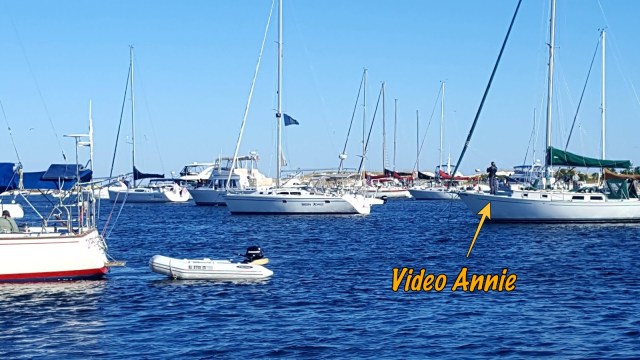
The view from Sea Hawk:

Turns out Bruce and Chris were anchored not too far behind our boat, which had Brandon’s Gulf Star rafted-up on our starboard side, and they had recognized the name on the back of our boat “Plaintiff’s Rest” from some of our YouTube videos.  This past year, Bruce and Chris moved out of their house up in Michigan and onto their 1968 Morgan (beautiful classic boat) and started sailing around Lake Superior to get their sea legs feet wet (or freezing!).  They had eventually made their way down the coast to Pensacola with their sights set on the Gulf, the west coast of Florida, the Caribbean and beyond.

Bruce dinghied up behind Brandon’s stern and started chatting away with Brandon who was out on the deck, grilling sausage.  About 80% of the time when Brandon and the family are out on the boat, there is sausage of some form grilling—breakfast, lunch, happy hour snack, or dinner (and we love them for it!).  I heard the words “Video Annie” and figured I had to pop up to see what was going on (and more importantly, what Brandon might say in response).  Bruce—God love him—was talking ninety miles-a-minute with no one able to get a word in edgewise.  He was talking about my YouTube videos, our time in the shipyard, our sail to Cuba and how he and Chris had been following my video blog for a while, how it had inspired them to finally start cruising, yachta, yachta, yachta …

I peeked out our companionway and could see Brandon smiling and chuckling to himself.  Then Bruce said, “And you’re a lawyer too, right, like Annie?  You guys both practice, or used to.  Chris and I thought that was so funny, two lawyers become sailors.”  And, Bruce continues rattling on.  I’m now laughing behind Brandon’s back and seeing him try to cut in to correct Bruce, but after Bruce just kept on a-truckin’, Brandon finally said.  “Yeah, the practice is hard.  I have to go to a lot of depo parties.”  I then let an uncontrollable cackle out.  Brandon loves to call legal depositions “depo parties.”  I finally stepped up into our cockpit so I could finally be seen by Bruce and he bellows: “VIDEO ANNIE!”

Turns out she lives on.  That feisty old gal.  Bruce, a little confused, glanced down at the name on Brandon’s stern, 5 O’Clock, then at the name on our stern, Plaintiff’s Rest, and said “Oh okay, this is your boat,” as he pawed his dinghy over to our Niagara, still chatting away about us (Brandon and I as he pointed) being lawyers and all.  Then Phillip finally emerged from our companionway, and Bruce said, “Oh … ” the first moment of silence since he’d arrived.  “Oh yeah, the bald one.  You’re the lawyer!” Bruce shouted, and Brandon lost it.  “Yeah, the bald ones are better,” he laughed.

Brandon, you funny!

Love that guy.

After a few minutes of unraveling Bruce’s confusion and him now understanding this was the same Brandon with Perdido Sailor, from all of our shipyard videos, Bruce then felt like he was truly in a celebrity circle.  We had a very fun chat with Bruce and his wife, Chris, about their finding their boat, following our HaveWind blog, enjoying our videos and, even, their first big sea experience on Lake Superior.  Chris was telling me that their first day out, they experienced 6-8 foot seas all day, and I told her that sounded a lot like my first offshore voyage on our boat.  “Oh yeah?” she asked.  And, then I asked if she had read Salt of a Sailor.  Bruce perked up and said “Video Annie writes, too?”

’Course she does!

“Yes, I love to write!” I piped back at Bruce.  “Do you like to read?” I challenged him, to which he and Chris both immediately spouted, “Yes!”

“Wait right there, then,” and I promptly went below to fetch Bruce and Chris one of my books from our cabin.  I began writing an inscription in Salt of a Sailor for them and told them they would enjoy the story of my first voyage which I told them, as I winked over to Chris, “also involved some 6-8 foot stuff.”

“Oh, our second day across the lake, we were in 12-14 footers!” Chris responded.

12-14 footers?  In a cold-ass lake!  I thought to myself.  Holy Moley!  I can’t wait until Chris writes that story because I would love to read it!  You can follow along on Bruce and Chris’s Sea Hawk’s Journeys here.

The reason I share this fun little exchange is because while I will never have the same reach with simply my blog, Instagram and Facebook page, that I had with YouTube—because video marketing is simply the way of the future—I still always want people to know that my platform at HaveWindWillTravel started with words.  It started with one of my favorite passions: writing.  And, I want to share my love for books and stories as much as my love for photos and videos.  Writing that, just now, I had to go back and look.  Wow, here is my very first blog post, dated March 29, 2013, titled “My First Sail,” which later became my first article in a sailing magazine, Cruising Outpost.  Man, how time flies!

Everyone knows the saying: “A picture is worth a thousand words.”  And, most millennials would probably say: “Then a video is worth a thousand pictures.”  While that may be true, I believe it’s all in the eye of the imagination-holder.  My own humble view is that it is, in fact, words—with their silent draw, their open canvas, their endless possibility for interpretation—that are worth a thousand videos.  With that in mind, I blew on my signature to dry the Sharpie scrawl, closed the cover to Salt of a Sailor and handed it to Chris, saying: “I hope Writer Annie inspires you, too.”

After that fun little share, I believe it’s high time Phillip and I kicked off this four-week Holiday Book Giveaway.  What say you?  If some of you don’t know, I have published three fun, entertaining sailing books that I love to share with followers.  You can download and read free previews of each book or order copies here.  Just as Bruce and Chris now hold and (I hope) cherish their signed copy of Salt of a Sailor, one of you can too.  First follower, either here or on Facebook, to answer this question correctly in a comment wins!  If you know the answer but already have a hard copy (or do not need another hard copy to give away as a gift), please let another follower chime in, thanks!

Book Giveaway #1:

For our first book giveaway trivia, we’re going to dig all the way back to the origin of Annie’s sailing days, back to 2013 and our first passage on our 1985 Niagara 35.  Who doesn’t love the infamous Mitch, right?  The answer is no one.  Just no one.  So, “while you’re down there” digging around in your HaveWind mental archives, what was the food item the infamous Mitch was craving right after we broke down in Carrabelle and were waiting on the mechanic to come and have a look at our engine?

And … GO!

Happy Holidays folks.  Phillip and I are so grateful to have you all following along and we hope you continue to enjoy ours and pursue your own journey!  It’s a big world out there.  Mostly accessible by boat!  : )

Bahamas Boat Project Recap!

“Go, go!  To the Bahamas you must!” said our good friend Pam.  As she went on and on about their fresh Bahamian bread and jam.  So “go, go!” we decided: “To the Bahamas or bust!”  But first Phillip and I had to break out the boat projects list and blow off the dust.

Hello followers!  I hope you like green eggs and ham.  I like it on a boat with a side of Spam.  I also like, nay love, Dr. Seuss, which is why I’ve written a few ditties here in true Seuss-style, and I thought a recap of the many, many projects Phillip and I have been knocking out this summer to prepare our boat for some more extensive cruising in the Bahamas and beyond this winter would be more fun with a Seuss spruce.

So, do you want to know how many projects we were able to squeeze in?  Kick back, grab a snack and let the project roll begin!

A leaking starboard water tank simply won’t do.  When we found the crack, Phillip said, “Out with you!”  But wrestling that tank out was a monstrous feat.  One I’m sure we won’t want to soon repeat.  As Phillip scratched his head and went about ordering anew, we thought the re-install would definitely go smoother if we spared an inch or two.


Once the water tank was out, the diesel tank was as accessible as could be, so we thought why not pop it out, too, and have a look-see.  We knew we’d had a wee leak that Phillip had previously clogged with JB Weld and we wanted to see if it had held.  An air compression test by a local welder told us it was no good, so have the tank professionally patch-welded we decided we should.


If you give a mouse a cookie, he’ll want a glass of milk.  And it seemed our diesel tank was of the same ilk.  Because not only did she demand a professional weld repair, once out and exposed she also wanted some Rhino-liner as protective wear.

Our cookie theme continued as we kept saying “While we’re in there,” and promptly decided, with both tanks under the starboard settee out, to glass it up and Bilge-kote down there.


With Westie nearby saying he wanted some love too, we decided to go ahead and dump the  old engine oil and pour in new quarts, just a few.


Some of you may recall the movement we noticed on the way to Cuba in our rudder post cap.  We reinforced the bolts with big thick custom washers to stop the wobble and called it a wrap.


Work, work, work.  Now you get the gist.  Clicking off projects left and right.  What’s next on our list?  Old flaky varnish?  That simply won’t do.  Not for our gal, she deserves every percent of our work, one-hundred-and-two.  Time to strip, clean, sand, and coat anew!


The brightwork was about a three-week job, a sweaty one for sure, but rewarding too!

So, tell us are you liking this spin on green eggs and ham?  Do you like it as much as a new Garhauer Cunningham?

While we were on the rigging, Phillip and I knew there was something else that needed our touch.  No one likes a clutch that won’t clutch.  We had a few on the coachhouse that were losing their grip, so we swapped them out for new Spinlocks with no slip!


Are you tired yet?  Perk up!  We’ve much more to do!  Time to knock out and re-bed some port lights that were letting rain water through.

Phillip asked of Annie: “Speaking of water, how’s that original 1985 pump in the head sound?”  “Like a wailing rat that’s about to drown!”  We’d had trouble with this guy not holding pressure and sucking our power, so we decided to replace him and save our amp hours.

And if we ever, God forbid, took on water out there, we’d want to pump it out quick.  Better get a few bilge pumps to spare.  “Stick your head down there Swab,” Phillip teased.  “Try to read the model number upside down, without bumping your head!”

A solar panel, sitting useless, scratched and giving no power?  Unacceptable!  When you can rip the old one off and pop on a new, in under an hour.

A dirty toe rail all scraped and scuffed?  Nuh-uh, no way, not when we’ve got Acetone and time to polish that stuff!

It seems almost every inch of the boat needs some unique form of care.  Some Iso-shield here and Armor-all there.  On-and-off went the mustache as we cleaned and polished everywhere.

And nothing shines like stainless steel.  Bust out the Colinite and polish that shit for real!

Man, look at those ratty old shifters, all wax-dipped and peeling.  I conspired with Brandon to surprise Phillip with shiny new ones, it just took a few free beers and secret dealings.  But I think we’re both going to enjoy driving the boat more with these on there, I’ve just got a feeling!


Speaking of driving, that’s been our great goal of the summer!  Get this gal behind the wheel more, so she won’t think docking is such a bummer.  And, it’s a good thing those shifters make it clear how fast you go, because I’ve been getting better and better following Brandon’s rule: “Go slow, hit slow.”


Enough with the plumbing and steering and everything else that so often fails, let’s talk about the one thing that you can always rely on, the sails!  Phillip and I knew we wanted a much broader sail plan this year to allow us to sail comfortably no matter the wind or weather, so we finally busted out our spinnaker to see if we could sail in winds light as a feather.

And when the winds, as they often do in the Gulf, want to stay above fifteen, we had a 90% working jib made so we can sail more comfortably out there and reduce our lean.


And, while we never want to find ourselves in blue water when it really starts to wail, if we do, we’ve got the 35% storm jib we had made this year in case we find ourselves in a gale.

And what’s that you say, Phillip?  Our whisker pole is in a funk?  With a dent that prevented it from sliding we were considering throwing it out as junk.  But, in a pinch, I decided to ask an auto body shop if it was something they could fix and Coastal Body Works here in Pensacola did it for this little gal just for kicks!

Chore after chore, have you yet grown weary?  That’s right when Mother Nature will throw you something frightful and eerie.  Twice we braced for hurricanes this season, Nate forcing us out of the water and up on the hard without reason. While we were incredibly grateful to come through unharmed, it was a great lesson in storm boat prep so next time we’ll be more practiced and less alarmed.

Once we were out of the water, the cookies continued to fall.  Because you know the first thing you’re going to want to do, if you have to haul.

A bottom job, that’s right!  If her hull is out of the water it’s what you must and should do! And, our pretty gal is so lucky she got a full-boat buff too!

But with our boat safe from the storms and ready to be floating again, that didn’t mean our boat chores would end.  Once she was splashed back, the reassembly began.  To retrieve the halyards, First Mate Annie (I wasn’t a Captain yet ; ) had to climb the mast again!

But it was a fortuitous hoist as it gave me a chance to inspect and give our new 5/16 wire rigging a polish.  It’s terrible to think of what simple sun and salt can quickly demolish.

Too many projects?  Is your head spinning yet?  We just got word, the new water tank came in!  We must go get!

Boy, was she pretty and sturdy and our eyes she sure lit.  We were quickly disheartened to find, however, she simply did not fit.

We wrestled and struggled and scraped knuckles and cursed.  And soon we were starting to fear the worst.  Perhaps we would have to order another new tank, this one even more slim.  Thankfully, before we made that decision, our buddy Brandon found another way to slip her in.

With a snip by the Dremel and some more cursing and prayer, we got the new water tank in (finally) with just inches to spare.  As with every minor refit, there is always one particular project that stresses you to the max, and this water tank, being the most costly and irritating, was definitely that.  But, despite our tired state and our water woes that we thought were through, our boat whispered: “I’ve got something else for you.”  Just when we were crawling out of a boat project slump, we discovered we had a leak from our raw water pump.

So Phillip and I rolled up our sleeves and decided to replace that too.  We might as well do everything here at the dock that we can possibly do.  While a summer spent on projects is definitely not what we’d call great fun, it’s better to knock them out now than trying to handle them during an offshore run.  So, little Sherwood, we’ll fix you too.  In fact, we’ll put in what we learned is a better pump, a Johnson that leaks less and is new.

While the water tank still holds the gold as the most frustrating project of the summer, the injuries Phillip and I received during this water pump replacement were quite the bummer.  A nasty burn from the heat gun to my right calf that thankfully resembled a heart, and a huge ripped blister on Phillip’s hand sure did smart.

Okay, I believe that covers the biggies.  Here’s our completed list!  Although I can already see there are some that we missed.

But, in comparison the remainder are minor and probably qualify more as routine care.  If you ever think you’ll get “finished” with a boat, trust me, you’ll never get there.  There will always be more polishing and whipping and cleaning and fixing to be done.  If you don’t think you’ll like that, then I’d say, a boat, you maybe shouldn’t get one.

For Phillip and I, while we enjoy much of the work that we do: lawyering, writing, marketing and all the rest.  It’s really the work we do on the boat that we like the best.

Hope you enjoyed the hammy recap – ha!  We’re Bahamas bound now!  Shove-off date is a little flexible (as it should be, right?)  But, it will be sometime in the next 3-4 weeks.  In the meantime, we’re poring over our Explorer charts and Steve Dodge Abacos guide (thanks again for the recommendation Pam Wall!) and planning our possible stops and routes.  We can’t wait to share this next adventure with you all!

Let’s Talk About This Captain’s Paperwork

My, my, the paperwork for this thing!  It was almost as hard to complete as the Captain’s License exam.  Okay, not really.  That exam was no freaking joke.  But the paperwork was a bit of a hurdle to overcome too.

Applicant Annie, mailing off her paperwork September 13, 2017.

Ahoy followers!  Hello from … now I can officially say it … Captain Annie!  If you haven’t seen on Facebook yesterday, I GOT MY CAPTAIN’S LICENSE!!

Man, I take a lot of selfies!  But, I’m not ashamed; I’m mighty proud of mySELF! : )

That is super duper cool.  But, just like the exam, it was no small feat.  For any of you out there thinking about going for your USCG Captain’s License, too, we wanted to share with you all the process and what all was required for me to obtain my license.  I wrote previously about my experience studying independently for and passing the Captain’s Exam (whew!), article here.  Now that I’ve received the official license, I thought I would share with you all the process of compiling all of the necessary paperwork for my application and my experience with the Coast Guard submitting and supplementing my application.

So, what all is required to apply to become an Operator of an Uninspected Private Vessel (OUPV)?  The checklist published by the National Maritime Center (“NMC”) was, in my opinion, the most organized, easy-to-follow list I found that sets out the OUPV License Application Requirements.  So, let’s start there.  Here’s the link.

Looks pretty straightforward, but I did have some hang-ups.  Perhaps there were blonde moments on my part (likely), but just in case some of you run into similar issues, here’s how the process played out for me:

     1.  Transportation Worker’s Identification Card (TWIC)

No more bank robberies!  You’re in the system now, ha!  A TWIC card is basically an identification credential issued to Merchant Mariners to allow them unescorted access to secure areas of port facilities, outer continental shelf facilities, etc.  To get a TWIC card, you simply visit this website and fill in an application online or schedule an appointment and complete the entire process at one of their processing centers.  You can find an application center here by inputting your zip code.  The center closest to Pensacola was in Mobile, so not a bad 45-minute drive for me.  And, it was a quick 15-minute in-and-out process.  They took my photo and fingerprints and filled out my application.  I was then issued a TWIC card that came to me in the mail about two weeks later.  You will have to include a scanned photocopy of this card, front and back, in your OUPV application packet.

One rub.  I hate my picture!  The TWIC guy (we’ll call him that), told me specifically to not smile.  “Hold a slack face,” he told me.  And, look at me!

There, I do look like a bank robber.   Why couldn’t they have used one of my typical, open-mouth selfies?

At least that way people wouldn’t question as often whether the woman on the TWIC card is me.  But, c’est la vie.  Moving on.

       2.  Evaluation User Fee

This should be paid online, your receipt printed and included with your Captain’s License Application.  Initially, I did not know this and was planning to pay by check.  But, first I checked with my contact at the Mariner’s Learning System (recall this is the company I used to buy an independent study packet for the exam so I could study at my own pace).  I wasn’t sure whether, having purchased their Captain’s License Package, the Mariner’s folks would help me compile my application to make sure it was correct and complete, so I sent an email inquiring.  Lisa over at Mariner’s (who was phenomenal and very patient with my many, many questions) confirmed they do not offer a document check, but advised she was available to answer any specific questions I might have (which were many).  The first of which was this payment issue.  You’ll see here, Lisa sent me the link to pay online and advised me it would cost $145.

You can also access the Pay.Gov payment center through the National Maritime Center here; it just takes a little more navigating to get to the Captain’s License page.

I got confused, however (who me? nooooo …), when I got to the actual payment page as to whether I was paying for an “officer endorsement” or “rating endorsement” and whether I needed to pay my “exam fee” or if that was waived because I had purchased the Mariner’s system.  So, again, I reached out to Lisa and, again, she steered me in the right direction.  Here is what she advised (you’ll see the drop-down menus filled in appropriately below):

Once the payment was processed, the NMC emailed me a receipt, which I printed and included in my final Captain’s License Application packet.  You’ll also notice I had to select a USCG Regional Exam Center during my check-out process.  You have to be sure to send your Application to the same REC you select during the check-out process to make sure all of your license requirements and fee are processed at the same facility.  Here is a list of the centers.  I just chose the one closest to me, in New Orleans.  And, I love NOLA, so I was hoping it would make for a little good luck boost on my application.  : )

P-Dub and I biking the beautiful oak-lined streets of NOLA April, 2017.

    3.  CG 719B Application

 You’ll notice it says “CG 719B” application.  That means it is an official Coast Guard form.  Before I found this detailed NMC checklist, I didn’t know some requirements had to be completed on an official CG form and, as a result, almost made a big mistake on my medical certificate, see #6 below.  Here is a link to the CG 719B Application.  You can fill it out online or print and fill it out by hand.  It’s pretty straightforward, just be sure to read each section carefully and make sure it is a section they want you to fill out or one that is for USCG use.

OATH

You’ll note in this paragraph on the NMC checklist that the Coast Guard requires an oath, stating the oath “may be administered by a designated Coast Guard individual or any person legally permitted to administer oaths in the jurisdiction where the person taking the oath resides.”  Hmmpfh.  Again, I haled Lisa as I wasn’t even sure what the oath should say.  Again, Lisa saved me by directing me to this form in the “Resources” section of the Mariner’s Learning System website, which I was able to print and sign.

Also, lucky for me, Phillip is a registered notary in Pensacola, so I had a readily available notary to notarize my oath.  Done.  What’s next?

    4.  Form I-551 Alien Registration Card

Applies only to foreign nationals, so this was not a requirement for me.

    5.  Signed Conviction Statement

 Thankfully, this “statement” is included in the CG 719B application, Section III, page 5, so completing and signing this section of the application satisfies this requirement.

    6.  CG 719K Physical Examination Report

Here’s where I almost goofed.  As I mentioned, this NMC checklist was the most useful to me because it was detailed and explicit in the types of forms required by the Coast Guard.  Many other “license requirements” checklists I had found on other websites (example here) merely stated a “physical examination” was required, not a CG 719K report.  I made an appointment with a doctor here in Pensacola before I knew anything about this specific CG 719K form.  Thankfully, my doctor (Dr. Tim Tuel with Baptist Medical – “Thank You Dr. Tuel!”) was much wiser than me.  It’s a good thing I told him what the examination was for, just for fun.  As you can imagine, Applicant Annie was excited about this whole process and willing to share with anyone willing to listen.  “I’m going for my Captain’s License!” I told Dr. Tuel, which made him chuckle at my energetic burst.  This tan little toned-up blonde trying to be a Coast Guard Captain.  It is kind of funny when you think about it.  But, Dr. Tuel just smiled and asked, “Where’s your form?”  [Insert Annie’s look of bewilderment here.  Form?  What form?]  I asked, “How do you know it has to be on a certain form?”  To which Dr. Tuel replied, “This ain’t my first rodeo.”  Ha!  Love that guy.  He was a lot of fun.   Dr. Tuel Googled and pulled up the correct form himself right there in the examination room, took the time to fill it out and even printed it for me.  Nice guy, that Tuel.

Unfortunately, he missed one section of the Report (I’m telling you, these things are tedious).  The first response I received from the Coast Guard after sending in my application was this:

That’s right, “Notice of Incomplete Application.”  Uggh.  Not the best feeling in the world.  But, when I read through the email, it seemed it was just a simple mistake of Dr. Tuel failing to state on my CG 719K form which methodology he used to test my vision.  So, I went back to Dr. Tuel with my previous 719K form and asked if he would complete the section and initial it and then re-sign the certificate at the end.  Thankfully, I caught him on a slow day and it was just a 15-minute wait while he finalized my report.

Also, after speaking with Beverly at the USCG, I was advised the completed medical form could be emailed in for processing (as opposed to snail mail) and that was helpful.  So, one glitch there.  Fixed and re-submitted.  Moving on.

    7.  CG 719P Chemical Testing Report

 Ahhh … the drug test.  I knew I was totally clean there.  While I will readily admit that I love my wine and liquor, Captain Annie does not do drugs.  No judgment on folks who do.  It’s just not my thing.  But, mean ole’ Brandon had me really freaked out about it when I stopped by the shipyard to pick up some parts we had ordered right after I had already taken the test, and he told me they were going to analyze my urine for alcohol.  “If you still have alcohol in your system, they’ll pick it up.  Did you drink last night?” Brandon asked.  “Did I drink last night …. Is it a Wednesday?” I thought.  Of course I did!  I think most sailors operate on a pretty base-line low-alcohol level, am I right?  But, what was done, was done.  I had already pissed in the cup, and sent it up the chain, so I just had to be a little freaked out about it for a few weeks before it came back COMPLETELY NEGATIVE.

Take that Brandon!  Ha!  My piss is primo!  (Love that guy.)

But, how did I go about getting a test conducted that would be sure to meet the USCG requirements?  Again, like the medical certificate, the drug screen must be completed on the Coast Guard’s specified form, here, the CG 719P.  The gal at Mariner’s Learning System recommended I contact Quest Diagnostics to handle everything.  It was a breeze.  I called to request a drug screening specifically for my Coast Guard’s License application, paid over the phone (I believe it was $65.00), and set up an appointment online at a local facility.  Luckily, there are two facilities in Pensacola, so this was an easy 30-minute appointment to make and the results were emailed to me by Quest a couple of weeks later on the appropriate CG 719P form, which I printed and included in my Captain’s License Application packet.  Voila!  Next up?

    8.  Front and Back Copy of Driver’s License

Piece of cake!

    9.  3rd Party Release

This is needed if you want the NMC to be able to discuss, release or receive information or documents from a third party (i.e., spouse, employer, etc.).  This didn’t apply to me.

    10.  Evidence of Appropriate Sea Service

This is the real meat of your application (or at least it was for me).  In order to apply for an OPUV 6-Pack license, the applicant:

  • Must be able to document 360 days of experience on a vessel
  • Must have 90 of these days within the last 3 years
  • 90 of the 360 days must be on the ocean or near coastal waters, or the license will be limited to inland waters only.

The license will be limited to uninspected vessels of less than 100 gross tons.  When calculating qualifying sea time, you must have been underway on the water for a minimum of four (4) hours to count as one (1) sea day. (Only one day’s credit is allowed per date.)  And you must document the time on the Coast Guard’s specified Sea Service form, the CG 719S.

I had not been keeping up with my sea time since I started sailing in 2013, but I would recommend anyone who is thinking about going for a mariner credential at some point in the future to do this along the way.  Bring along a few blank Sea Service forms when you know you’re going to make a passage or be on the water for several days and get the Captain or Owner of the vessel to sign off for you once your sea time is complete.  Because I had not been doing this, I had to sit down with a calendar and re-construct my time over the last four years and obtain signed Sea Service forms from the various Captains and Owners I had sailed under.  It was actually a very fun escapade down memory lane and I did a brief write-up and tribute to each of those captains here.  Thankfully, with mine and Phillip’s many offshore passages on our own boat, our Atlantic-crossing in 2016 and the handful of passages and sails I have done on friends’ boats, all within the last four years, it was fairly easy for me to meet the “90 days within the last three years” and “90 days offshore” requirements.  It was really cool, too, to tally these up and see how much awesome sailing I’ve done in such a short time.  I’m quite proud of these days!

Total days experience:  368

Number of days offshore: 112

Wow.  I hope I double those numbers over the next three years.  Sail on Captain Annie!

    11.  Photocopies of all applicable Training Course Certificates

This is why Phillip and I went to STCW school back in June!

While the firefighting was wicked cool, and I got an awesome burn, the first aid, CPR, fire-fighting and water survival training included in this certification sufficed for my Captain’s License “training course” requirements, which is the primary reason Phillip and I took the course.  We went through the Sea School because they had a facility relatively close to us in Bayou la Batre, AL.  After completing the course (there were some moderately difficult tests involved, but the instructors worked hard to make sure you passed), the Sea School sent Phillip and I a packet of certificates for the courses we completed, copies of which I included in my Captain’s License application.

    12.  Course Certificate

Proof that you passed the MPT Captain’s Exam within the last year.  I took my Captain’s Exam on June 26, 2017 at a USCG testing facility (a.k.a. a conference room at a Holiday Inn here in Pensacola) and thankfully passed!  After Mariner’s Learning System was notified of my score, they emailed me a certificate documenting my accomplishment which I printed and included in my application packet to prove I had passed the exam.  That was a biggie.  Whew! 

    13.  Three (3) Letters of Recommendation

This was one requirement that was a little hidden in my opinion.  At least not every Captain’s License requirement checklist I found on the web included this.  For example the NMC checklist I cited primarily above did not mention this.  But, if there was anything I learned from studying for the Captain’s Exam, it was to consult a lot of different sources.  Several other sites I found mentioned this “letters of recommendation” requirement for original license applicants, meaning, those who were seeking issuance of a license for the first time.  ‘Tis me!” I said, and promptly Googled around to see what an acceptable “letter of recommendation” looked like and found this website, with a sample letter of recommendation.

I typed up three of these for three of the captains I had sailed under to sign and complete and that sufficed for this requirement.  But, I have talked to several other applicants during this process who did not know about this “letters of recommendation” requirement.  So, there are many potholes to fall into, so to speak.

The good news?  I found the Coast Guard folks were very forgiving and easy to work with.  They were responsive and notified me immediately of any deficiencies in my application, noting I had 60 or 90 days to fix each one.  So, that was comforting.  After my incomplete Medical Certificate issue was fixed, the next errors the Coast Guard caught were a few places I forgot to sign my own Sea Service forms (doh!) and areas on my Sea Service forms where I had filled in the vessel owner’s name, when I should have put my own.  However, the Coast Guard folks advised I could cross-through the wrong name, fill in my own and initial it and that would remedy things.  And, I was notified of all of these issues and errors via email from the Coast Guard and offered the ability to send in supplemental portions via email.  So, that made things a lot easier for me as I do most of my work remotely via email and digital documents.

In all, the OUPV documentation process took me about four months to complete (although, granted, I wasn’t focused on it every day, but there are many moving parts and you have to rely on the cooperation of other people, so it does take time).  I was advised by the Mariner’s Learning System folks that I had to complete and submit my application within one (1) year of successfully passing my Captain’s Exam (for me, that would be June 2018), so I was well within the time limit.  But, it is definitely a project you want to get started on early as there are a lot of hoops to jump through.

Many thanks to all of the Captains I have sailed under who were generous enough to review and sign my Sea Service forms and provide letters of recommendation and the very patient folks at Mariner’s Learning System and the Coast Guard who helped walk me through the process and answer my many questions.  I hope this post will help shed some light for those of you out there who are also thinking about pursuing a Captain’s License to get a better understanding of the paperwork and requirements involved.

I honestly can’t believe I have obtained this credential.  While Phillip and I decided this would be a good endeavor for me to help shape me into a far more capable and knowledgeable mate (and now sometimes Captain!) on our future travels, it still shocks me a little that I, who only started sailing four short years ago, was able to accomplish this so soon in my sailing career.  The training and education I have acquired have already started to show in mine and Phillip’s passages and cruising, and I am so proud that I am able to offer him, now, so much more insight, input as well as a sounding board for some of our very difficult decisions when navigating, weather routing, deciding on destinations, passages and – oh yeah – docking!  I’m getting better at that, too.  Primarily the goal was to grow my skills so that I can contribute more to help share the “stress of cruising” so that the entire experience is more comfortable for us both.  It’s also a very good benefit to know this license will help decrease our annual insurance premiums (yay!) and will allow Phillip and I to earn money on the occasional offshore delivery that works with our schedule and plans.  In all, it was an educational and enlightening process that I am proud and glad I completed.  If any of you out there are thinking about going for your Captain’s License and have questions this post and my previous “Let’s Talk About This Captain’s Exam” post did not answer, please feel free to email me and reach out.  I’m happy to share.

Now, when Phillip and I head off on our next adventure, it will be Yours Truly more often at the helm, scanning the charts, checking the weather, and shouting to Phillip, “Hey Swab, while you’re down there, tighten that hose clamp.”  Ha!

Thanks to my followers, as well, for your support and encouragement.

Captain Annie, signing off.

Chasing a Blown Impeller: Get Back Here Little Feller!

“The end of a mystery?” Yannick wrote me just a few short weeks ago. That’s a title that will catch anyone’s attention. And when I open the email what do I see?   Yannick’s grubby fingers clutching the culprit. Yannick has been after this guy since we first pointed his 46’ Soubise Freydis south toward the Gulf of Mexico on our way to sail across the Atlantic Ocean last year. Seriously, not two hours into the first day of our offshore voyage, May 29, 2016, the starboard engine on Yannick’s boat overheated and we had to shut her down to investigate. For those of you who watched our movie from the Atlantic-crossing, you’ll remember this little gem.  For those who haven’t seen it yet: Lord!  Clear your calendar tonight, grab some popcorn and carry-out on the way home and call it Movie Night!  Link to view here.

What we found when Yannick took the water pump off and disassembled it was a blown impeller.  The thing had launched several of its vanes.  (Or “impeller fingers” as I call them; it’s a good thing Phillip speaks Annie.)

Yeah, those guys.

By boiling the thermostat from Yannick’s starboard engine, we also found it was not opening completely, so Yannick dutifully replaced both the impeller and the thermostat and the engine then held temp fairly well.  However, the starboard engine continued to struggle at times to hold temp and it was not pumping as much raw water exhaust (“pissing” Annie called it) as Yannick would have liked.  And, apparently, that was still the status of the engine all the way up to a few weeks ago.

That’s when Yannick found the end of a mystery!

This little guy.  The culprit!  Do you know what that is?

That’s right.  An impeller finger!  Wedged in the output end of Yannick’s water pump, only detectable when he took the entire pump off to change the seals.

The lesson here?  When facing a blown impeller, your first instinct needs to be “Get back here little feller.”  Brandon with www.perdidosailor.com has warned us about this many times.  If you throw one or more impeller blades, do not put the engine back together until you’ve found every last piece.  Yannick did not know this blade had been stuck in the back end of his water pump for over a year restricting his raw water exhaust.  But, he extracted it this time and has reported he’s now thoroughly satisfied with his pisser!  : )

Nice work Captain Yannick!

Real-Life Example #2:

I swear it felt Phillip and I were attracting water pump issues that week.  The same week Yannick sent me that email, Phillip and I had another chance to chase down a little feller.  We headed out on a Friday afternoon, like we often do, sailing across Pensacola Bay over to Red Fish Point for a quiet, relaxing weekend on the hook.  Some anchorages around here are absolute party towns where everyone knows your name and everyone starts drinking at 10:00 a.m.  I can only do that for so long before I lose my voice and my dignity.  Phillip and I like to shake it up and spend some weekends in PartyVille (known as Ft. McRee) and other weekends at more secluded, quiet anchorages (like Red Fish Point or Big Sabine).  We’re lucky, Pensacola offers handfuls of both.  Some fantastic photos for you here from our exquisite sunset sail over to the anchorage

We arrived at dark, dropped the hook and were pleasantly surprised the next morning to find the masthead lights we had seen the night before were actually some very good cruising buddies of ours: Mike and Sherry on s/v Imagine, a 1981 Tartan 37’ that they have done a fabulous job restoring.  I did a tour of Mike and Sherry’s boat that you can view here:

After the end of a glorious weekend on the hook, Mike and Sherry weighed anchor early on Sunday morning to sail home but, unfortunately, did not make it very far.  Not thirty minutes after they had left, Phillip got a call from Mike:

“Uhhh … hey Phillip, I’m in the North cut and we had to cut the engine because it overheated.”

Good times.  Sometimes boats can drive you crazy.  Wait.  Scratch that.  Often times.  Thankfully, Mike had a very favorable east wind that, on Phillip’s suggestion, he used to sail his way back through the tight channel to our anchorage so we could help him dissect the overheating problem.  Phillip and Mike dug in and sure enough, found him again.

The culprit!

One of the blades on Mike’s impeller had wedged itself in his exhaust hose and impeded the flow.  So, say it with me now: If you’re facing a blown impeller, what do you say?

That’s right.  “Get back here little feller.”  You’ve got to locate and account for all of the missing impeller blades because you never know where one might wedge itself at a moment when you desperately need your engine.  While Phillip and I had been told this many times, our recent experiences with Yannick and Mike really brought the message home.  And, it’s always fun to learn a good lesson when it happens on someone else’s boat, right?  Thanks for the perfect exemplar Mike!

But, here’s the real kicker.  It’s as if our own gal was getting a little jealous of all the attention we were giving other folks’ raw water systems.

Real-Life Example #3

After getting Mike all buttoned up and running again, Phillip and I weighed anchor ourselves later that morning to motor home from Red Fish Point and—as if on cue—our water pump started leaking on the way home.

While we weren’t sure we had thrown an impeller blade (but I can assure if we had, we would chase that thing to high heaven!), we have experienced a water leak at this very spot several times before.  It’s at the weep hole between the two seals that prevent the oil side of the pump from leaking into the water side (and vice versa).  We’ve had to re-build our water pump twice due to a leak in this area, the last time was the day before we were planning to shove off for Cuba.  Phillip said, “Nuh-uh, Sherwood.  You ain’t stopping this show.”  Ha!

It’s not too difficult of a task, just one we were sick of repeating.  Phillip had researched and found this was a known issue on the Sherwood pump (a leak between the oil and water seals), which caused Westerbeke to start using Johnson raw water pumps instead.  Phillip had ordered one a while back that we were planning to bring with us to the Bahamas as a spare.  Well, it was now high time for that spare.  We decided to just go ahead and put the new one on in hopes of it lasting throughout the season (and hopefully longer) without issue and re-building the Sherwood to bring along as our spare.

Scraping off the old gasket is the hardest (and most curse-worthy) part.


Now, that’s a fine-looking impeller.  Always remember to coat it really well with glycerine on the first “dry” crank so you don’t throw a blade right out of the gate.

We also changed out the zinc (it was high time) while we were in there and cleaned out the heat exchanger as best we could.  She had a graveyard of old zincs knocking around in there!

Much better!  Good work Miner Annie!

Putting the new pump in (we painted it Westerbeke red to match!):

Replacing the pump isn’t too taxing of a chore, but you probably need to set aside an entire afternoon to do it. And that’s assuming everything goes as planned.  When, during a boat project, does everything fit, you always have the right tool or part and you’re able to start and finish the job on the same day?  If we learned anything during our three-month stint in the shipyard in the Spring of 2016 it’s that just about every project has its fair share of kinks.  During this water pump project, Phillip and I got a little kinky ourselves and ended up some very bad hoes!  Anytime we talk about hoses on the boat, it always reminds me of that brain-cell-suckingly stupid “Boats & Hoes!” Will Farrell video from Stepbrothers.

And, yes, I sing that out-loud every time we deal with any kind of hose on the boat.  Now, it’ll be stuck in your head.  You’re welcome. Phillip loves my musical contributions.

Phillip and I decided, since we were going to replace the water pump, we might as well replace the super-old hoses on it, too.  We call it the Mitch theory: “While you’re down there.”  But, what all-important lesson did we learn during this raw water project?

NEVER FIGHT BAD HOES!!

Just don’t.  They will bite, cut and maim you.  Look what they did to us!!


I got a good “doctoring” (as my Dad would say) from Phillip.

Those are some serious boat bites.  And, I promise you, none of these boat bite pics are in any way edited.  Now, how, you might ask did Phillip and I get so beat up just trying to wrestle some hose onto the new water pump?  Because we’re idiots, is the short answer.  And, we apparently need to go back to Caliper School.  Phillip and I accidentally got the wrong size hose and spent the better part of the day trying to fight 3/4” hoses onto 7/8” barbs.  Yeah, brilliant.  Turns out, hoes don’t like to be tortured.  Boy did they fight back!  I’m surprised we got those too-small hoses on as far as we did.  We should have realized something was off, but what did we do instead?  Kept fighting bad hoes!  Don’t let this happen to you, my friends.  Our boat bit me the hardest she ever has to make sure this lesson stuck for me.  I first got burned by the heat gun we were using to stretch the ridiculously too-small hoses, then the boat ripped my blister open while I was trying to fight them on.  But, after I saw the mark she left behind, I realized she what she was trying to show me:

SOME BOAT LOVE

Even when she bites me, I love that salty gal.  I don’t ever want to think what I would do without her.  It gives me heart burn.  What, too much?  Ha!

Two weeks healed!  I’m kind of digging it now.  It’s like the best boat bite ever.

Hurricanes: The Sometimes Horrible Reality of Cruising

I’ll have to admit, this is one part of being a cruiser I really don’t like.  You thought I was going to say docking, didn’t you?  Admit it!  While that is definitely one.  That and de-docking (Annie term).  I also loathe the threat of hurricanes.  As a cruiser, you don’t just own a boat.  You love her.  She’s not just fiberglass and wood to you.  She’s a friend, a member of the family, your home, your ticket to world travel.  And she holds so many memories.

I remember the day Phillip and I shoved off the dock, April 17, 2013, with our new-to-us Niagara 35 and saying goodbye to her previous owners.  Jack and Barbara had spent twenty-four amazing years sailing her along Florida’s west coast, as well as the Keys and Caribbean, Jack even single-handed her in the Mackinac race several times, and now they both had tears welling up in their eyes as we waved goodbye.  It was like they were sending a child off to college, a mix of hope for an exciting new chapter in her life, but also the pain of watching her leave.  Seeing how tough that decision was for Jack and Barb, I cannot even begin to imagine what it feels like when that precious element of your life is ripped from you without choice, and not to set sail on a new adventure, but smashed to bits, never to be enjoyed again.  By anyone.

My chest aches writing this and thinking of all those, many we know, thousands we do not, who lost their boats in the recent storms.  Hurricanes are just a horrible reality cruisers and boat-owners have to deal with.  And, while many can plan to stay outside of the hurricane box during the season, or haul-out every time a tropical storm watch develops, many simply cannot get out of the path due to other obligations: work, family, money, time, etc.  So, they have to strap their baby down as best they can, say a prayer, and hope for the best as a hurricane barrels down on her, whispering “Hold fast, girl.”

Others find their only option is to try to sail away from the hurricane.  Many—who are unfamiliar with offshore sailing and the impact weather, wind and gear failure can have on the speed and success of a voyage—when they see hundreds of boats destroyed from a hurricane think: “Why didn’t they just sail to somewhere safe.”  It’s not always that simple.  Hurricanes often form quickly and can cover a span of hundreds of miles.  Irma was 400 miles wide.  Four.  Hundred.  Even in favorable conditions, sailboats just don’t go that fast.  On a boat like ours, if you’re averaging 5-6 knots an hour, you’re doing great.  But, that still means you are only traveling roughly 130 miles a day.  If a hurricane the size of Irma is set to hit you in three days, that doesn’t give you a very comfortable window of time to get out of the path, and that’s assuming the path holds, which is always a gamble.  You may find yourself out there in 10-20 foot seas and winds over 120 mph.  It’s rare any live-aboard sailboat can survive that.

Phillip and I recently watched a fellow cruiser and friend from Marathon, along with her boyfriend and dog, who had tried to sail north away from Irma, and they had to be rescued off the coast of Clearwater by the USCG.  (Article here, and I hope to be able to speak with Pamela and Sebastian once they have more fully recovered and learn what happened so we can all benefit from this harrowing, but thankfully life-saving, event.)  Phillip also told me I needed to read John Kretschmer’s At the Mercy of the Sea, before writing this.  While it is the next book on my list, I felt too strongly about this now, while we’re all bracing for, and still recovering from, so many vicious storms.  But if any of you have read that book and would like to share, please feel free to do so in a comment.

I will also admit, having grown up in the middle of New Mexico, I am, thankfully, very new to the horrid reality that hurricanes bring to living on the coast.  Ivan was the first hurricane I experienced.  I was married at the time and my husband’s parents lived in Perdido Key.  He kept watching news footage of weathermen and women, shouting in the spitting rain, picking up twigs and overturned road signs, and satellite image after satellite image for two days, and I really didn’t understand why.  How is watching that going to change anything?  You just board up your house and leave, right?  Then come back and assess the damage.  Little did I know.  Hurricanes do not just cause damage.  They decimate.  I did not know houses could be leveled to mere slabs, with not a scrap of wood or even a personal belonging in sight.  My husband and I drove far west through Mississippi, then down south—literally rounding the west wall of Ivan as it came up through Alabama—to get to Perdido Key.

We waded through water in thick underbrush to try reach his parents’ neighborhood from behind because the roads were blocked.  I did not know at the time the dangers of wading in open water after a hurricane.  Had I, I would have never followed him.  But, I did, and I cringed each time I saw a snake drop from a tree near me while I carried my small black lab, blue heeler mix, Dixie, in my arms.  It was a horrible experience.  When we reached his parents’ street, we found two feet of water in the house, four in the garage.  It was a mess.  Soiled, filthy, wet remains of what once was a beautiful, warm, welcoming home.  And this was just a house with water in it.  Over the course of the next few days, we walked the streets along Grand Lagoon and Perdido Beach Boulevard and that’s when it really hit me.  Washers, dryers, chairs, pillows, and framed photos were piled up on the street in dunes of debris taller than me.  Houses were slabs.  Huge pine trees were mulch.  Condos on the beach looked like they had been eaten.  Whole floors bitten away by some giant monster.  Entire swimming pools, surrounded by concrete and tiled patios and gates were literally gone.  Only sand was left.  That’s when I learned what hurricanes can really do and how easily the ocean, if she’s angry enough, can take whatever she wants.  It is a simple and undeniable fact.  You cannot predict or control the weather and sometimes she’s just going to win.  She’s just going to take.

This is the risk you sign on for when, knowing this, you decide to still buy a boat and set your sights on exotic locations.  Everything has its risks and nothing is guaranteed.  If you drive a car, you risk an accident.  If you buy a home, you risk losing it to a fire or flood.  If you fall in love and give someone your heart, you risk getting hurt.  But you do it anyway.  Why?  Because that’s life.  Not going or giving because you are afraid of loss is not a way to live.  The one thing that is guaranteed in life is that you’re only going to be here for a certain period of time.  It’s finite.  And you’re going to suffer loss, whether you try to avoid it or not.  You will lose things, pets, and people (even the boat equivalent) whether you decide to live your life fully or not.  So do it anyway.

This is at least what I tell myself when I see so much devastation and loss recently from Harvey, Irma, and Maria and when I feel, now, Hurricane Nate bearing down on Louisiana and the panhandle and it knots my stomach. While I hate the feeling, I try to remind myself it is only because I have such wonderful things in my life to lose, which makes them worth all of the stress, work, blood, sweat and money.  So, with that in mind—as I sit and type this on Friday morning, October 6th at 9:42 a.m., waiting for the 10:00 a.m. NOAA update on Nate and deciding whether we are going to haul-out today or not.  That is such a heated question.

No hurricane plan is a guarantee.  No matter how well you secure your boat, if you’re not there (which you shouldn’t be in any storm too dangerous to ride out), you will not be able to stop another boat, (or barge or tree or a hundred other things that are tossed around like bath toys in a hurricane), from colliding with your boat and causing damage.  You can tie up ultra-secure in a hurricane hole, but your anchor may fail or your boat may begin to take on water and eventually sink.  If you haul-out, your jacks could fail, the boat next to you could topple over, or they can even drop your boat while in the straps.  If Plaintiff’s Rest can stay in the water, Phillip and I would prefer it.

Currently, however, we have a mandatory evacuation from our marina and with not a lot of time or hurricane holes around here that are not probably full already, Phillip and I decided to use our hurricane haul-out option and at least schedule a haul-out for 2:00 p.m. this afternoon.  We also got some great advice from fellow boaters on how to secure our boat even further once she is on the jacks which we’re happy to share with you:

  1. Tie all of the jacks together with wire, chain, or strong line to form a reinforced cradle rather than independent jacks.
  2. Tie seizing wire around the cranks for the jacks to ensure they are not able to rattle loose in the intense vibrations from the storm.
  3. If possible, e., in a non-paved marina, embed earth anchors and strap your boat down to those as well.

If Nate’s path continues to track east and our prediction holds as merely a tropical storm warning and if the marina lifts the mandatory evacuation order, we would like to stay at the dock.  If we did, we would secure extra dock lines with chafe guards (we use strips of fire hose, with little dyneema tie-downs to keep them in place in the chalks).  I also did a post recently on Facebook showing all of our prep (including Pam Wall tips!) on dropping all of the canvas and pulling all of the lines up into the mast with photos, which you can view here.  Whether our boat rides out Nate at the dock or on the hard, she will ride with as little windage as possible.

We welcome anyone else’s tips on best hurricane prep measures and best practices you have found in the past to make your boat more secure for a storm.  Feel free to share.

Phillip and I will be as ready as we can be.  After that, we just have to remember how awesome and fulfilling this lifestyle is and hope for the best.  We hope you, and your boats, all remain safe in the eye of this storm.  If Mother Nature decides it’s our time to suffer a loss, Phillip and I will bear that and be thankful we’ve still got very full lives ahead of us to live and we will rebuild together.  We’ve done it before.

UPDATE: We hauled Plaintiff’s Rest out this afternoon.  She’s stripped, tied down and as ready as she can be.  It’s all we can do.  I gave her a kiss and told her good luck.  Hold fast girl.

A Silky Article in Cruising Outpost!

“Call it crazy, call it beautiful, bold, I call it: No regrets.  I will never forget that moment.  That feeling.  Soaring weightlessly, floating freely in satin sheets from the mast of a sailboat, with the vast Gulf horizon as my backdrop.”  Hey crew!  I’m so proud to share this with you, an article I wrote for Cruising Outpost Magazine about silking on a sailboat, even during an offshore passage on SailLibra last year on our way to the Miami Boat Show.  I spy TeddyJ in there, too, with SailLoot.  Man, how time flies!  It’s such a freeing feeling.  I hope some of you out there grab a pair of silks and start silking on your sailboats, too.  Many thanks, as always, to one of my mentors, Bob Bitchin, and his fun and beautiful wife, Jody, for sharing this opportunity with me.  It’s such an honor.  You guys go pick up a copy of Cruising Outpost today and check out these stunning aerial silks photos for yourself!

I even made the cover …. eek!  : )  Happy Little Author Annie here.  See?  I told you guys when I stopped doing the full-length YouTube videos, I was going to do more writing.  I’ve still got a few more articles coming at you this year.  Enjoy!

Monohull versus Multihull: We Share in SAIL Magazine!

“Bouncing cement really captures it.”  I love that line.  Because it does.  It just does.  “Each time water trapped between the two hulls rumbled, thundered and finally bashed its way out, I had to convince myself that we had not just hit a whale.” So true.  And, yes, yes, I know that is just the offshore-on-a-catamaran experience which Phillip and I became very familiar with during our Atlantic crossing last year on Yannick’s prized 46’ Soubise Freydis, Andanza.  Island hopping and on the hook, multihulls are a total floating condo, spacious and stable.  But, with boats, there are always trade-offs.  When Phillip and I announced last year that we would be crossing an ocean on a catamaran, many followers told us that we would “be converted.”  I can assure you we were not.  There’s just something about monohulls and the way they feel (and heel) under sail that we have fallen in love with.  Like the fiesty little French gal we met in the Azores put it: “They dance with the ocean.”  Real treat for you here followers!  Many of you have often asked me and Phillip our opinion on monohulls versus multihulls.  Now you can read our thoughts on the matter in my latest article in SAIL Magazine.  Many thanks to Peter Nielsen and the hardworking crew at SAIL for publishing another article of mine.  It means a great deal!  Go grab a copy and let us know your own thoughts on mono versus multi in a comment below.  Enjoy!

My First Delivery (Attempt): Carrabelle to Pensacola on a Catalina

With Wild Phil Hickok at the helm, ominous rumblings in the distance, and magic wires and mysterious wildlife awaiting us in the midnight river, me and these adventurous three are about to get underway.  Buckle up!  Strap in!  And let the tale of my first delivery (attempt) begin!

(Annie’s First) Captain’s Log

 Saturday, 8:34 a.m.: Wild Phil successfully de-docks at the Carabelle Marina, docks at the fuel dock, fills up and leaves the fuel dock unscathed.  Motoring through Apalachicola Bay at 4.8 knots with thunderheads building and rumbling on the horizon.  The crew discovers the auto-pilot is not working.

By now, I’m a little irritated this man has now docked three times right out of the gate without issue but—hindsight being 20/20—I now know he’s got plenty of issues coming, so I’m cool with it.  It did show me perhaps I freak out a little too much about docking as this man, a brand new boat owner, didn’t even flinch at it.  I later learned Wild Phil is cocky as hell.  Granted, it usually became a handy, self-fulfilling prophecy, but even when his confidence outgrew his abilities, it didn’t seem to get him into as much trouble as I imagined. Lesson Learned: Confidence, justified or not, is an asset.   

No answer for you on the auto-pilot.  Bob noted in the survey that it was working fine but we just could not get the darn thing to come on.  It may be a wiring issue, but with all of the tight navigating we knew we would have to be doing in the ICW, we knew a good bit of this trip would require hand-steering, so we didn’t investigate the failed auto-pilot any further.  Grab the wheel.  C’est la vie.

Saturday, 10:27 a.m.: Typical Florida pop-up storm creeps up on us.  The crew decides to let Captain Phil handle it solo, which he does like a champ.

Aren’t we nice?  I mean, the man did say he wanted to gain as much experience as possible.  Knowing what it feels like to hold the helm in driving rain is definitely high on the list.


Saturday, 11:02 a.m.: Storm passes within 15 minutes.  Engine dies inexplicably.  Crew throws out the head sail for propulsion.  Captain Annie sails the boat around shoaling while Phillip and Phil inspect the engine and investigate.  Phillip determines the engine overheated, adds coolant, allows to cool.  Engine re-cranks and we continue under motor-sail at 4 knots.

When I “sails the boat around shoaling,” I mean puckered my ass and sailed the snot out of that thing!  Eeking out what little navigation I could, with winds of 6-8 knots and 3 foot depths around the narrow ICW, was some of the most pinched sailing I’ve ever done.  Definitely a great experience for me to be forced to sail in a narrow channel with light winds. 

So, what happened to the engine?  At first, we thought it had overheated because Phil noticed it was over 180 on the temp when it cut out and he recalled the previous owner told him the engine would automatically shut down if she overheats, which apparently she did.  We had some trouble locating the overflow coolant bin (the hoses from the engine seemed to go into the bulkhead into nowhere), but we eventually located it in the port-side lazarette.  Why is this a big deal?  Because while we’re scratching our heads and chasing silly hoses, Annie is tacking and turning and trying to keep our keel off the ground.  Lesson here: Phillip and I should have located all of the fluid fills sooner so we could have handled this problem more efficiently.  But, we did still have to have to wait for the engine to cool before it would re-crank.  A quick turn of the key showed the temp was over 200 and the level in the overflow bin was below the low mark, so we definitely thought she had overheated.  A few more minutes of creative sailing by Annie while the engine cooled and she then re-cranked and we were back on our way toward the Apalachicola bridge under motor sail.

Saturday, 12:15 p.m.:  Engine dies again.  Annie takes the helm again while Phillip and Phil investigate.  Crew believes not enough coolant was put in the first time, although the temp had not breached 180 this time.  Bit of a mystery.  Coolant added while engine cooled, re-crank and motor-sailed under St. George Island bridge.

The coolant was just above the “low” mark on the bin.  When Phillip filled it the first time, he filled right up to this mark, thinking it was the “high” mark but further investigation proved the high mark was higher up.  But, no one really had that “Aha, it overheated”-type revelation here because the temp never got over 180.  To be honest, we were now a little stumped as to what was going on with the engine but the crew was glad to be making way and looking forward to stopping for a drink and bite in Apalachicola before heading up “the ditch” to Lake Wimico.

Saturday, 3:45 p.m.:  Engine dies again just before Apalachicola Bridge. Crew is starting to think this is a fuel problem.  Phillip and I note crud in the bottom of the secondary filter globe but the fuel itself looks clean.  Phillip notices the two clamps on the hose leading to the filter are loose and have slacked down the line.  He re-tightens thinking this may have been allowing intermittent air intake in the fuel system, and shutting down the engine.  He tightens the clamps, engine cranks and Phil docks successfully at the Apalachicola City Docks.

Sorry, Mechan-Eric, you can’t get it 100% right every time.  One of his guys must have forgot to tighten the hose clamps back after they changed the fuel filter.  We were all hopeful the engine was just sipping air now and again and this was causing the repeated shut-downs.  Only time would tell.  For now, Phil had navigated his third docking with ease (the bastard!) and I was starting to get a little pissed off by it.  When was he going to finally hit something?  When you’re first learning, you have to bump a few pilings and docks, right?  It’s required.  Apparently not, for this guy.  Proud new owner, Phil, docked safely in Apalachicola:

Saturday, 7:32 p.m.:  Bellies full of Appalachian tacos, fries and beer (just one each, a margarita for me), Phil navigates us off the dock and up the ICW.  Engine running fine for the moment.  Crew plans to motor the ICW overnight.

Yes, another de-docking without incident.  Whatever.  I was over it by then.  Things were just always going to work out for this guy.  He even got duck fat fries that day.  Any day that includes duck fat fries can never be considered a bad day.  If you’re ever in Apalachicola, go to the Owl Tap Room and order these.  That’s not a suggestion. Fries and cheese, smothered in beschamel and topped with bacon. They will change your life!  


 Saturday, 9:15 p.m.:  Beautiful sunset on the river, but visibility is very poor in the ICW.  Tight channels and turns and floating debris have to be constantly spotlighted for the helmsman.  Two-man shifts begin with one crew member at the bow spotting, the other at the helm hand-steering.

This was one of those never-experienced-before moments for Phillip and me.  While we had navigated the ditch (the stretch of ICW between Apalachicola and Port St. Joe) many times, it was always during the day.  We had never motored any stretch of that portion of the ICW overnight and we could tell as soon as the sun set and darkness set in that this was going to be a long night.  With cloud cover remaining from the afternoon storms, visibility on the water was almost non-existent.  Also, the markers along the ICW are not lit; they have to “be lit” by shining a light on their reflective tape.  So, each marker had to be located and lit, the borders along the river constantly swept with the floodlight, and floating logs and trees spotted for the helmsman.  It was a bit of a surreal feeling steering solely by the light of your fellow crew-member at the bow.

The spotlight Phil had picked up also proved invaluable.  You see?  The ridiculously-long provision and supply list doesn’t seem like such a joke anymore.  Thankfully, Phil had picked up a 600-lumen floodlight the day before knowing visibility in the river might be an issue.  He also had the foresight to pick up a huge pack of batteries for it, which we burned through in its entirety (18 total) throughout the night, with each battery change affording us a few scary moments of blackness in the murky river. 

While holding these shifts was tiring, what frightened me about it was the engine.  She had been totally untrustworthy during the day, cutting out every couple of hours.  If she did it again in the river, we would have only a minute or two to react, drop an anchor and hope it stuck before the boat would drift out of the ICW and run aground, at night.  For this reason, I made a point during my spotlight shift at the bow to ready the ground tackle for an immediate drop in case the engine cut out anytime during the night.  After several hours running solid, though, we all started to relax a bit and enjoy the cool, crispness of the night.  The clouds started to dissipate around midnight and the stars came out.  While Phillip and I have reveled at the view of the stars from our cockpit many times, it was a new experience for both Phil and Keith to be traveling by sailboat under the stars and was very fun for Phillip and I to be able to share with them.  It was definitely a memorable night on passage. 

Sunday, 4:32 a.m.:  Engine cuts out again while Phil and I are holding watch.  I was at the bow, spotting and Phil was at the helm, thankfully with some room to bob in West Bay, north of Panama City.  After a few minutes, the engine will not turn over.  It also sounds different upon re-crank attempts, like an electrical issue.  I discover disconnected starting wire, re-connect, she cranks and we’re off.

We later called this the “magic wire.”  It was ironically the very same wire that had rattled itself off of our starter right after Phillip and I docked at customs in Cuba in December, 2016.  Here’s a picture from the video we made of it.

When Phil was trying to turn the engine over that morning, it seemed to be making the same sound our Niagara did when we were trying to crank and motor to our slip at Marina Hemingway.  It’s like more of a clicking, electrical sound than a crank.  For some reason, this made me think back on the issue Phillip and I had and I started inspecting the wires to the starter on Phil’s Catalina.  Sure, enough, through a tiny hatch in the head, I found the very same wire that connects to Phil’s starter had rattled off just as it had on our boat.  I popped it back on and “Voila!” the engine cranked and we were back in business.   

This was, I’ll say it, my kind of “shining moment” as a newbie captain because it seemed like such a Kretschmer-style “hand me a piece of duct tape and a coat hanger and I’ll get this engine running” kind of fix.  While the crafty sailing in the ICW to prevent us from running aground earlier on Saturday was definitely much harder and more impressive to me, it was really cool to see the look on Phillip’s face when Phil was mesmerized by my quick fix.  I could tell he was so proud.  That really did feel good.  It’s funny, there’s not a lot of truly really-hard-to-fix problems you face on a boat, usually, it’s determining what’s causing the problem that is the hard part and the fix is really simple.  And, the easiest problems to face are ones you’ve experienced before, just as this one was.

 More importantly, this particular failure to re-crank—because it seemed so different (the sound and the cause) and had left us bobbing (thankfully in enough water at the time) for our longest stretch yet, about twenty minutes at night—was a moment Phil was just about ready to call Boat U.S. for a tow.  He was looking up the number when I recalled the “magic wire.”  So, for this reason as well, it was a very timely, fortuitous fix.  I could also tell Phillip had much more trust in me when he rose instantly when the engine died (I swear that man’s body gets immediately in tune with any boat he does a passage on), he also immediately checked out when I re-connected the wire and the engine re-cranked.  I don’t even think Phil and I were done Whoo-Hoo’ing by the time Phillip crashed back out, which is rare for him to check so easily out of a boat problem and leave it all to me.  Phil looked at me and asked if I was ready to go.  I said “Yep,” and manned my post back spotting again, with Phillip sleeping soundly again below and me, to be honest, feeling pretty darn cool at the bow. 

Oh, and Keith slept right through all of that shit.  Opening the engine compartment, bumbling around the cabin, lights shining everywhere, multiple attempts to re-crank and us shouting back and forth from the helm to the engine below—none of that phased him on the starboard settee.  The man was out.


Sunday, 6:28 a.m.:  Phil and I are rewarded with a beautiful sunrise.  The engine had run solid for a couple of hours, then died again around 6:30 a.m.  Crew believes it is a constant “crud in the fuel” problem.  We wait a few minutes, re-crank and continue motoring in the ICW toward Destin.

This really was a stunning sunrise.  I could take a thousand pictures.  I love when it’s a glowing pink ball on the horizon.  And, it was neat to see Phil experience this for the first time from the helm of his boat.  Phil and I were also both exhausted, having held shift since 3:00 a.m. that morning, but the sunrise rejuvenated us and reminded us why we were out there.  Tired, dirty, sweaty, and we didn’t even care.  Even the intermittent engine failures didn’t bother us by then, they were so common and the engine always seemed to re-crank after a few minutes, we just shrugged it off.  “Look at that sunrise, would ya?  What bad could possibly await us?”


Sunday, 10:46 a.m.:  Naked rower.  Nuff said.

The naked rower!  That’s what awaited us.  After handing the helm over to Phillip and getting some much-needed post-sunrise sleep, I was perched up at the bow mid-morning, reading while we were motoring through another beautiful section of the ICW, an untouched river, and we saw a rower ahead off of our starboard bow.  He was on a kayak with long paddles extending out both sides.  Out of habit from the night before (anyone at the bow should be keeping a bit of a watch for things in the water), I looked back at Keith, who was holding the helm at the time with a now very-well-understood “You see that?” inquiry and Keith immediately clocked the boat a bit over to port to give the rower some room. 

As we began to near him, though, I started to notice the highly-visible tan line on the man’s back, followed by a blindingly-white not-so-tan section below and below that, the very beginnings of a crack.  I looked back to the boys in the cockpit to see if they were seeing what I was unfortunately seeing and it seemed they all were as the chatter had stopped and all eyes were on the rower.  As he passed me at the bow, I could see he was probably nearing eighty, but in fantastic shape, with weathered, leathery skin.  Well, everywhere but there, but you couldn’t really see much of his nether regions with his rowing hands in the way.  And he didn’t seem a bit embarrassed or apologetic that he was, well, rowing by us naked.  A bit impressed by his bravado, I gave him a little wave.  He smiled, laid one paddle down and raised his arm to wave back.  Lesson learned: Never wave at a naked rower. 

 I did not get a picture of the rower.  

But, we did have a very fun morning motoring up “the river,” that day.  Chef Phillip also grilled up some fabulous burgers for lunch (and only dropped one patty overboard.)  Phillip called it a sacrifice to Neptune, “or whatever other Sea God inhabits the ICW.” 


Sunday, 12:35 p.m.:  Engine dies.  Yes, again.  Thankfully, in the rather large body of water in Choctawatchee Bay just before the Mid-Bay bridge to Destin.  Crew knows the routine by now.  I take the helm to do some “creative sailing” while Phil and Phillip investigate and eventually decide to change the fuel filters.

Thankfully the shoals in this bay weren’t near as tight as those in Apalachicola Bay, so this wasn’t bad sailing at all.  We had light winds between 9 and 11 knots, enough to push around back and forth while Phil and Phillip disassembled the secondary fuel filter.  The furling drum on the forestay was giving us some trouble.  Phillip and looked at it and it seemed like it had dropped about six inches down toward the pulpit and was really chafing the furling line on the opening of the drum when furling.  It didn’t seem like a really big issue at the time—the sail was out and doing its job—so it did not supersede the faulty fuel system on our “stuff we gotta deal with first” list.  Keith read up on Nigel Calder’s diesel engine maintenance book and actually picked up a few good pointers on how to bleed the fuel system of air once we got the new filter on.  Phil learned how to hack up a plastic water gallon, Annie-style, to catch fuel from going into the bilge, and Phillip had fun watching this newbie boat owner get all sweaty and grimy in the cramped aft berth.  Been there.  Done that.  Soiled the t-shirt.

But Wild Phil was a trooper, getting down there elbow-deep in diesel and fumes, holding back sea-sickness while we were bobbing around.  He and Phillip were able to change the filter on the fuel pump, but they were struggling with the secondary filter, so Phil decided to just dismount the entire globe from the bilge wall.  When he pulled it out and sent it topside for cleaning, Keith and I were both surprised at the amount of crud in the bottom.  It was thick and grainy and likely causing all of our engine problems.  In addition to the grime in the bottom of the globe, the filter itself (which we understood had just been recently changed in Carrabelle) was already a deep black and in need of changing again.  Good for Phil for getting spare fuel filters!  Bad for Phil for getting the wrong type.  Granted, it didn’t sound like it was really his fault.  He had ordered them through Mechan-Eric’s Marine Services office gal in Carrabelle, simply asking for fuel filters for his Catalina, assuming, having just changed the fuel filters for him, they would pull the right type but, for whatever reason, they were not the right type. So, Wild Phil was armed with four spare secondary fuel filters that didn’t fit and facing a dismembered fuel system that would need re-assembly and manual bleeding, only to continue sucking dirty fuel and likely shutting down every couple of hours during another night motoring up the narrow ICW.  It was about 4:30 p.m. that afternoon that he made the call.


Sunday: 4:38 p.m.:  Phil decides to call Boat U.S. for a tow.  Fuel system is disassembled with no secondary replacement fuel filters onboard and not enough wind to sail safely under the Mid-Way Bridge or to an available marina.  Boat U.S. responds and advises tow boat will arrive in 45 minutes.  Plan is to be towed to Bluewater Bay Marina in Niceville.

Phil took this like a champ.  Coming up sweaty and stinky—not to mention a little green from his engine work while bobbing around in diesel fumes in the aft berth—but he was still cracking jokes about it.  “Well, I did say I wanted experience,” he laughed as he punched in the number.  And boy was he getting it.  Phillip and I have never had the pleasure of being pulled by Boat U.S. or Sea Tow in our boat yet (knock on freaking wood!) and I’d never been towed period.  While that experience would be new, in and of itself, to me, what I was not expecting was the “experience” we got when the Boat U.S. Captain almost took off our …  You know what?  I’ll save the experience of my first sea tow for another post. Captain Mo (we’ll call him) deserves a post all his own.  It was a damn rodeo.


Sunday, 5:48 p.m.:  Phillip holds the helm while Captain Mo with Boat U.S. tows us into the Bluewater Bay Marina.  We dock the Catalina, wash her down and secure the boat for the night.  Phil and Phillip make plans to return the following day with the right fuel filters, change them out and get the fuel system working properly and Phil would then bring the boat the rest of the way another day with a fellow sailor.

Captain Mo … that man.  I can’t wait to tell you about him.  But, first let’s talk about this tow to the dock.  That, itself, is not an easy thing to do.  I had heard friends who had been towed in by Sea Tow before say “they kind of slingshot you in,” but I had yet to experience the pleasure of “being slingshotted” myself.  It’s a bit of a dance and, I can imagine, not one that always ends up with a perfect entry into the slip.  Thankfully, this time, with Phillip at the helm (his first time holding the helm while being towed to a dock) and me at the bow ready to throw the tow line off and make a five-foot leap when the moment was right, we were able to bring Phil’s Catalina in with just a light smack of the rub rail on a piling.  Nothing to it! 

What was funny, though, were the marina’s instructions on how we were supposed to find our spot on the dock.  We were coming in after the marina closed at 5:00 p.m. so they had told Phil on the phone, “We put up a flag at your spot on the dock.”  While being towed in by the delightful Captain Mo, we thought this sounded like a fool-proof plan.  “Perfect, just look for the flag.”  Do you know how many flags fly at marinas?  I had never really noticed before until I found myself at the bow trying to find whatever was to be considered “our” flag.  Just about every boat has a flag.  Many have them on the stern and on the flag halyard.  Some have them all the way up and down halyards like a used car tent.  It seemed like there were a million flags!  All flapping and snickering at us.  We were looking at any available slips, flag or no, to “be slingshotted into” just so we could secure the boat, then move her or coordinate afterward if need be.  While looking, we did spot one available dock with the tiniest little orange flag you’ve ever seen licking the wind.  Seriously, this was probably a 9” flag compared to the dozens of 4-footers waving behind each stern.  It was laughable, but we deemed it “our flag” and signaled Mo to shoot us that way, which he did.  It did feel good to at least have the boat secure, tied up to the dock—not aground or adrift or heading into a bridge—as we all had imagined often each time that darn engine cut out.  Wild Phil’s Catalina wasn’t home, yet, but she was safe and closer. 


The Catalina docked safely (again – whew!) in Niceville.

While I may not technically be able to call that a delivery (seeing as how we didn’t actually deliver the boat to its home port in Pensacola), I’ll still call it a success.  This also marked the end of my time on the boat during this delivery.  Phil and Phillip planned to come back to Niceville in the next couple of days—this time with the right fuel filters—change out the fuel filter and get the fuel system working correctly.  Why didn’t I join?  All evidence to the contrary, I do work, and I had a few design projects that needed my attention and, luckily Phillip had a free day he could offer.  I hate that I missed this experience, though, because Phillip’s re-enactment of it that night over drinks was nothing short of an Oscar-worthy performance.

Phillip was standing in the kitchen, legs spread wide, arms on either side out, pulling imaginary lines.  “I was up on deck, with the furling line in one hand and the sheet in the other,” he told me, “trying to sail with whatever little puffs of wind we had, blowing into the sail myself to try and get her to go.”  And he would then do a mock, pull-and-blow.  It was hilarious.  It took half the day, but the report I got was that Phil and Phillip were able to replace the secondary fuel filter, bleed the system and get the engine running again a little after noon.  Afterward, Wild Phil decided to pop out for a “quick sea trial” and run the boat around in the bay to make sure the engine would continue to run for the last leg of his delivery, which he was planning to make the next day.  That’s when things got wild.

Apparently the engine ran fine for a bit, letting Phil and Phillip navigate safely out of the narrow, shoal-lined inlet to the marina.  They cruised around and did some circles in the bay.  Life was great.  Then the engine died.  Of course!  You were totally expecting that, right?  The boys inspected some things.  Everything looked good, Phillip told me.  They waited a bit and tried to re-crank.  That was Phil’s go-to.  “Just give her a few minutes she’ll be fine.”  Not this time.  They bobbed around some more, knowing they didn’t have much time to decide to either sail her in or call Boat U.S. again.  I don’t think Phil could stomach another embarrassing (and, frankly, a bit dangerous in and of itself) tow from Captain Mo, so he made the command decision.  “Sail her in,” he told Phillip and Phillip manned the sails.

All was going well until they started to near the channel entrance, a challenging little dog-leg to maneuver under sail.  With shadowed wind, they were creeping dangerously close to a marker when Phil decided to re-crank at the last minute.  The engine roared to life, he throttled her up to 2,000 rpm “and slammed that baby into gear!” Phillip told me, imitating Phil’s hot throttle move.  Now Phil is faced with the decision to motor safely out of the channel, back into the bay and call his buddy Mo or keep making way through the narrow channel to the marina.  I’m sure you know what he chose.  We call him “wild” for a reason.

They cruise along another twenty feet or so and … Say it with me.  The engine dies again.  Yes, again, this time with docks and waterfront homes to port and a stiff 6 knots of breeze coming over their starboard beam.  Phillip was now doing the same “pinched sailing” I had been eeking out back in Apalachicola Bay, but he said they weren’t going to make it.  The boat was inching closer and closer to collision when Wild Phil again, cranks on a wing and prayer, throttles her up and slams her into gear for another tiny little “turbo-boost” forward before she sputtered out again.  But, Phillip told me it was just enough to let them coast back toward the dock, where Phillip lunged for a piling and Phil docked his boat under sail.  Not a lot people can say they’ve done that.  Phillip and I have, once, and only because Brandon goaded us into it—and very rightfully so, that’s a skill any sailor should try to hone.

Phil called the mechanic there at the marina and he sent one of his guys out to the boat to help figure out what the heck was going on with the fuel system on the Catalina.  Phillip told me this guy, Scott, was great, and took an hour looking over everything, inspecting the filters the boys had replaced, checking the connections at each juncture, bleeding behind Phillip and Phil but finding they had bled the air at every point.  Except for one.  One Phil and Phillip had not seen and one Scott said is kind of rare, on the injection pump.  Sure enough, Scott opened her up, a little whiff of air sputtered out, then a spray of pink fuel and that was it.  One tiny little bubble of air made the difference between Phil’s boat safely docking and crashing into a pier.  Boats … such fun!

With this last point bled, Scott recommended they tie the boat with extra lines on the dock, throttle her up and put her in gear so she could run under load for about an hour to make sure all of the air was out of the system.  The boys did this and Phillip told me the boat ran fine.  Phil made plans to motor the boat the rest of the way (about 12 more hours) from Niceville up to Pensacola the next day with another buddy.  Phillip and I were planning to be on stand-by when Phil came into Bayou Chico to help him get docked up that evening, but Phil called us early, around 5:00 p.m. the following day, to let us know … (can you guess?)

Yep, the engine had died.  Who knew at this point what the heck was going on.  I think we were all so sick of trying to figure out why that darn engine kept puttering out on a consistent basis, we just wanted to get her home.  Phil told Phillip he was out in Pensacola Bay at the time (thankfully with a lot of water around).  We are very lucky in Pensacola to have a large, naturally-deep bay to sail around in.  Apparently, Phil had tried to re-crank so many times, he believed the batteries no longer had the juice to turn the engine over.  Phillip also told Phil if he tried to crank too many times without the engine turning over, raw water could back up in the manifold and get into the engine, causing him way worse problems than the suspected bad fuel.

So, there Phil was again, without an engine and facing the decision to sail in or call for a tow.  “I’m sailing in,” he said.  I told you he was wild.  The right kind, too.  That guy should be the confidence poster-child for new sailors.

Phillip and I ran down to meet Phil at the Palafox Marina, the closest, most easily-navigable marina to him, thinking he could plug in there to recharge the batteries perhaps or stay a couple of days while he got the fuel problem solved.  We didn’t know, but either way, Phil was coming in.  Thankfully, he had a nice, light breeze from the west pushing him downwind toward the marina.  Yet, again, day three in his boat-owning career and here he was about to dock under sail for the second time.

He also told us over the phone as he was coming in that he had run aground that morning trying to get out of the marina in Niceville, but he was able to back the boat up, ease off the shoal and keep going.  He also continued to fight with the furling drum and it eventually chafed through the outer barrier of his furling line and stripped it to the core.  (He learned later from the rigger that the halyard was too loose, which caused the drum to drop and had gotten snagged on the swivel shackle up top, causing the tension and chafe.) So, two more notches in Phil’s “shit happens” belt.

I was amazed at this guy.  Phil really made me feel all of my blubbering and worrying over docking our boat UNDER ENGINE POWER was truly ridiculous.  And, trust me, it was a good feeling.  I’m not saying, plow around in your boat all cocky-like and run into stuff just for fun, but it was a bit of a revelation for me to see a guy so un-phased by it all.  I mean, he probably had the right amount of adrenaline keeping him focused, but there really wasn’t any feat in his boat Phil wasn’t willing to try, accomplishing most of them with impressive skill.  Or luck, either way!

Here Phil comes, sailing into Palafox Marina!

When I asked him how he would rate his second docking under sail, Phil gave me an “eh” hand wiggle, saying he’d do it better next time.  Ha!

But, here’s the kicker.  After Phil docked, under sail, very well I might add at the Palafox Marina, with little help on mine and Phillip’s part, he decided to try one more time to re-crank the engine before plugging in and making a new plan.  And guess what happened?  I’m sure you can.

It’s a boat, right?  I honestly do think they love to f&*k with you.  She cranked right up.  Purred actually.  Phil huffed, laughed, and said “I’m going!”

I was shocked.  This man had some serious sailing cahones.  Surely, that engine was going to die in two minutes, probably right before he could round the concrete seawall and he would now be facing a headwind so light it wouldn’t allow him to navigate under sail.  Also, the Bayou Chico inlet he would be motoring into is super narrow with super shallow shoaling to the south and very-forgiving boats and docks to the north, and Phil was going to trust his very-trustworthy engine to navigate that?  This man was crazy!  I was sure of it.  But before I could tell him that, him and his buddy were off, motoring out of the marina.

Phillip and I were laughing about it while driving over to meet Phil in Bayou Chico.  It’s hard to ever say what the right decision in when cruising.  I just know, now, that Phillip and I definitely fall on the conservative side and Phil, well, he’s a renegade.

About thirty minutes later, though, we saw him rumbling in, just a few slips down from his boat’s new resting place and the engine was still going strong!

For the moment at least.  As Phil neared the slip he hollered to Phillip about whether he should go bow in or try to back the boat in.  I scoffed.

Really dude?!  I’m sure you just spent every last one of your “good luck points” (those are a thing in Annie Land) motoring that tiny little treacherous channel with your funky fuel and now you want to try to back your boat in for the first time ever just … because it would be nice to be able to get on and off easily via the stern?  You do know if something goes awry and we can’t save you, you may no longer HAVE a stern.  You know that right?!

But Phil didn’t seem to pick up all of that, which I was saying with my drop-jaw face.  “I’m backing it in,” he shouted and proceeded to drive past the slip, throw her in reverse and start making his way in, which of course did not go well.  This was probably his first time trying to truly navigate in reverse and we all know sailboats back like a drunken elephant.  Phil started to get the boat cock-eyed and guess what happened?  I swear every bit of this is true.

The damn engine died.

“Son of a!” I heard Phil shout from the cockpit.  I told you luck points were real.  I hopped on the boat his bow was about to hit (a very nice, very new and very much more expensive 45′ Catalina) and fended him off there.  His buddy fended him off a piling mid-ship, and somehow Phillip got a stern line from Phil and was able to wrestle the Catalina into the slip.  It’s a very good thing there was no one right next to him on port or I’m not sure how that would have played out.  But, Phil had done it!  Brought his boat home.  The delivery was done.  And while it does make for a very good tale (and I haven’t even told you the best part yet, just wait for the Captain Mo saga!), what amazed me about this delivery, which didn’t even involve any offshore time, was that it did force new-boat-owner Phil (the wild man) to suffer and overcome many of the things we all fear can and someday  will happen to us on our boats.  Within Phil’s first few days on his boat, he:

  • Had the engine cut out on him in narrow, dangerous channels
  • Had to navigate tight channels under sail alone
  • Had to dock under sail (multiple times)
  • Had to disassemble, diagnose and attempt to repair his engine while underway
  • Had to deal with a faulty furling drum
  • Ran aground, annnddd
  • Had to call for a sea tow

Many of those things I have yet to experience and I’ve been sailing for years.  My best takeaway from this was how experience on your boat, no matter whether it’s good or bad, is really the best thing you can accumulate because the best problem to face on your boat, or any other, is one you’ve faced before.  I know I will never achieve quite the level of bravado of Phil (because frankly, I think a healthy dose of fear helps in making good decisions), I realized many of the things I fear handling are not quite as scary as I had made them out to be.  And for that, Wild Phil, I thank you.

But no more stern-in dude!  That’s just crazy!

Next up, Captain Mo and the rodeo!  Yeehaw!